---
Publish Now: null
author:
- Yujan Shrestha
cta_button_text: Find out how
cta_case_studies:
- 35d69707-1cbd-4b24-b365-f8bdbe34ab6d
- 141bd5b7-a754-80c4-8e9a-fa24807a2e59
- 170bd5b7-a754-8008-92e4-f68616c03660
cta_hero_details: Innolitics full service end to end clients hit the first 510(k)
milestone with \$5M and 12 months backed by our 510(k) timeline and clearance guarantee.
That's a full \$6M and 13 months ahead of the capital-efficient median.
cta_hero_text: Get Series A Results with Seed Round Dilution.
date: '2026-05-09'
description: 'For AI SaMD founders deciding how much to raise and how long the first
FDA 510(k) will take. A 37-company benchmark: \$16.0M market-comparable median,
\$11.0M capital-efficient, 25.7 months to clearance, and \$11.6M per follow-on.
Includes a defensible bucket allocation for a first-510(k) plan, the five drivers
that push a program above the median, and what those numbers translate into on the
cap table.'
related:
- 355bd5b7-a754-805b-94ab-f189ea27611d
- 125bd5b7-a754-80ec-b227-cc3b5dabde1c
- 307bd5b7-a754-801b-9977-fce85266969e
title: How much money should an AI SaMD company raise?
topics:
- AI/ML
---
One of the most common questions I hear most from clients, especially bench-to-bedside tech transfer portfolio companies: how much should we raise, and how long will it take?
To answer it, I built a two-part model. The first part measures the time and the money from a company\'s first funding round to its first FDA 510(k). The second part takes the funding raised after that first clearance and divides it by the number of additional 510(k)s the company has shipped since. Clearance counts come from the FDA\'s public list of AI/ML-enabled medical devices. For companies that later went public, the analysis stops at the IPO date \-- post-IPO proceeds, typically much larger than venture rounds, would pull the per-510(k) number downward. The result is a pricing model a founder can use in a fundraising plan.
The latest data refresh changed the benchmark. Anumana is back in the active cohort after the supposed IPO turned out to be a private acquisition, moving the Stage A median to **\$16.0M** and the active first-510(k) cohort to **37 companies**.
## Caveats
First off, let's go over some caveats and limitations of this analysis.
**The dollar figures are floors, not ceilings.** Companies routinely raise capital that does not show up in the public record: non-dilutive grants such as SBIR, NIH, or institutional awards; translational dollars from a university tech-transfer office; confidential seed rounds; founder savings; friends-and-family financing; and later rounds that close without disclosing an amount. Every figure in this article counts only what companies chose to publish. The real total raised before each first 510(k) is likely higher.
**The 25.7-month timeline is also a floor.** The clock starts at the company\'s first publicly disclosed funding round. Predicate research, intended-use scoping, prototype development, and early data work typically began months or years earlier, often inside an academic lab or a corporate R&D group. Treat the medians as the time from a fundable team to a 510(k), not the time from an idea to a 510(k).
**AI assisted research.** We used our agentic AI tools (such as our home built FDA browser and Claude desktop extensions) to do the research, analyze, and visualize the results. We have checked the results but some errors and edge cases may have gotten through. Nevertheless, the conclusions matches our intuition and provides actionable feedback.
**Public companies are excluded:** for companies that have gone public, the analysis stops at the IPO date. IPO proceeds are usually much larger than venture rounds and would pull the per-510(k) number downward in a way that does not reflect what private fundraisers should plan for. Companies still private at the time of analysis are included with their full disclosed funding history.
**Analysis method:** Funding amounts and time-to-clearance are log-normally distributed in this cohort (heavy right tail). We report medians and percentiles rather than means because the arithmetic mean is dominated by a handful of platform companies and overstates what a typical first-510(k) program needs.
----------------------------------------------------------------------------------------------------------------------------------------------------------------------------------------------------------------------------------------------------------------------------------------------------------------------------------------------------------------------------------------------------------------------------------------------------------------------------------------------------------------------------------------------------------------------------------------------------------------------------------------------------------------------------------------------------------------------------------------------------------------------------------------------------------------------------------------------------------------------------------------------------------------------------------------------------------------------------------------------------------------------------------------------------------------------------------------------------------------------------------------------------------------------------------------------------------------------------------------------------------------------------------------------------------------------------------------------------------------------------------------------------------------------------------------------------------------------------------------------------------------------------------------------------------------------------------------------------------------------------------------------------------------------------------------------------------------------------------------------------------------------------------------------------------------------------------------------------------------------------------------------------------------------------------------------------------------------------------------------------------------------------------------------------------------------------------------------------------------------------------------------------------------------------------------------------------------------------------------------------------------------------------------------------------------------------------------------------------------------------------------------------------------------------------------------------------------------------------------------------------------------------------------------------------------------------------------------------------------------------------------------------------------------------------------------------------------------------------------------------------------------------------------------------------------------------------------------------------------------------------------------------------------------------------------------------------------------------------------------------------------------------------------------------------------------------------------------------------------------------------------------------------------------------------------------------------------------------------------------------------------------------------------------------------------------------------------------------------------------------------------------------------------------------------------------------------------------------------------------------------------------------------------------------------------------------------------------------------------------------------------------------------------------------------------------------------------------------------------------------------------------------------------------------------------------------------------------------------------------------------------------------------------------------------------------------------------------------------------------------------------------------------------------------------------------------------------------------------------------------------------------------------------------------------------------------------------------------------------------------------------------------------------------------------------------------------------------------------------------------------------------------------------------------------------------------------------------------------------------------------------------------------------------------------------------------------------------------------------------------------------------------------------------------------------------------------------------------------------------------------------------------------------------------------------------------------------------------------------------------------------------------------------------------------------------------------------------------------------------------------------------------------------------------------------------------------------------------------------------------------------------------------------------------------------------------------------------------------------------------------------------------------------------------------------------------------------------------------------------------------------------------------------------------------------------------------------------------------------------------------------------------------------------------------------------------------------------------------------------------------------------------------------------------------------------------------------------------------------------------------------------------------------------------------------------------------------------------------------------------------------------------------------------------------------------------------------------------------------------------------------------------------------------------------------------------------------------------------------------------------------------------------------------------------------------------------------------------------------------------------------------------------------------------------------------------------------------------------------------------------------------------------------------------------------------------------------------------------------------------------------------------------------------------------------------------------------------------------------------------------------------------------------------------------------------------------------------------------------------------------------------------------------------------------------------------------------------------------------------------------------------------------------------------------------------------------------------------------------------------------------------------------------------------------------------------------------------------------------------------------------------------------------------------------------------------------------------------------------------------------------------------------------------------------------------------------------------------------------------------------------------------------------------------------------------------------------------------------------------------------------------------------------------------------------------------------------------------------------------------------------------------------------------------------------------------------------------------------------------------------------------------------------------------------------------------------------------------------------------------------------------------------------------------------------------------------------------------------------------------------------------------------------------------------------------------------------------------------------------------------------------------------------------------------------------------------------------------------------------------------------------------------------------------------------------------------------------------------------------------------------------------------------------------------------------------------------------------------------------------------------------------------------------------------------------------------------------------------------------------------------------------------------------------------------------------------------------------------------------------------------------------------------------------------------------------------------------------------------------------------------------------------------------------------------------------------------------------------------------------------------------------------------------------------------------------------------------------------------------------------------------------------------------------------------------------------------------------------------------------------------------------------------------------------------------------------------------------------------------------------------------------------------------------------------------------------------------------------------------------------------------------------------------------------------------------------------------------------------------------------------------------------------------------------------------------------------------------------------------------------------------------------------------------------------------------------------------------------------------------------------------------------------------------------------------------------------------------------------------------------------------------------------------------------------------------------------------------------------------------------------------------------------------------------------------------------------------------------------------------------------------------------------------------------------------------------------------------------------------------------------------------------------
| **Model input** | **Data-backed value** | **Interpretation** |
|----------------------------------------|-------------------------------|------------------------------------------------------------------------|
| First 510(k), market-comparable median | \$16.0M | Median disclosed funding before first 510(k), n=37 |
| First 510(k), capital-efficient median | \$11.0M | Median among companies with ≤\$50M pre-first-510(k) funding, n=29 |
| Time from first raise to first 510(k) | 25.7 months | Median from first disclosed funding event to first 510(k) |
| Follow-on 510(k) capital | \$11.6M per additional 510(k) | Median post-first-clearance pre-IPO funding per follow-on 510(k), n=29 |
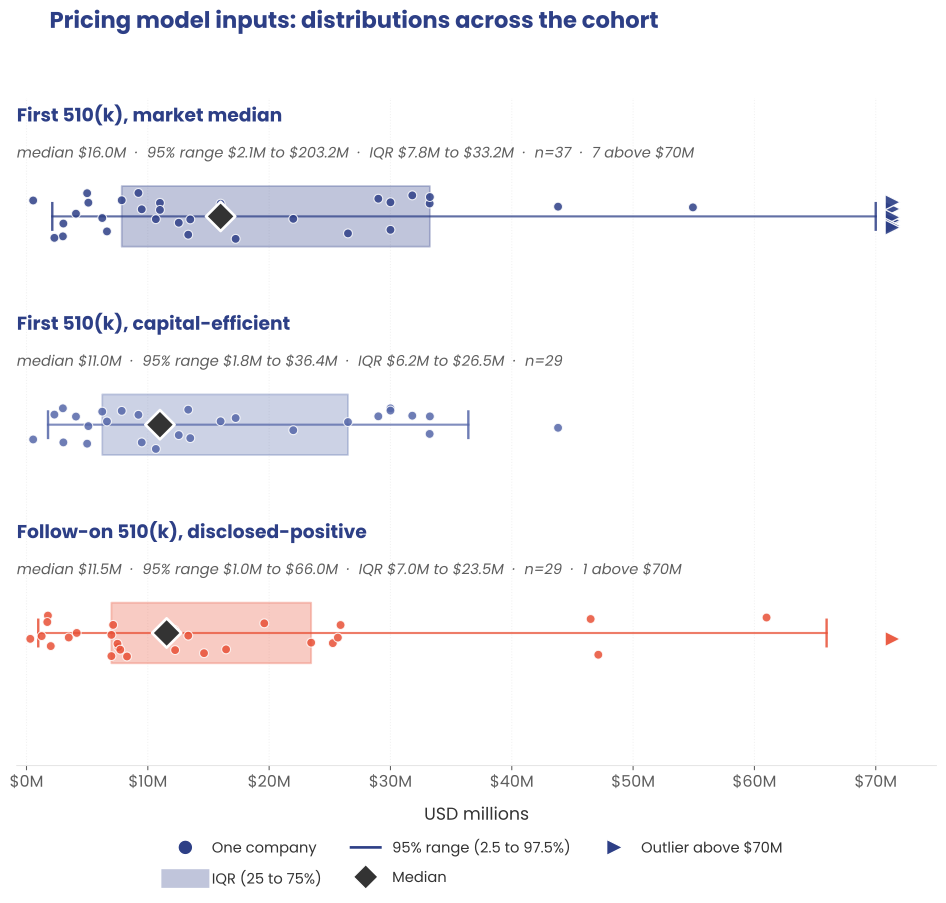
The short version: model the first 510(k) at roughly **\$16M** for a market-comparable plan, or around **\$11M** for a capital-efficient plan, then add about **\$11.6M per additional follow-on 510(k)**.
Figure 1. Distribution of pricing-model inputs across the cohort.
Box = IQR, whisker = 95% range, diamond = median, dots = individual
companies.
## First 510(k): the median company raised \$16.0M
Thirty-seven AI SaMD companies in the benchmark have a public funding number before their first 510(k). The median was \$16.0M, with a middle spread (interquartile range) of \$7.85M to \$33.25M.
The high end of that range is wide because the cohort includes companies that were already funding broader commercial infrastructure, multiple product lines, or platform capabilities before their first 510(k), not just the regulatory submission itself. To strip that out, I also looked at the subset of companies that raised no more than \$50M before clearance. In that subset, the median falls to \$11.0M, with a middle spread of \$6.24M to \$26.50M.
Two practical takeaways. \$7M to \$12M is plausible if the program is tightly scoped: one clinical claim, one workflow, retrospective evidence, a team that has shipped a 510(k) before. \$16M is the more defensible market-comparable plan if the company still needs to hire, secure validation data, or settle the intended-use scope.
## First raise to first 510(k): the market median was 25.7 months
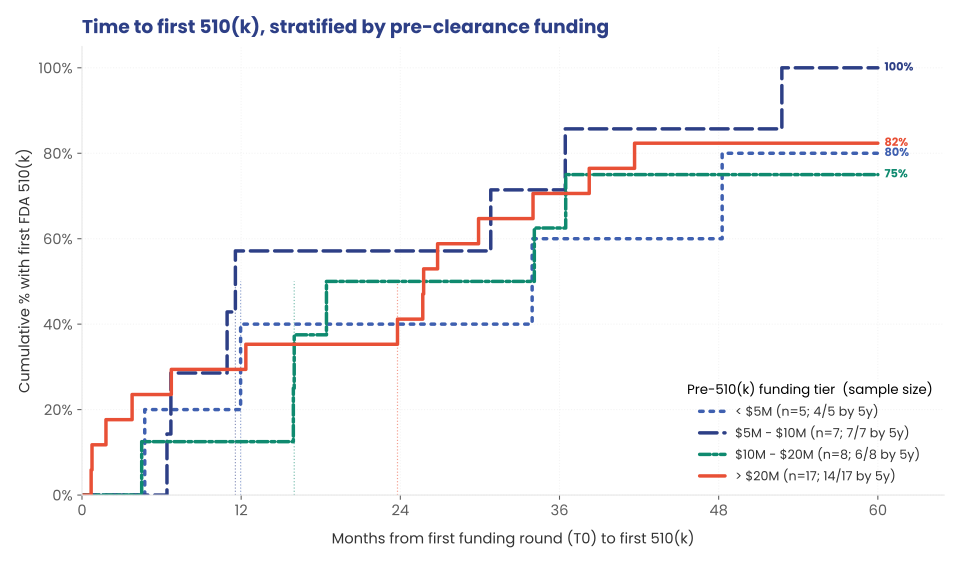
Figure depicting the fraction of companies achieving their first 510(k)
after funded stratified by funding amount.
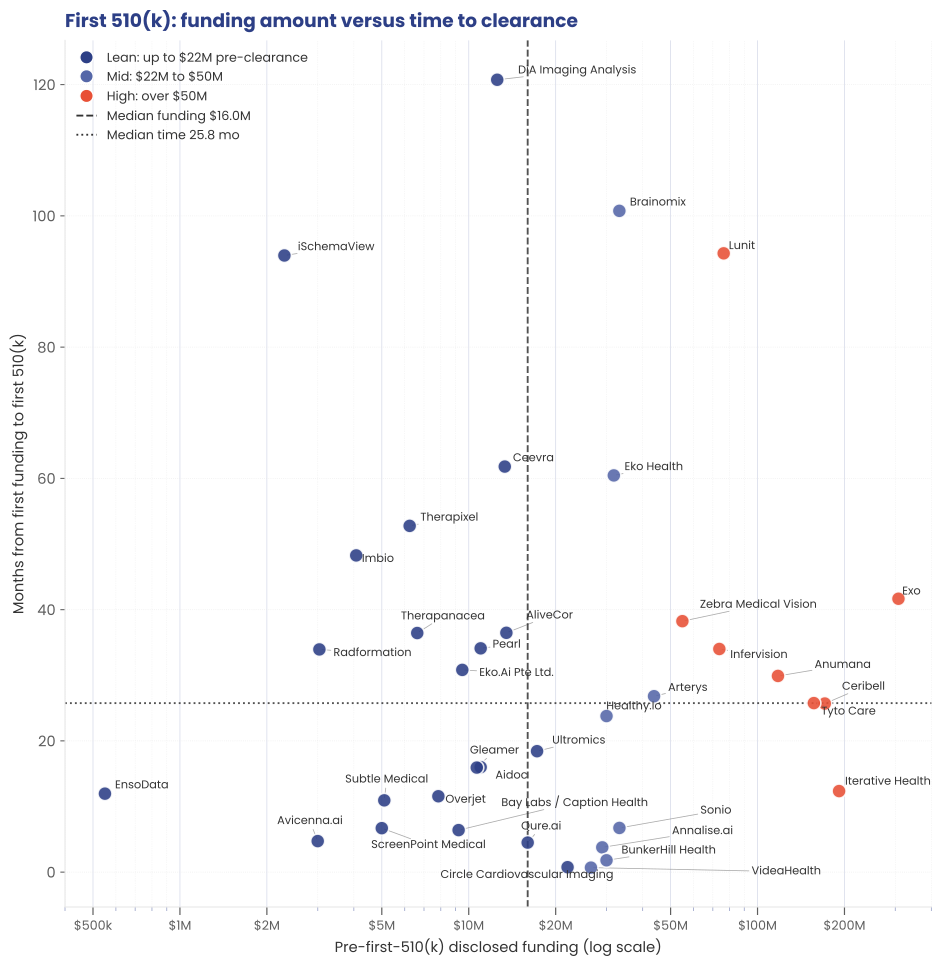
Time matters as much as money. In the same 37-company cohort, the median time from first funding round to first FDA 510(k) was 25.7 months. The mean was 32.0 months, and the middle spread was 10.9 to 41.7 months.
Twelve-month paths to clearance happen, but they are not the median. The faster cases share a few traits: a narrow clinical claim, a clear predicate device, validation data already in hand, and a team that does not let the product scope drift. The slower cases usually involve a broader platform plan, data the company does not yet control, prospective evidence requirements, De Novo-style novelty, or significant hiring overhead during the program.
Figure 2. Pre-first-510(k) funding (log scale) versus months to
first 510(k). Dashed lines are the cohort medians.
The takeaway for founders is to size the first raise against both money and time. A \$10M raise that funds 24 to 30 months of disciplined work is often more realistic than a \$5M raise that assumes a 12-month path before predicate, data, and quality-system readiness are settled. The exception to the rule is if you can hire a specialist team who have the track record and an integrated regulatory and technical roadmap to make the \$5M and 12 month plan feasible.
## Follow-on 510(k)s: about \$11.6M of capital per additional clearance
The second part of the model asks a different question. Once a company has its first 510(k), how much capital does it raise to ship each additional 510(k)?
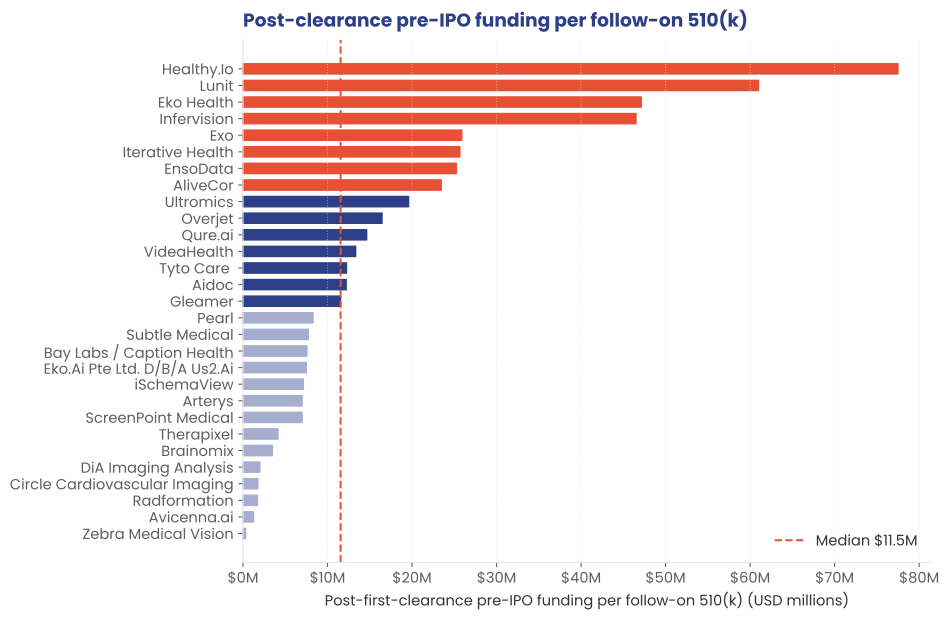
Twenty-nine companies in the benchmark had at least one follow-on 510(k) and at least one publicly disclosed funding round after their first clearance. For each, I divided the post-clearance pre-IPO funding by the number of follow-on 510(k)s the company shipped before any IPO. The median was \$11.6M per additional clearance, with a middle spread of \$7.0M to \$23.46M.
Figure 3. Per-company post-clearance pre-IPO funding per follow-on
510(k), sorted descending. Dashed line is the cohort median,
$11.6M.
**Key finding: First FDA 510(k): about \$16M market median, or \$11M capital-efficient median. Additional follow-on 510(k)s: about \$11.6M each.**
\$11.6M is not just the cost of writing a 510(k). It is the company-level capital that companies actually raised while shipping each additional clearance, before any IPO event. Some of that money pays for regulatory work; most of it pays for sales, deployment, reimbursement, integrations, clinical evidence, engineering, quality management, and the next submission.
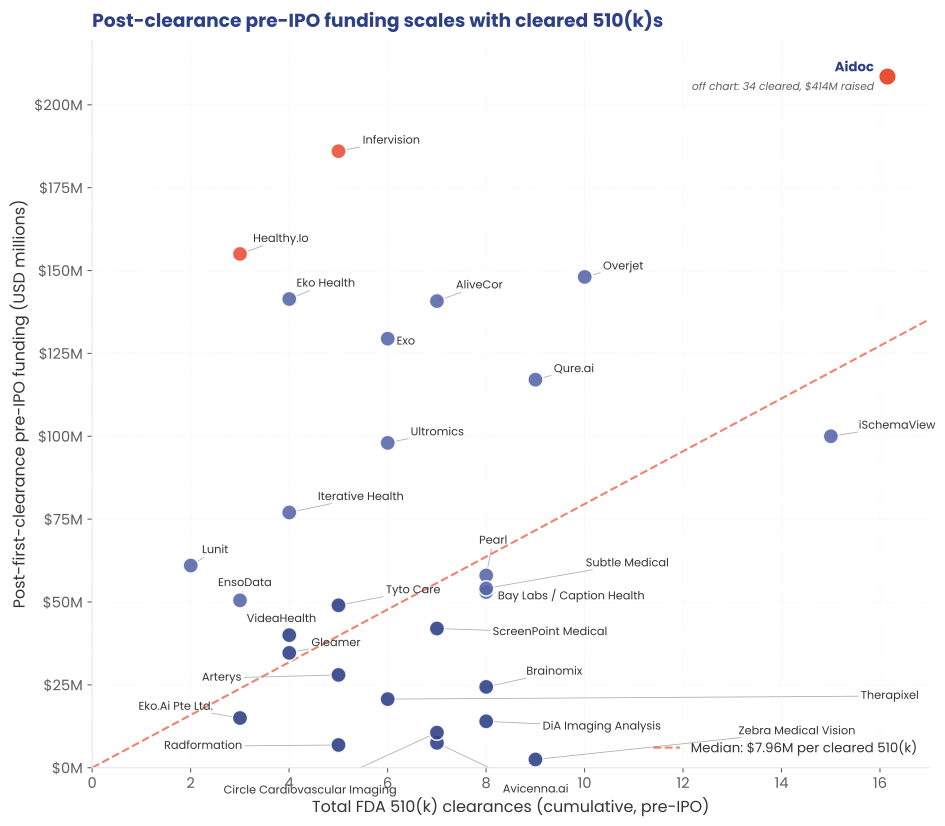
## Post-clearance funding scales with cleared 510(k)s
The same \$11.6M shows up a different way when you plot the cohort directly. Each company is one dot. The horizontal axis is the total number of FDA 510(k) clearances the company shipped before any IPO. The vertical axis is the total disclosed pre-IPO funding raised after the first clearance. The dashed line is the cohort median per cleared 510(k).
Figure 4. Post-first-clearance pre-IPO funding versus total cleared
510(k)s. Each dot is one company. The dashed line is the cohort median
per cleared 510(k).
Two patterns matter. First, the line is roughly proportional rather than exponential. Companies that have shipped many clearances raised more capital, but each additional clearance is incremental, not multiplicatively expensive.
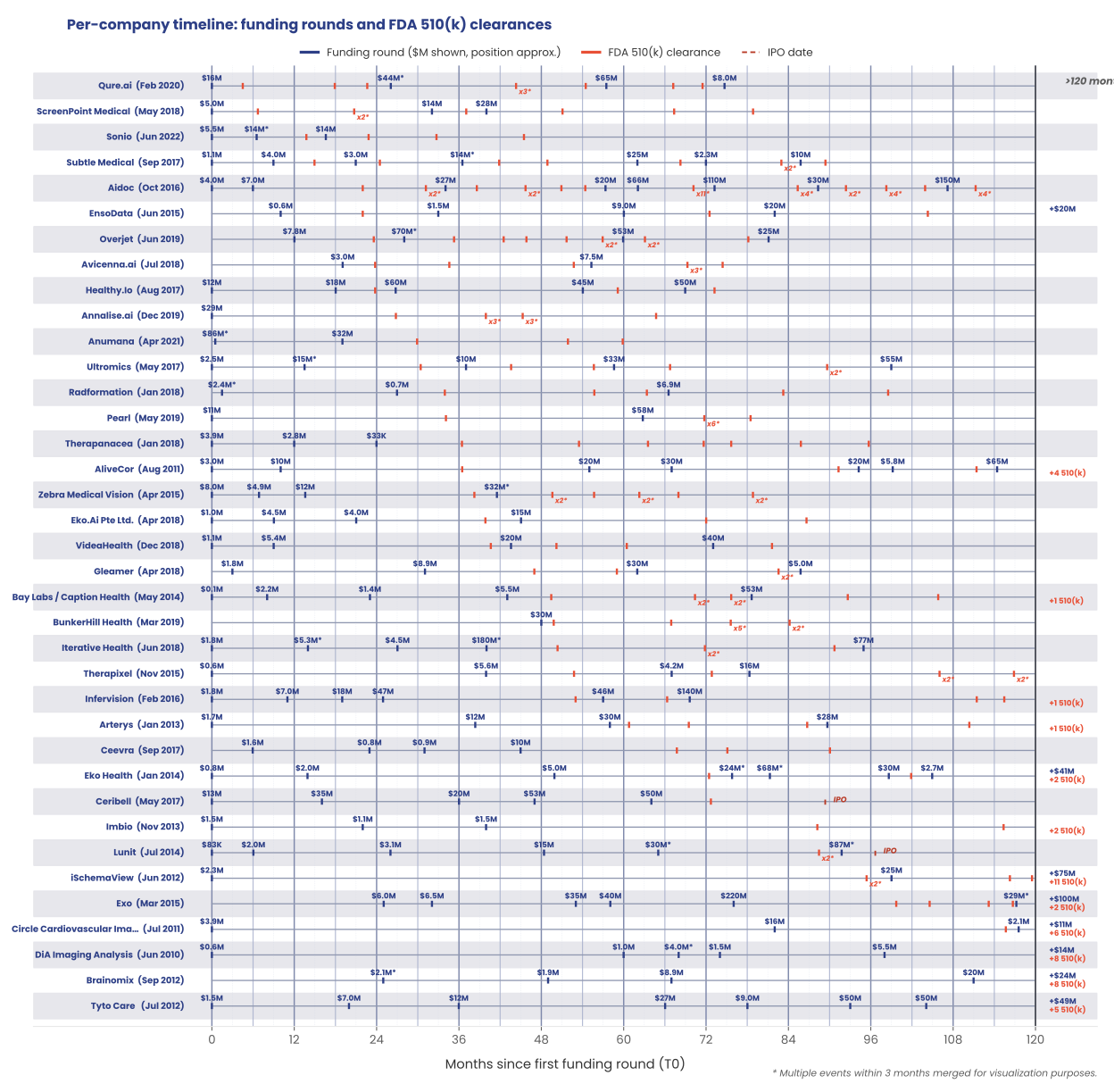
## Per-company timeline: where the money landed and when the clearances came
Aggregates hide the details. The timeline below is one row per company in the cohort, capped at 120 months from each company\'s first disclosed funding round (T0). The left sidebar shows the company name and T0 date. Indigo ticks on the baseline mark funding rounds, with the USD amount above each tick (positions are approximate; labels shift to avoid overlap). Orange ticks mark FDA 510(k) clearances. A dashed crimson tick marks the IPO date for public companies, after which post-IPO events are excluded. The right column summarizes events past 120 months: indigo total raised on top, orange clearance count below.
Figure 5. Per-company timeline. T0 = first disclosed funding round.
Indigo = funding rounds (USD M shown above each tick); orange = FDA
510(k) clearances; dashed crimson = IPO date. Public companies clipped
at IPO.
Look at the spacing between T0 and the first orange tick: that is each company\'s Stage A (capital-to-first-clearance). Look at the density of orange ticks after the first one: that is each company\'s Stage B (cadence of follow-on clearances). Companies with tight Stage A and dense Stage B tend to have raised modest first rounds and compounded clearances on a small post-clearance capital base. Companies with sparse Stage B usually raised much larger rounds for non-regulatory reasons such as hardware build-out, prospective evidence programs, or new commercial channels.
## How to use the model in a fundraise
| **Scenario** | Fundraise | Time to first 510(k) |
|--------------------------------|---------------|----------------------|
| Capital-efficient first 510(k) | \$11.0M | 25.7 months |
| Market-comparable first 510(k) | \$16.0M | 25.7 months |
| Additional follow-on 510(k) | +\$11.6M each | N/A |
| Experienced team first 510(k) | \$5M | 12 months |
A founder raising for one focused 510(k) should not benchmark against a company with 20 or 30 clearances. The right comparison is the first-510(k) cohort. A founder raising for a platform should show the math explicitly in the deck: first clearance cost, expected follow-on clearances, capital per follow-on, and how shared infrastructure brings the marginal cost down over time.
The four-clearance platform plan now lands at \$50.8M because the Stage A median rose and the post-clearance dataset got more complete after the raw data refresh.
Whether the right number for a particular program is the capital-efficient median, the market-comparable median, or somewhere in between depends on the team\'s execution risk and the scope of the first product. The point of the table is to keep the deck honest: separate the cost of the first clearance from the marginal cost of every clearance after it and be self aware of the experience of the team. Adding an experienced AI SaMD service partner on your team could allow you to defensibly claim a faster time and success probability of your first 510(k).
## Where the first 510(k) raise actually goes
The bucket allocation below is what a defensible \$11.0M first-510(k) plan looks like, anchored on the capital-efficient cohort median. Publicly available cost breakdowns are difficult to come by but The regulated wrapper around the software (regulatory strategy, validation, the quality system, cybersecurity) takes more than half the round. When account for all the other cost centers, FDA submission costs is a rounding error in the overall budget.
| Bucket | Amount | Share | What it pays for |
|------------------------------------|---------|-------|----------------------------------------------------------------------------------------------------------------------|
| Engineering and data science | \$3.7M | 34% | Production code, model management, deterministic builds, integration adapters, software verification and validation. |
| Regulatory strategy and submission | \$2.4M | 22% | Predicate analysis, intended use, Q-Sub strategy, Clinical the 510(k), FDA responses, reimbursement positioning. |
| Clinical and analytical validation | \$1.8M | 16% | Ground truthing, retrospective validation, statistical analysis, reader or comparator studies. |
| Quality management system | \$1.1M | 10% | Design controls, document control, risk management, traceability, release procedures. |
| Pre-launch commercial planning | \$0.9M | 8% | Pilot planning, integration documentation, economic story, sales-readiness work, marketing website. |
| Buffer | \$0.55M | 5% | Cloud infrastructure, legal, data delays, FDA deficiency response reserve. |
| Cybersecurity | \$0.45M | 4% | SBOM, threat modeling, penetration testing, security documentation. |
| FDA fees and registration | \$0.05M | 1% | MDUFA V user fee, FDA establishment registration, administrative fees. |
The shape of this allocation is consistent with how external benchmarks describe a lean 510(k) AI SaMD program: software engineering 16 to 23%, clinical validation 10 to 20%, quality and regulatory 6 to 12%, data and labeling 8 to 15%, with the remainder spread across cybersecurity, cloud, legal, and G&A. Our cohort lands at the efficient end of that range because the median company is software-dominant and pursuing a workflow or assistive claim rather than an autonomous diagnosis.
### **Three things founders consistently get wrong on this budget.**
The first is treating FDA fees as a meaningful line item. The FY26 standard 510(k) user fee is \$26,067 (\$6,517 for small businesses); the De Novo equivalent is \$173,782 (\$43,446 small business). On a \$11.0M plan, the 510(k) fee is less than a quarter of one percent (0.24%) of the round. Founders fixate on it because it is the only number FDA publishes; the actual cost driver is the work that happens before submission and during sponsor response cycles, not the filing fee.
The second is undercounting people, recruiting, and spin up. Across our cohort and consistent with general AI SaMD benchmarks, fully loaded compensation absorbs 55 to 70% of pre-clearance burn once it is spread across engineering, data science, clinical affairs, quality, regulatory, and leadership. Recruiters often charge 30% of first year's salary per hire, and often more for high calibre leadership in the C suite. You should also account for the possibility of a bad hire and budget a contingency of additional recruiting expenses.
The third is underestimating annotation and validation labor when a clinician must be in the loop. A modest reader study or annotation campaign of 2,000 specialist-hours, including adjudication, QA, and disagreement review, is roughly \$850K in specialist labor alone, before any labeling platform, project management, or engineering integration. That is why imaging programs with physician-generated ground truth often look more expensive than non-clinical ML programs with similar codebases.
### **What pushes a company above this median.**
Five drivers, in roughly descending order of impact:
1. **No predicate (De Novo path).** External triangulation places lean 510(k) programs in the \$8M to \$20M range and De Novo or autonomous programs at \$18M to \$55M. The fork between paths is more financially consequential than any other pathway choice.
2. **Clinical autonomy.** A device that renders or strongly determines a diagnostic decision needs prospective evidence sized to that risk. The canonical case is IDx-DR: roughly \$22M raised before its 2018 De Novo, with a 900-subject pivotal trial across 10 primary care sites. That spend profile is not optional once the claim is autonomous and novel technologies usually require prospective studies are usually required.
3. **Prospective studies.** A big mistake founders make is assuming retrospective evidence is good enough. A single-arm study at 5 to 10 sites could add \$2M to \$5M and 12 to 18 months; MRMC with adjudication doubles both. Adding a prospective arm mid-program is the most common reason a \$10M plan becomes \$20M.
4. **Cybersecurity.** FDA considers cybersecurity risk mitigation a duty required by manufacturers. Every AI enabled medical device needs an SBOM, threat model, vulnerability management plan, and penetration testing before submission. Budget \$0.4M to \$1M for the first clearance. I have seen companies fail because they forgot to budget for this and don't have the funding to overcome the FDA hold letter laden with cybersecurity findings.
5. **Reimbursement readiness.** Clearance is not adoption. Companies that defer payer evidence until after first 510(k) often discover they have solved the wrong problem for the hospital buying committee, which forces a second round before commercial scale.
## Conclusion
The cohort answers the headline question with four numbers: \$16M and 25.7 months for a market-comparable first 510(k), \$11M for capital-efficient, and \$11.6M per follow-on after that. More than half the round goes to the regulated wrapper around the software, while the FDA filing fee is 0.3%. And the spread is wide: at the same clearance count, some companies raised half the median and others three times, depending on whether they were dragged into De Novo, prospective evidence, late cybersecurity, or deferred reimbursement.
## About Innolitics
The cohort median for a capital-efficient first 510(k) is \$11.0M and 25.7 months. Clients who have used Innolitics for full service engineering, regulatory, quality, and reimbursement partner typically get the same result with a \$5M raise and 12 months. Founders take less dilution, reach market faster, and coordinate with one partner instead of wrangling separate regulatory, software, validation, quality, and cybersecurity vendors or employees.
The compression comes from our key differentiators:
- We have more interactions with FDA in one week than most companies have in their entire lifetime.
- We have insider knowledge that allows us to work on only what FDA cares about and nothing else.
- We have a extremely selective hiring and training process that removes the seams between the roles collapsing the seams between vendors, not from skipping work. Innolitics\' clearance guarantee applies when the device meets the acceptance criteria defined during regulatory strategy and Innolitics leads the FDA application.
- We are so confident in our strategy, **we offer a 510(k) timeline and clearance guarantee** for devices that meet the clinical validation acceptance criteria we set during the initial strategy engagement.