---
author:
- J. David Giese
cta_button_text: ''
cta_case_studies: []
cta_hero_details: ''
cta_hero_text: ''
date: '2026-08-08'
description: FDA has selected Cadence as the second participant in TEMPO. Its clinician-supervised
  HypertensionOS software generates protocol-bound medication-initiation and titration
  proposals. Together, Cadence and Dexcom offer early clues---not firm rules---about
  which products FDA may admit, how the pilot could evolve, and how evidence and payment
  may work in parallel.
related: []
title: 'Cadence Enters TEMPO: What the Second Participant Suggests About the Pilot’s
  Direction'
topics:
- Regulatory
- AI/ML
---

On August 5, FDA named Cadence the second participant in its TEMPO pilot, for a system called HypertensionOS. When FDA named Dexcom as the first participant on July 22, I wrote about [how TEMPO and the CMS ACCESS model are designed to address two problems that often stall digital health together: evidence and payment](https://innolitics.com/articles/dexcom-tempo-staged-evidence-wearable-ai/).

With only two participants, it is too early to treat either selection as a rule. But the cases give us the first evidence from which to infer the direction FDA may be taking TEMPO and the kinds of products it may be willing to admit. Cadence makes a useful contrast with Dexcom: Dexcom\'s software flags patterns for independent clinicians to consider, while HypertensionOS generates specific, protocol-bound medication-initiation and titration proposals for Cadence clinicians.

I\'m excited about the care model ACCESS and TEMPO may enable. Between office visits, a patient\'s readings flow into medical device software, the software proposes a treatment change, a clinician decides whether to act on it, and subsequent readings show whether the regimen is working. That feedback loop can run more frequently than conventional office-based follow-up.

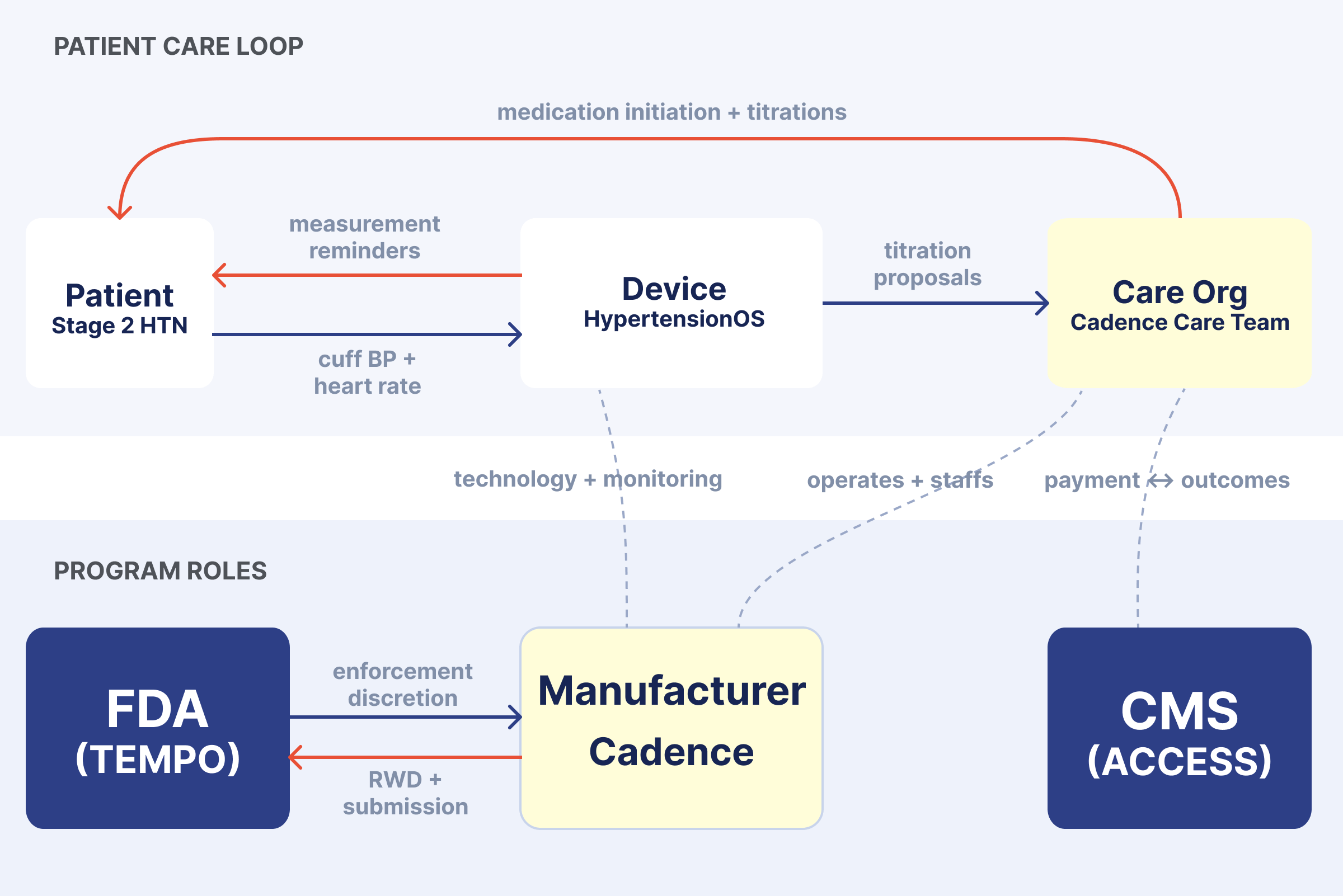
The whole arrangement fits in one diagram. In this article, I analyze each box and arrow to separate what is established from what we can reasonably infer about TEMPO\'s direction---and because each piece is a decision that anyone bringing a software- or AI-enabled product to market has to get right.

FDA\'s selection of HypertensionOS and its published intended use are established facts. The likely authorization pathway, the reasons the product fits the pilot, and the implications of Cadence\'s vertical integration are my analysis based on the public record. TEMPO participation is not marketing authorization, and it does not establish that FDA has found the device safe and effective for commercial distribution.

<figure>
  <img src="/img/articles/Cadence_Enters_TEMPO_What_the_Second_Participant_Suggests_About_the_Pilots_Direction-6977a9c55342411e8ca474b1fc40c013.png">
  <figcaption>
    Two halves. The top band is the patient care loop, how care happens day
    to day. The bottom band is the program roles, who governs it: FDA sets
    the evidence terms, CMS sets the payment terms, and Cadence sits in the
    middle playing three roles at once. The dashed lines show that the
    manufacturer, the care organization, and the clinicians are the same
    company.
  </figcaption>
</figure>

## The Care Loop

### The Patient: People Diagnosed with Stage 2 Hypertension

The ACCESS model covers eligible people in Traditional Medicare with the following chronic health conditions:

- High blood pressure
- High cholesterol (dyslipidemia)
- Obesity
- Prediabetes
- Diabetes
- Chronic kidney disease
- Heart disease (atherosclerotic cardiovascular disease)
- Depression
- Anxiety
- Ongoing muscle or joint pain

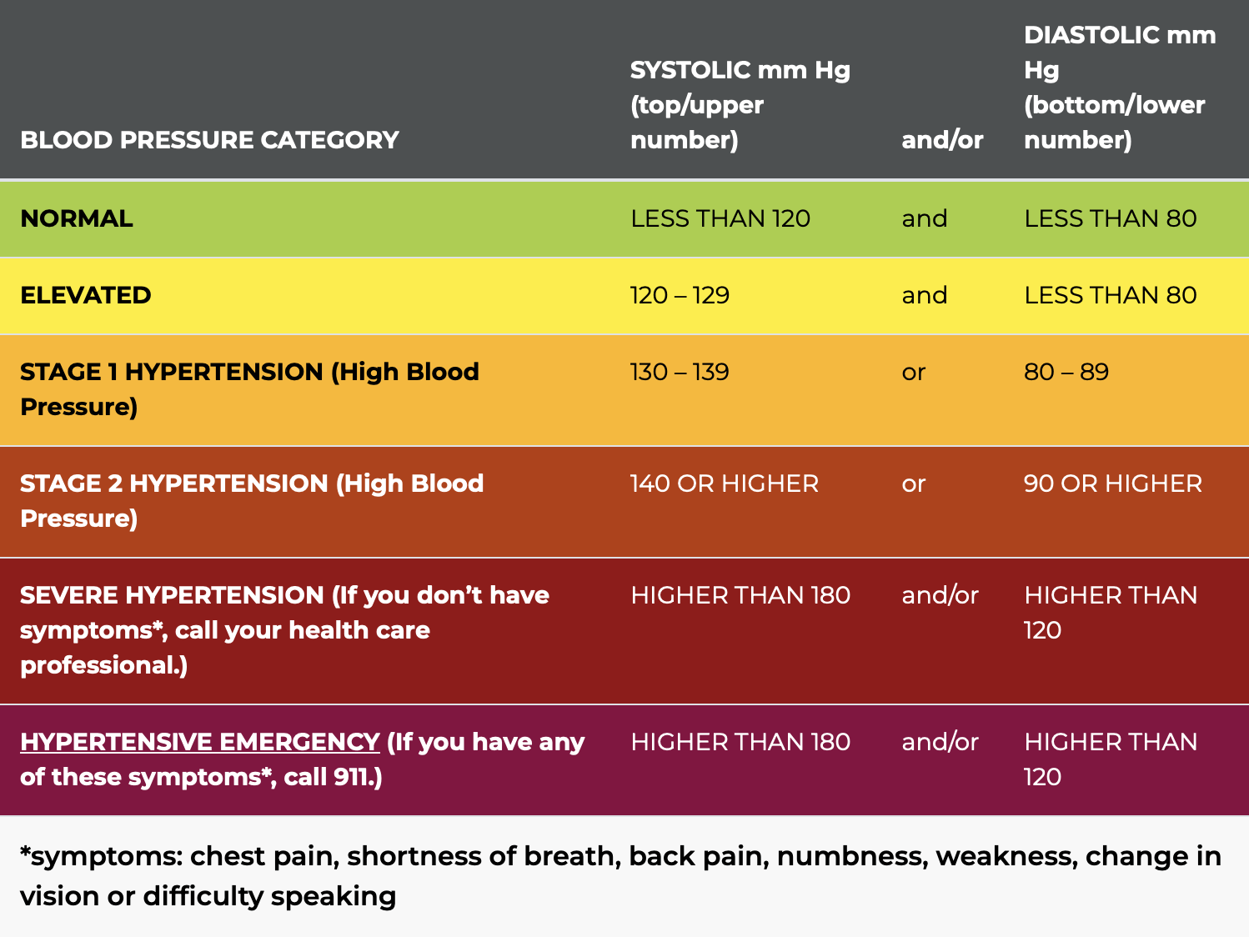
Cadence\'s intended-use population comprises adults already diagnosed with Stage 2 hypertension. Stage 2 hypertension is generally defined as systolic blood pressure of at least 140 mm Hg or diastolic blood pressure of at least 90 mm Hg; diagnosis ordinarily relies on repeated measurements rather than a single reading.

Nearly half of U.S. adults have high blood pressure, and only about one in four of them has it under control. The treatment playbook for Stage 2 hypertension is standardized: the ACC/AHA guideline calls for lifestyle changes plus antihypertensive medication, starting with one or two first-line agents (thiazide diuretics, ACE inhibitors, ARBs, or calcium channel blockers) and adjusting every few weeks until blood pressure reaches goal, typically below 130/80 mm Hg.

<figure>
  <img src="/img/articles/Cadence_Enters_TEMPO_What_the_Second_Participant_Suggests_About_the_Pilots_Direction-3b9bd5b7a7548005b074ebd2611c4e4b.png">
  <figcaption>
    Blood-pressure categories from the American Heart Association. Cadence's
    intended-use population comprises adults diagnosed with Stage 2
    hypertension.
  </figcaption>
</figure>

### The Device: HypertensionOS

HypertensionOS is the software device being used and evaluated under TEMPO. FDA published the following intended use for the pilot:

<div class="pl-3 border-solid border-0 border-l-4 border-gray" custom-style="Block Quote" markdown="1" role="blockquote">

Intended to support clinician-supervised, protocol-bound antihypertensive medication initiation and titration when predefined eligibility criteria and deterministic safety checks are satisfied. HypertensionOS is intended for use by licensed healthcare professionals with prescriptive authority, such as physicians or Advanced Practice Registered Nurses, to assist in the outpatient management of adult patients who, at the time of initiating HypertensionOS, have diagnosed Stage 2 hypertension. Patients who progress from Stage 2 hypertension to Stage 1 hypertension while being managed with HypertensionOS may continue to be managed with HypertensionOS.

</div>

Three parts of that statement matter for the regulatory analysis. \"Clinician-supervised\" means the software does not prescribe on its own; a licensed clinician with prescriptive authority reviews each proposal and decides whether to act. \"Protocol-bound\" means the titration logic is fixed rather than adaptive, allowing the safety checks to be deterministic and auditable. And the population language draws the claim\'s boundary: patients enter with diagnosed Stage 2 hypertension, while the final sentence allows those whose blood pressure improves to Stage 1 to remain within the intended-use population.

Although Cadence describes a broader AI-enabled care platform, the HypertensionOS function presented in TEMPO is protocol-bound and deterministic. The case has implications for AI-enabled products, but the treatment logic described publicly is not adaptive machine learning.

As readings accumulate, HypertensionOS checks the patient against predefined eligibility criteria and applies its titration protocol to generate a specific medication proposal, such as initiating a medication or changing a dose. Deterministic safety checks---rule-based logic, not machine learning---gate those proposals. Public materials do not disclose the complete protocol or every condition under which the software withholds a proposal.

### Patient → Device: Cuff Blood Pressure and Heart Rate

The loop starts with data. The patient measures blood pressure and heart rate at home with a cellular-connected cuff, and each reading is sent to HypertensionOS automatically. Multiple readings can accumulate between office visits, and home monitoring can reduce the influence of the white-coat effect that makes a single office measurement a weak basis for a medication change. This stream is what the titration protocol works from, so everything downstream in the loop depends on its quality and continuity. In Cadence\'s published cohort, \"∼22% of enrolled patients had a program baseline mean BP at goal even though their in-office BP was not at goal.\"

### Device → Patient: Measurement Reminders

A titration engine is only as good as its inputs, and the inputs stop when the patient stops measuring. HypertensionOS sends *measurement reminders* to keep readings flowing, so the protocol can work from current data instead of pausing until the next appointment. On their own, reminders are unremarkable software. In this workflow, they matter because they keep the titration engine supplied with the data its eligibility criteria and safety checks depend on.

### The Care Organization: Cadence Care Team

The proposal goes to a Cadence clinician with prescriptive authority---typically a nurse practitioner working under Cadence medical directors---who reviews it and decides whether to prescribe. Cadence reports that its clinicians make roughly 24,000 medication changes a year. Two things about this box matter later: it provides the human review on which TEMPO\'s safety case depends, and the reviewers work for Cadence rather than an outside health system.

### Device → Care Team: Drug Initiation and Titration Proposals

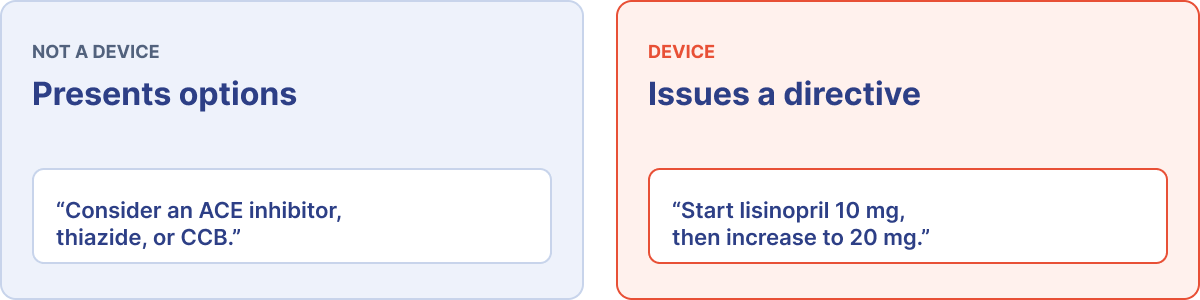
This is the arrow at the center of the regulatory analysis. HypertensionOS gives a clinician a specific proposal: start a medication or change a dose. FDA\'s CDS framework distinguishes software that supports a clinician with recommendations from software that provides a specific diagnostic or treatment output or directive. A specific medication action weighs strongly toward device status even when a clinician must authorize it; the complete analysis still depends on all applicable statutory criteria, including whether the clinician can independently review the basis for the recommendation.

<figure>
  <img src="/img/articles/Cadence_Enters_TEMPO_What_the_Second_Participant_Suggests_About_the_Pilots_Direction-4e59753a55264fd2ac5fe1271996222e.png">
  <figcaption>
    FDA's 2022 CDS guidance distinguishes software that supports independent
    clinical judgment from software that provides a specific treatment
    output or directive. Protocol-bound medication-initiation or dose-change
    proposals weigh toward device status even when a clinician must approve
    them. The closest precedent discussed here is DreaMed Advisor Pro
    (DEN170043, 2018).
  </figcaption>
</figure>

FDA\'s decision to admit HypertensionOS to TEMPO is strong evidence that the agency regards it as a device for purposes of the pilot: TEMPO is open only to products that meet the device definition in section 201(h) of the Federal Food, Drug, and Cosmetic Act. Participation is not marketing authorization, however, and it does not establish that FDA has found HypertensionOS safe and effective for commercial distribution. The published intended use helps explain the device determination. FDA\'s 2022 Clinical Decision Support Software guidance distinguishes recommendations that support independent clinical judgment from \"a specific preventive, diagnostic, or treatment output or directive.\" A protocol that says, for example, to start a particular drug or change a dose is closer to an instruction than to a menu of options; requiring clinician approval does not by itself move the software outside device regulation. FDA has treated medication-dosing software as devices for years: DreaMed Advisor Pro went through a De Novo in 2018 (DEN170043), and Hygieia\'s d-Nav, Voluntis\'s Insulia, and Amalgam\'s iSage followed as cleared insulin-titration devices. I have not identified a cleared antihypertensive-titration device that appears to offer a straightforward predicate. If FDA agrees that no suitable predicate exists, a De Novo request would likely be Cadence\'s eventual pathway.

### Care Team → Patient: Drug Initiation and Titrations

The adjustment cycle is where conventional visit-based care often loses momentum, and not because the guideline is lax: it calls for monthly follow-up while a regimen is being adjusted. In practice that cadence often does not hold, and even when a patient arrives with readings above goal, clinicians intensify therapy at only about one in eight such visits. One analysis of U.S. ambulatory care found that five or more elevated-BP visits typically pass before one produces a medication change. The literature calls this therapeutic inertia.

The prescribed change and continued follow-up return to the patient as *medication + follow-up*, and the loop repeats: new readings, a new proposal, a new prescription. This kind of feedback loop is difficult to sustain through episodic office visits alone, and it is one reason continuous, software-supported care may improve blood-pressure control. The observational results are encouraging, not definitive. A 23,638-patient study in *JACC: Advances*, run across 10 health systems in 21 states, reported the proportion of patients at goal rising from 21.5% to 36.6%, an absolute increase of 15.1 percentage points. The full-medication subgroup, in which Cadence\'s clinicians manage medications, had the largest reported relative improvement at 79%.

Across the cohort, the study recorded 3,975 up-titrations, 2,539 medication initiations, 1,674 discontinuations, and 1,139 down-titrations, with 75% of patients still measuring at six months and 57% at twelve. Because the study had no control group, it cannot isolate how much of the change was caused by the program rather than patient selection, concurrent care, or other factors. As the authors put it, \"without a control group, the net effect of the program compared to the standard of care is difficult to delineate.\"

## The Program Roles: Who Sets the Terms

The bottom band is easy to underestimate. It is not about the clinical loop; it is about who lets the loop run and who pays for it.

### FDA (TEMPO)

FDA runs the pilot through its Digital Health Center of Excellence. TEMPO (Technology-Enabled Meaningful Patient Outcomes) began accepting statements of interest by email on January 2, 2026. A statement of interest includes the proposed indications for use, a description of the device, any prior FDA interactions, and, where the device is unauthorized, a request for enforcement discretion.

Eligibility has three practical requirements:

- The product must be a finished device that meets the device definition in section 201(h) of the Food, Drug, and Cosmetic Act.
- Its proposed indications must target improving outcomes in the clinical use areas the ACCESS model covers (the chronic-condition list in the patient section above).
- And it must be used through participating ACCESS organizations, because that is as far as the enforcement discretion reaches.

For HypertensionOS, FDA conducted the initial review required for pilot selection and determined that the **finished** device was suitable for participation. That is different from the review required for marketing authorization.

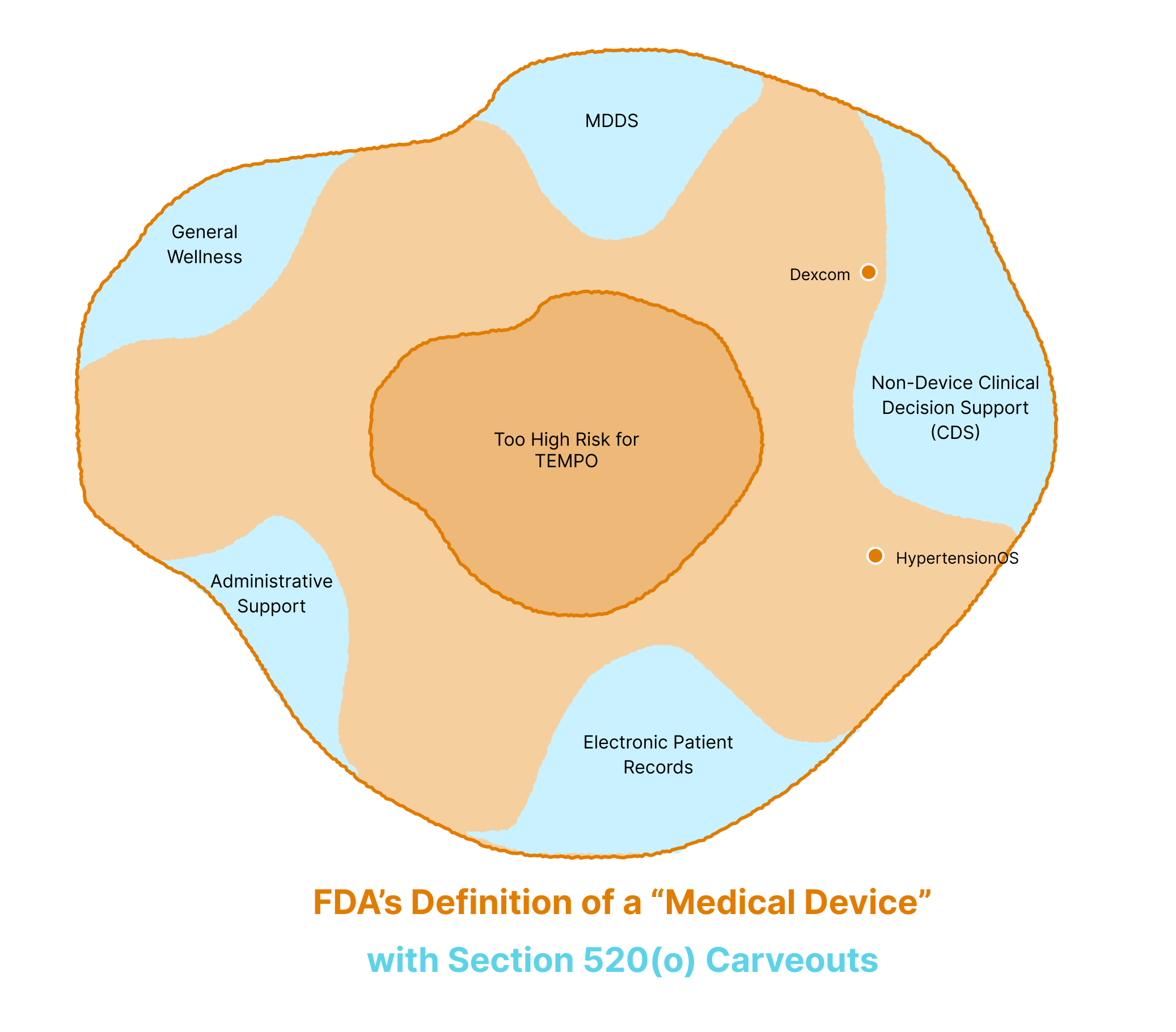
A fourth constraint may be implicit, and Cadence helps illustrate it: a product likely has to sit close enough to the regulatory boundary that supervised use under enforcement discretion presents a risk FDA is willing to accept. To be eligible at all, a product must cross the device line; software that remains on the non-device side of the CDS boundary has no premarket requirement to be relieved of and little to gain from TEMPO. But my hypothesis is that a product cannot sit too far inside the line either. A deterministic, protocol-bound titration engine whose outputs require review by a prescribing clinician may be easier to justify than adaptive dosing logic, weaker human review, or higher-acuity decisions. The two announced participants are consistent with that hypothesis---Dexcom approaches the boundary from the screening side---but two cases are too few to establish a selection rule.

<figure>
  <img src="/img/articles/Cadence_Enters_TEMPO_What_the_Second_Participant_Suggests_About_the_Pilots_Direction-d694eedbc2e3435ba44450e6f3adc8ba.png">
  <figcaption>
    Conceptual model—not an FDA framework. The orange region represents
    FDA's device definition under section 201(h), while the blue pockets
    represent the section 520(o) software carveouts. The dashed core
    represents devices that may carry too much residual risk for TEMPO's
    lighter initial review. The two announced participants appear to sit
    between those regions: across the device line, but close enough to it
    that supervised use may be defensible.
  </figcaption>
</figure>

### FDA → Cadence: Enforcement Discretion

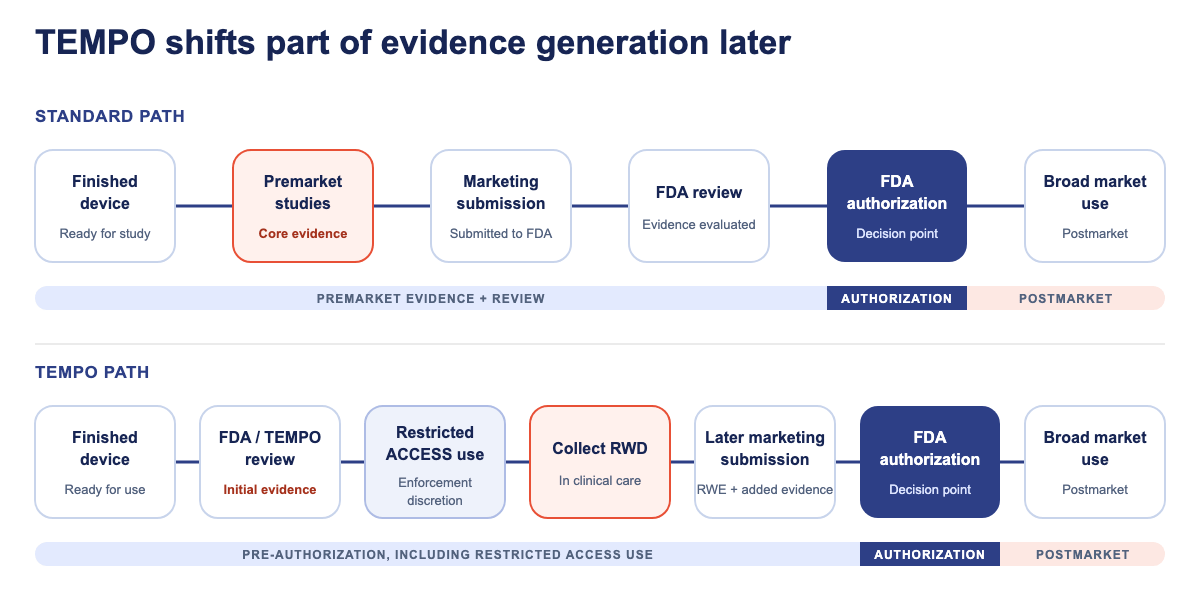
What FDA grants through the pilot is *enforcement discretion*: it declines to enforce premarket-authorization and investigational-device requirements so long as the device is used under the pilot\'s conditions through participating ACCESS organizations. That does not eliminate those requirements permanently or authorize unrestricted commercial use. Subject to those conditions, Cadence can use HypertensionOS in eligible care before marketing authorization rather than completing the ordinary premarket process first.

### Cadence → FDA: RWD and Submission

The arrow back to FDA is why the discretion is not a free pass. Cadence collects real-world data under an agreed plan and is still expected to pursue marketing authorization. The resulting evidence will still have to support the eventual submission; participation does not guarantee authorization. TEMPO reorders the work rather than removing it.

<figure>
  <img src="/img/articles/Cadence_Enters_TEMPO_What_the_Second_Participant_Suggests_About_the_Pilots_Direction-d4031e748f934ae89719732469ae1020.png">
  <figcaption>
    The standard path generally front-loads core effectiveness evidence
    before broad use. TEMPO keeps the final authorization bar but permits
    evidence collection during supervised, ACCESS-covered use. That care may
    also be reimbursed under ACCESS, subject to the model's eligibility and
    payment conditions.
  </figcaption>
</figure>

### Cadence (Device Manufacturer)

Cadence is a New York-based company founded in 2021 by Chris Altchek and Kareem Zaki to provide remote chronic-condition management for large health systems. It works with more than 20 health systems and reports managing over 100,000 active patients across hypertension, heart failure, and type 2 diabetes. The company raised a \$100 million Series C in June 2026 to expand its AI-enabled chronic-care platform.

The same company that runs the care team also makes the device. The dashed lines are why that matters.

### CMS (ACCESS)

CMS runs the payment side. ACCESS (Advancing Chronic Care with Effective, Scalable Solutions) is a voluntary CMS Innovation Center model running for ten years, 2026 through 2036, inside Traditional Medicare. The first performance period began in July 2026, with rolling start dates after that.

Eligibility operates at two levels. On the organization side, eligible Medicare Part B providers---including primary-care and specialty practices---may apply if they meet the model\'s technology, care-delivery, and electronic outcomes-reporting requirements, including standards-based data exchange. On the patient side, ACCESS serves eligible people in Traditional Medicare who have a covered chronic condition and receive care through a participating organization; a diagnosis alone does not necessarily make every beneficiary eligible. Cadence announced in March 2026 that it would participate as an ACCESS care organization and reported launching its first cohort in July.

### CMS ↔ Cadence: Payment and Outcomes

The arrow between CMS and Cadence runs both ways. ACCESS pays care organizations through Outcome-Aligned Payments, which tie condition-specific payments to clinical and patient-reported outcomes rather than billing solely for individual visits and procedures. Existing remote-monitoring and care-management codes can reimburse parts of this work, but ACCESS may align Medicare payment more directly with the model\'s aim of improving outcomes while reducing avoidable utilization. A *Mayo Clinic Proceedings* analysis found that Cadence\'s program was associated with approximately \$1,302 lower total cost of care per patient per year and 27% fewer hospital admissions. Those findings are encouraging, but they should be interpreted in light of the study\'s observational design and any residual differences between groups.

### The Dashed Lines: One Company, Three Roles

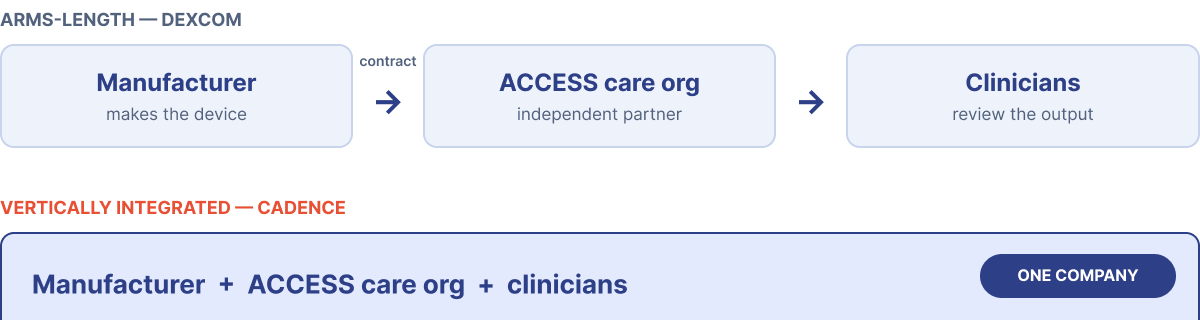
The three dashed connectors (*technology + monitoring*, *operates + staffs*, and *payment ↔ outcomes*) are the most important part of the diagram. They show that the HypertensionOS technology, the care team that operates the loop, and the manufacturer at the bottom are all one company. Cadence is the device maker, the ACCESS care organization, and the employer of the clinicians who act on the software\'s output.

<figure>
  <img src="/img/articles/Cadence_Enters_TEMPO_What_the_Second_Participant_Suggests_About_the_Pilots_Direction-e4d6f662e8eb4abd96d55bde4229914d.png">
  <figcaption>
    Dexcom operates at arm's length: it makes the device, but the clinicians
    who use it work for independent ACCESS organizations with which Dexcom
    contracts. Cadence is vertically integrated: the manufacturer, care
    organization, and clinicians are part of the same company, and
    HypertensionOS provides specific treatment proposals to Cadence
    clinicians. Integration may simplify data capture and safety reporting,
    but it also makes the independence and quality of human review an
    important governance question.
  </figcaption>
</figure>

That vertical integration cuts two ways. It may improve protocol consistency, auditability, adverse-event monitoring, and data capture because Cadence controls deployment and clinical operations end to end. It also means the clinicians providing TEMPO\'s human review work inside the organization developing and operating the software. That does not make their review ineffective, but it makes override rates, escalation procedures, independent audits, and incentive design especially important evidence to watch. Cadence\'s nurse practitioners collaborate with each patient\'s physician and retain prescribing authority; the relevant question is how meaningfully they review, modify, or reject the software\'s proposals in practice.

The care-organization role deserves its own look because it is the structural difference between the two TEMPO participants. Dexcom is a device company: to reach ACCESS patients it offers its sensors and AI program through care organizations, and the clinicians who act on its outputs answer to those organizations rather than Dexcom. Cadence built the care organization first. Cadence reports that its medical practice, staffed with nurse practitioners, registered nurses, and medical assistants, has monitored patients remotely since 2021 and was watching vitals from roughly 50,000 patients a day across 18 health systems before ACCESS existed. Under mutually agreed protocols with its partner health systems, that practice already titrated medications, ordered labs, and coached patients. HypertensionOS encodes the protocol the practice was running by hand, so when ACCESS opened, Cadence did not need to convince a separate care organization to adopt its device; it enrolled as one.

That ordering may have consequences beyond evidence speed. As the manufacturer, Cadence owns complaint handling and adverse-event reporting for HypertensionOS; as the care organization, it also generates the clinical records those reports draw on, allowing a safety signal to move from clinical care to the regulatory file without crossing a company boundary. The structure may also shape the eventual submission. Real-world data collected inside Cadence\'s own practice would show how the device performs under Cadence\'s staffing and protocols. If the requested marketing authorization includes use by outside organizations, FDA may ask how well that evidence generalizes beyond the company that built both the software and the care model around it. Cadence\'s structure may make evidence collection more direct; Dexcom\'s arm\'s-length structure may offer stronger evidence of transferability. Whether either advantage materializes will depend on study execution.

Care-delivery companies that also manufacture devices are not new. Livongo cleared connected glucose meters and Hinge Health cleared its Enso pain-relief wearable, but those devices measured or relieved while care decisions remained with people. Cadence differs because the TEMPO device function provides specific medication-initiation and titration proposals within Cadence\'s own practice. That makes the quality of human review and the potential for automation bias particularly relevant evidence to watch.

## What the First Two Participants Suggest About TEMPO

Strip away the hypertension specifics and the first two selections suggest---without yet proving---three things about TEMPO and the software- or AI-enabled products most likely to benefit from it.

Find your device line before you build the evidence. The most consequential arrow in the diagram is *titration proposals*, because it determines whether HypertensionOS is regulated at all. Teams often misjudge this by assuming human sign-off keeps them outside device regulation. It does not necessarily do so. An early, well-supported determination clarifies the evidence and documentation the product will need. A mistaken determination can cause avoidable work, delay, or enforcement risk. This is a speed-and-certainty question long before it is a paperwork question.

A novel function may mean a harder pathway, which is where programs often stall. I have not identified an obvious antihypertensive-titration predicate, so Cadence\'s likely route is a De Novo. De Novo work requires the evidence, documentation, and study design to align. In my experience, programs often stall not on any one of those components but in the gaps between them: software finished without the documentation a submission needs, cybersecurity bolted on after the architecture freezes, validation that does not trace back to requirements, or a study plan that does not support the intended claim. Each vendor can finish its piece while the product as a whole sits still.

Coherence across those workstreams is the potential advantage the diagram points to. Cadence\'s integrated structure may reduce handoffs across technology, care delivery, evidence generation, and regulatory strategy. Most companies do not have the whole loop under one roof, and they do not need to build a care organization to compete. What they do need is for the software, cybersecurity, validation, documentation, regulatory strategy, and submission to be managed as one coordinated effort rather than handed between teams and vendors that each optimize their own slice. In my experience, that coordination is often what prevents an otherwise well-funded program from slipping quarter after quarter.

## The Bottom Line

Cadence\'s model is an unusually integrated attempt to address two recurring digital-health constraints: generating regulatory evidence and paying for care while that evidence is collected. TEMPO and ACCESS do not remove either constraint, and with only two participants it is too early to know whether the programs will solve them. But the cases already suggest three practical lessons: define the device boundary early, test predicate and pathway assumptions before locking the product and study plan, and coordinate software, cybersecurity, validation, clinical evidence, and regulatory strategy as one program.

Those are the questions we help companies answer at Innolitics: whether a product has crossed the line into being a device, what evidence its likely pathway requires, and how to keep the technical, clinical, and regulatory workstreams aligned. If you\'re trying to determine the right pathway or correct a program that has drifted, it is usually less costly to resolve those questions early.

## About the Author

<div class="grid grid-cols-1 sm:grid-cols-2 gap-3">

<div class="[&_div.cta-wrapper]:my-4 [&_div.cta-wrapper]:sm:text-left [&_h1]:text-center [&_h1]:sm:text-left [&_h2]:text-center [&_h2]:sm:text-left [&_h2]:mt-0" markdown="1">

<div markdown="1">

![](/img/articles/Cadence_Enters_TEMPO_What_the_Second_Participant_Suggests_About_the_Pilots_Direction-3b9bd5b7a754806f92bad055d717968b.png)

</div>

</div>

<div class="[&_div.cta-wrapper]:my-4 [&_div.cta-wrapper]:sm:text-left [&_h1]:text-center [&_h1]:sm:text-left [&_h2]:text-center [&_h2]:sm:text-left [&_h2]:mt-0" markdown="1">

<div markdown="1">

Hi, I'm David Giese, a Partner at Innolitics. I've wrote this article based on my real-world experiences bringing 40+ diagnostic medical devices onto the US market. I take pride in the [in-depth articles](https://innolitics.com/people/j-david-giese/) I write, and appreciate feedback and questions. **I'd love to** [**connect on LinkedIn**](https://www.linkedin.com/in/jdavidgiese/)**, where I post pragmatic tips about medical-device cybersecurity for more than 7k followers.**
</div>

</div>

</div>

## Sources

- [FDA, Participants Selected for TEMPO for Digital Health Devices Pilot](https://www.fda.gov/medical-devices/digital-health-center-excellence/participants-selected-tempo-digital-health-devices-pilot)
- [FDA press announcement naming Dexcom the first TEMPO participant](https://www.fda.gov/news-events/press-announcements/fda-announces-first-participant-selected-tempo-digital-health-devices-pilot)
- [FDA, TEMPO for Digital Health Devices Pilot](https://www.fda.gov/medical-devices/digital-health-center-excellence/tempo-digital-health-devices-pilot)
- [FDA, TEMPO pilot frequently asked questions](https://www.fda.gov/medical-devices/digital-health-center-excellence/tempo-digital-health-devices-pilot-frequently-asked-questions)
- [Federal Register notice establishing TEMPO (Dec 8, 2025)](https://www.federalregister.gov/documents/2025/12/08/2025-22190/technology-enabled-meaningful-patient-outcomes-tempo-for-digital-health-devices-pilot)
- [FDA, Clinical Decision Support Software guidance (Sept 2022)](https://www.fda.gov/regulatory-information/search-fda-guidance-documents/clinical-decision-support-software)
- [DreaMed Advisor Pro De Novo, DEN170043](https://www.accessdata.fda.gov/cdrh_docs/reviews/DEN170043.pdf)
- [CDC, High Blood Pressure Facts](https://www.cdc.gov/high-blood-pressure/data-research/facts-stats/index.html)
- [2017 ACC/AHA High Blood Pressure Clinical Practice Guideline](https://www.ahajournals.org/doi/10.1161/HYP.0000000000000065)
- [Okonofua et al., therapeutic inertia and blood pressure control, Hypertension (2006)](https://www.ahajournals.org/doi/10.1161/01.hyp.0000200702.76436.4b)
- [Treatment intensification for hypertension in US ambulatory care, JAHA (2017)](https://www.ahajournals.org/doi/full/10.1161/JAHA.116.004188)
- [CMS ACCESS Model](https://www.cms.gov/priorities/innovation/innovation-models/access)
- [Cadence hypertension outcomes, JACC: Advances (2025)](https://pmc.ncbi.nlm.nih.gov/articles/PMC12418473/)
- [Cadence cost and utilization outcomes, Mayo Clinic Proceedings IQO (2026)](https://pmc.ncbi.nlm.nih.gov/articles/PMC12703855/)
- [Cadence confirms participation in the CMS ACCESS Model (Mar 2026)](https://www.cadence.care/post/cadence-confirms-participation-in-cms-access-model-launching-new-ai-first-care-model-for-outcomes-based-care)
- [Cadence first Outcomes Report announcement](https://www.cadence.care/post/cadence-releases-first-outcomes-report-remote-patient-monitoring-powered-chronic-disease-care-offers-the-path-forward)
- [Cadence raises a \$100M Series C, Fierce Healthcare (June 2026)](https://www.fiercehealthcare.com/finance/cadence-secures-100m-series-c-advance-chronic-care-ai-agents)
- [How TEMPO and ACCESS Could Support Wearable Diagnostic AI (Dexcom, first participant)](https://innolitics.com/articles/dexcom-tempo-staged-evidence-wearable-ai/)