---
author:
- Yujan Shrestha
cta_button_text: Take my concept to clearance
cta_case_studies:
- title: 'We Architected Neosoma''s Fast Lane to FDA: A Modular Strategy Built for
Rapid Repeat Clearances'
url: /portfolio/neosomas-fast-lane-to-fda/
- title: 'We Did It All: R&D, Clinical Study, and 510(k) Cleared in 12 Months'
url: /portfolio/body-check/
- title: Dental CADe Concept to 510(k). We built the app, trained the AI, ran the
MRMC study, cleared the FDA.
url: /portfolio/smiledx/
- title: 'Competitor: 5 years, $500k, no results. Us: 18 months, FDA cleared, IPO
filed.'
url: /portfolio/gyricalc-neuroanatomy-510k/
cta_hero_details: 'Scoping a multi-indication CADt roadmap accurately at the start
can save months of clinical, engineering, and FDA review rework. Innolitics runs
medical imaging engineering, AI validation, cybersecurity, clinical evidence, QMS,
and FDA submissions under one roof as your single partner: 31 public FDA 510(k)
clearances across 14 product codes, two former FDA CDRH staff on the team, and fixed-scope
timelines.'
cta_hero_text: From concept to FDA clearance. One partner.
date: '2026-11-28'
description: An empirical census of all 132 primary-code FDA authorizations under
21 CFR 892.2080 (QAS and QFM) from 2018 to November 2026 using Innolitics FDA Device
Explorer, tracing how radiology triage AI moved toward modular multi-indication
bundles.
related:
- title: Analysis of K252366 a2z-Unified-Triage
url: /articles/K252366/
- title: 'Foundation Models in AI SaMD: A Snapshot'
url: /articles/foundation-models-ai-samd-snapshot/
title: 'From Single-Finding Filings to Multi-Indication CADt: How FDA Triage AI Evolved
(2018-2026)'
topics:
- AI/ML
- Regulatory
---
> **Download the 1-Page Regulatory Landscape Brief:** Get the printable [Evolution of Multi-Indication CADt Clearances (2018-2026) PDF](/pdf/cadt-evolution-landscape-1pager.pdf) with 34 clickable links to primary FDA summaries, guidance, and source reports.
In November 2026, a2z Radiology AI cleared [a2z-Omni-Triage (K262765)](https://highlight.innolitics.com/v/pp1p85c14Mlw#h=1) in 100 calendar days, bringing its abdomen-pelvis CT triage portfolio to [26 cleared finding claims across three devices](https://highlight.innolitics.com/v/jLF0v46yMMDH#h=1) in 353 calendar days between its first and third clearances. Less than a year earlier, when we published our [teardown of a2z-Unified-Triage (K252366)](https://innolitics.com/articles/K252366/), bundling seven abdominopelvic findings into a single dual-code 510(k) looked like an outlier. Today, modular multi-indication bundling is emerging as a repeatable regulatory pattern across radiological triage AI.
To measure how the category has shifted, we audited all 132 FDA authorizations with primary product code `QAS` or `QFM` under `21 CFR 892.2080` through November 28, 2026 using [Innolitics FDA Device Explorer](https://fda.innolitics.com) (`N = 132` authorizations: 1 De Novo and 131 510(k)s), extracting indication counts across every published summary in the nine-year cohort.
Four empirical shifts stand out:
1. **Zero CADt submissions cleared more than 4 distinct clinical findings until April 2025; five have since crossed that bar.** Across the first 105 primary-code authorizations from February 2018 through April 22, 2025 (104 clinically validated submissions after excluding [`K203508`](https://fda.innolitics.com/device/K203508?doc=summary&hl=12:Performance%20data%20was%20not%20needed%20to%20support%20this%20modification%20to%20BriefCase.)'s non-clinical label update; see methodology for single-pathology segment/subtype lists), no CADt clearance validated more than 4 distinct clinical pathologies. Between April 23, 2025 and November 12, 2026, five submissions cleared 5 to 11 distinct clinical findings ([`K250831`](https://fda.innolitics.com/device/K250831?doc=summary&hl=6:Note%20that%20product%20code%20QAS%20only%20applies%20to%20clinical%20condition%20of%20interest%3A%20pneumoperitoneum.%20All%20other%20conditions%20are%20submitted%20under%20product%20code%20QFM.): 5, [`K252366`](https://fda.innolitics.com/device/K252366?doc=summary&hl=7:While%20the%20anatomical%20regions%20of%20interest%20differ%20%28abdomen%2Fpelvis%20for%20the%20subject%20device%20vs.%20head%20for%20the%20predicate%29%2C%20the%20core%20technology%2C%20intended%20use%20for%20triage%2C%20and%20principles%20of%20operation%20are%20similar.&hl=13:The%20PCCP%20does%20not%20include%20provisions%20for%20implementation%20of%20adaptive%20algorithms%20that%20will%20continuously%20learn%20in%20the%20field.): 7, [`K252970`](https://fda.innolitics.com/device/K252970?doc=summary&hl=11:Multi-triage%20module%2C%20locked%20artificial%20intelligence%20algorithm%20fine%20tuned%20from%20a%20foundation%20model.&hl=12:Each%20of%2011-clinical%20indications%20had%20a%20sample%20size%20of%20N%20%3D%20280%2C%20with%201769%20unique%20scans%20included%20across%20device%20indications.): 11, [`K260906`](https://fda.innolitics.com/device/K260906?doc=summary&hl=13:The%20standalone%20performance%20assessment%20validated%2010%20abdominopelvic%20findings%20comprising%203%20QFM%20findings%20%28Hydroureter%2C%20Large%20volume%20ascites%2C%20Obstructing%20ureteral%20stone%29%20and%207%20QAS%20findings&hl=13:The%20PCCP%20does%20not%20authorize%20adaptive%20algorithms%20that%20continuously%20learn%20in%20the%20field.): 10, [`K262765`](https://highlight.innolitics.com/v/pp1p85c14Mlw#h=1): 9 per [ITN](https://highlight.innolitics.com/v/jLF0v46yMMDH#h=2)), and all five used dual QAS + QFM product codes.
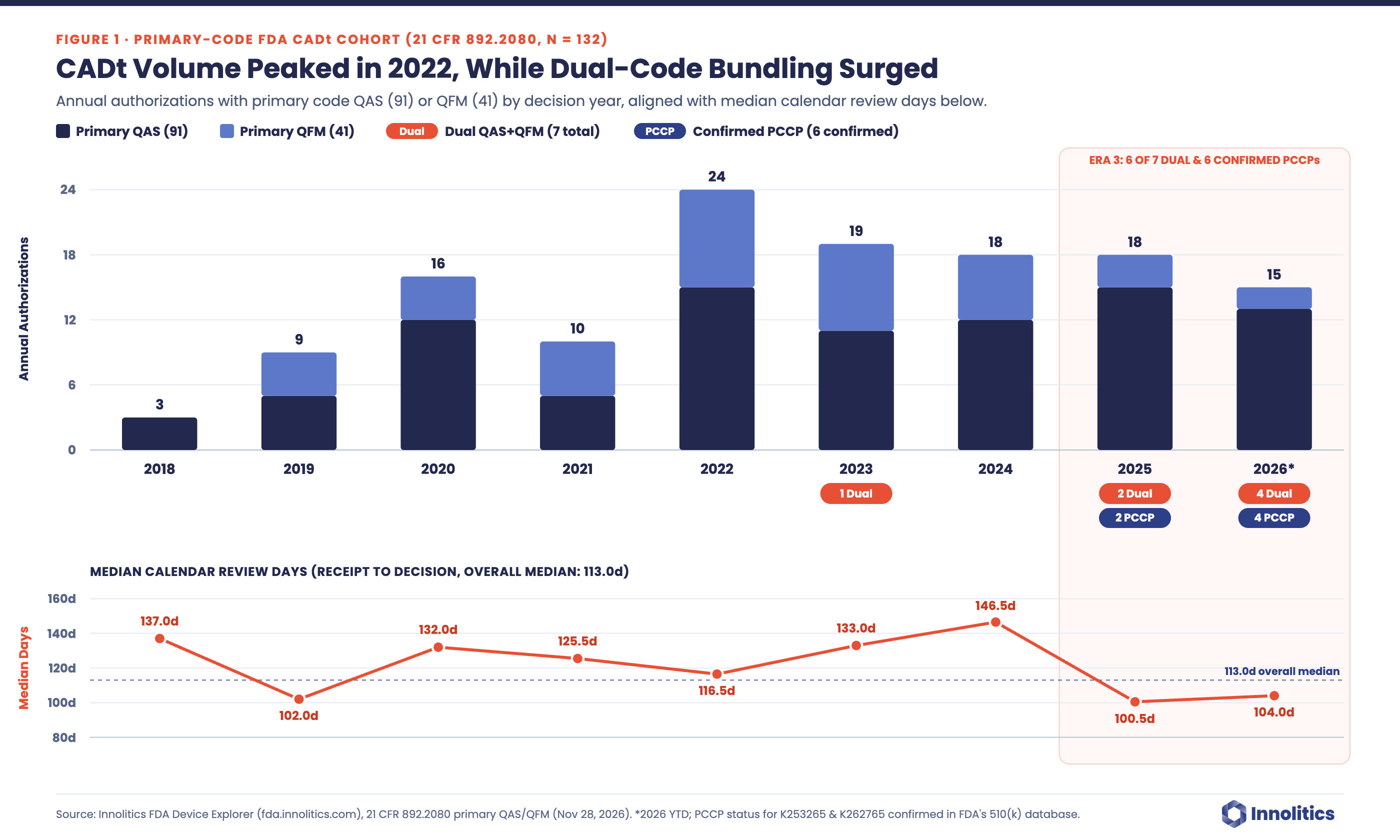
2. **Dual QAS + QFM bundling concentrated sharply in 2025 and 2026.** Among all 132 primary-code QAS/QFM authorizations since February 2018, only **7** combine QAS and QFM in one submission. **Six of those seven (85.7%)** were cleared in 2025 and 2026.
3. **Annual median review times fell in 2025 and 2026 alongside the arrival of multi-finding bundles.** Across all 132 primary-code authorizations, the overall median receipt-to-decision interval is **113.0 calendar days**, peaking at **146.5 days** in 2024 before dropping to **100.5 days** in 2025 and **104.0 days** in 2026 year-to-date. The five Traditional dual-code bundles cleared since late 2025 (`K252366`, `K252970`, [`K253578`](https://fda.innolitics.com/device/K253578?doc=summary&hl=10:Each%20of%204-clinical%20indications%20had%20a%20sample%20size%20of%20N%20%3D%20280%20each%2C%20with%20772%20unique%20scans%20included%20across%20device%20indications.), `K260906`, `K262765`) cleared in **100 to 181 days**, though annual medians pool single- and multi-finding devices as well as Traditional and Special 510(k)s and do not prove that bundling sped up review.
4. **Both scaling sponsors chose modular 4-to-11-finding waves rather than monolithic mega-bundles.** Across all 132 primary-code authorizations, no sponsor has cleared a 15-plus-finding CADt mega-bundle, and neither a2z Radiology AI (7, then 10, then 9 finding claims across three PCCP-authorized filings) nor Aidoc's foundation-model expansion (11, then 4 findings under CARE Multi-Triage) packed an entire organ system into one submission. Confirmed Predetermined Change Control Plans (PCCPs) now appear on at least **6** primary-code CADt authorizations (2 in 2025 and 4 in 2026), yet none of the four published CADt PCCP summaries examined authorize adding net-new clinical pathologies.
> **Methodology and primary-source scope:** Cohort records, dates, subsequent product codes, and whole-corpus indication extractions for all 132 primary-code `21 CFR 892.2080` authorizations (`2018-02-13` through `2026-11-28`) were pulled via [Innolitics FDA Device Explorer](https://fda.innolitics.com). Distinct-pathology counts distinguish multi-condition triage panels from single-pathology neurovascular segment lists (`K220709`, `K251151`, `K260729`, [`K261085`](https://fda.innolitics.com/device/K261085?doc=summary&hl=10:Rapid%20VO%20has%20an%20authorized%20Predetermined%20Change%20Control%20Plan%20%28PCCP%29.%20All%20modification%20types%20are%20restricted%20to%20the%20CT%20Angiography%20%28CTA%29), `K261317`), aggregate ICH subtype lists (`K221456`, `K241719`, `K250694`, [`K262301`](https://fda.innolitics.com/device/K262301?doc=summary&hl=9:Rapid%20ICH%20has%20an%20authorized%20Predetermined%20Change%20Control%20Plan%20%28PCCP%29.%20All%20modification%20types%20are%20restricted%20to%20non-enhanced%20head%20CT)), and `K203508`'s non-clinical user-label update across 6 previously cleared BriefCase indications. FDA also assigned QAS or QFM as subsequent product codes on clearances filed under other primary codes, including [`K261368`](https://fda.innolitics.com/device/K261368?doc=summary&hl=1:Trade%2FDevice%20Name%3A%20Rapid%20Platform%20%28R6.7%29&hl=1:Product%20Code%3A%20QIH%2C%20LLZ) (iSchemaView Rapid Platform R6.7, primary `QIH` with subsequent QAS and QFM) and [`K262062`](https://fda.innolitics.com/device/K262062?doc=summary&hl=1:Product%20Code%3A%20QBS%2C%20QFM%2C%20QIH&hl=2:also%20included%20the%20review%20and%20clearance%20of%20your%20Predetermined%20Change%20Control%20Plan%20%28PCCP%29%3A%20Predetermined%20Change%20Control%20Plan%20CINA-Aneurysm) (Avicenna.ai CINA-Aneurysm, primary `QBS` with subsequent QFM and `QIH`, PCCP authorized), which sit outside this primary-code denominator. For [K262765](https://fda.innolitics.com/device/K262765), FDA's [510(k) record](https://highlight.innolitics.com/v/pp1p85c14Mlw#h=1) confirms receipt on August 4, 2026, clearance on November 12, 2026 (100 calendar days), primary QAS, [subsequent QFM](https://highlight.innolitics.com/v/pp1p85c14Mlw#h=2), and **PCCP Authorized: Yes**, with no summary PDF posted as of November 28, 2026; accordingly, Omni's nine-finding list and 26-claim cumulative total come from the [Imaging Technology News (ITN) report](https://highlight.innolitics.com/v/jLF0v46yMMDH#h=2), and its PCCP scope remains unverified. Likewise, Aidoc's Special 510(k) [K253265](https://highlight.innolitics.com/v/3r61d7uINGlI#h=1) (cleared November 6, 2025) is marked **PCCP Authorized: Yes** in FDA's 510(k) database without PCCP scope details in its posted summary. All other device counts, endpoints, cohorts, and PCCP scopes come directly from published FDA summaries indexed in Innolitics FDA Device Explorer.
---
## The Whole-Cohort Baseline: 132 Primary-Code Authorizations Under `21 CFR 892.2080`
Computer-aided triage and notification (CADt) software is regulated under `21 CFR 892.2080` (Class II with special controls). Under that regulation, FDA classifies authorizations across two product codes:
- **[`QAS`](https://highlight.innolitics.com/v/maV4mtmNuRN2#h=1)** (*Radiological computer aided triage and notification software*): software intended to aid in prioritization and triage of time-sensitive radiological medical images in parallel with standard-of-care interpretation.
- **[`QFM`](https://highlight.innolitics.com/v/AmyiUigQF7PE#h=1)** (*Radiological computer-assisted prioritization software for lesions*): prioritization software first cleared under `21 CFR 892.2080` in March 2019 with CureMetrix's [cmTriage (K183285)](https://fda.innolitics.com/device/K183285?doc=summary&hl=3:cmTriage%20does%20not%20send%20a%20proactive%20alert%20directly%20to%20the%20radiologist.&hl=4:Radiological%20Computer-Assisted%20Prioritization%20Software&focus=2) for passive exam-level worklist flags on 2D screening mammograms without proactive direct clinician alerts.
Figure 1. Annual primary-code FDA CADt authorizations (21 CFR 892.2080, N = 132) from 2018 through November 28, 2026, showing primary QAS vs. QFM volume, dual-code and PCCP adoption, and median calendar review days.
Across the 132 primary-code authorizations by decision year, QAS accounts for 91 (68.9%) and QFM accounts for 41 (31.1%). Annual authorization volume peaked at **24 authorizations in 2022** and settled to 15 to 19 per year since. What changed in 2025 and 2026 is indication density per clearance, dual-code (QAS + QFM) pairing, and PCCP adoption:
| Decision Year | Total (`21 CFR 892.2080`) | Primary QAS | Primary QFM | Dual QAS + QFM | Confirmed PCCP | Median Review Days |
|---|---:|---:|---:|---:|---:|---:|
| 2018 | 3 | 3 | 0 | 0 | 0 | 137.0 |
| 2019 | 9 | 5 | 4 | 0 | 0 | 102.0 |
| 2020 | 16 | 12 | 4 | 0 | 0 | 132.0 |
| 2021 | 10 | 5 | 5 | 0 | 0 | 125.5 |
| 2022 | 24 | 15 | 9 | 0 | 0 | 116.5 |
| 2023 | 19 | 11 | 8 | 1 | 0 | 133.0 |
| 2024 | 18 | 12 | 6 | 0 | 0 | 146.5 |
| 2025 | 18 | 15 | 3 | 2 | 2 | 100.5 |
| 2026 (through Nov 28*) | 15 | 13 | 2 | 4 | 4 | 104.0 |
| **Total / Overall** | **132** | **91** | **41** | **7** | **6** | **113.0** |
*Source: [Innolitics FDA Device Explorer](https://fda.innolitics.com) (`21 CFR 892.2080` primary QAS/QFM cohort, queried November 28, 2026), supplemented with FDA's live 510(k) PCCP authorization flag for [`K253265`](https://highlight.innolitics.com/v/3r61d7uINGlI#h=1) and [`K262765`](https://highlight.innolitics.com/v/pp1p85c14Mlw#h=1). Review days reflect exact calendar days from receipt to decision (including hold time). Confirmed PCCPs include 4 documented in published summaries ([`K252366`](https://fda.innolitics.com/device/K252366?doc=summary&hl=7:While%20the%20anatomical%20regions%20of%20interest%20differ%20%28abdomen%2Fpelvis%20for%20the%20subject%20device%20vs.%20head%20for%20the%20predicate%29%2C%20the%20core%20technology%2C%20intended%20use%20for%20triage%2C%20and%20principles%20of%20operation%20are%20similar.&hl=13:The%20PCCP%20does%20not%20include%20provisions%20for%20implementation%20of%20adaptive%20algorithms%20that%20will%20continuously%20learn%20in%20the%20field.&focus=2), [`K261085`](https://fda.innolitics.com/device/K261085?doc=summary&hl=10:Rapid%20VO%20has%20an%20authorized%20Predetermined%20Change%20Control%20Plan%20%28PCCP%29.%20All%20modification%20types%20are%20restricted%20to%20the%20CT%20Angiography%20%28CTA%29), [`K260906`](https://fda.innolitics.com/device/K260906?doc=summary&hl=13:The%20standalone%20performance%20assessment%20validated%2010%20abdominopelvic%20findings%20comprising%203%20QFM%20findings%20%28Hydroureter%2C%20Large%20volume%20ascites%2C%20Obstructing%20ureteral%20stone%29%20and%207%20QAS%20findings&hl=13:The%20PCCP%20does%20not%20authorize%20adaptive%20algorithms%20that%20continuously%20learn%20in%20the%20field.&focus=2), [`K262301`](https://fda.innolitics.com/device/K262301?doc=summary&hl=9:Rapid%20ICH%20has%20an%20authorized%20Predetermined%20Change%20Control%20Plan%20%28PCCP%29.%20All%20modification%20types%20are%20restricted%20to%20non-enhanced%20head%20CT)) plus `K253265` (2025) and `K262765` (2026).*
---
## Three Eras of CADt Architecture (2018 to 2026)
Viewed longitudinally, CADt authorizations fall into three architectural eras reflecting both how imaging models evolved and which regulatory templates FDA's radiological imaging review teams had established precedent to review.
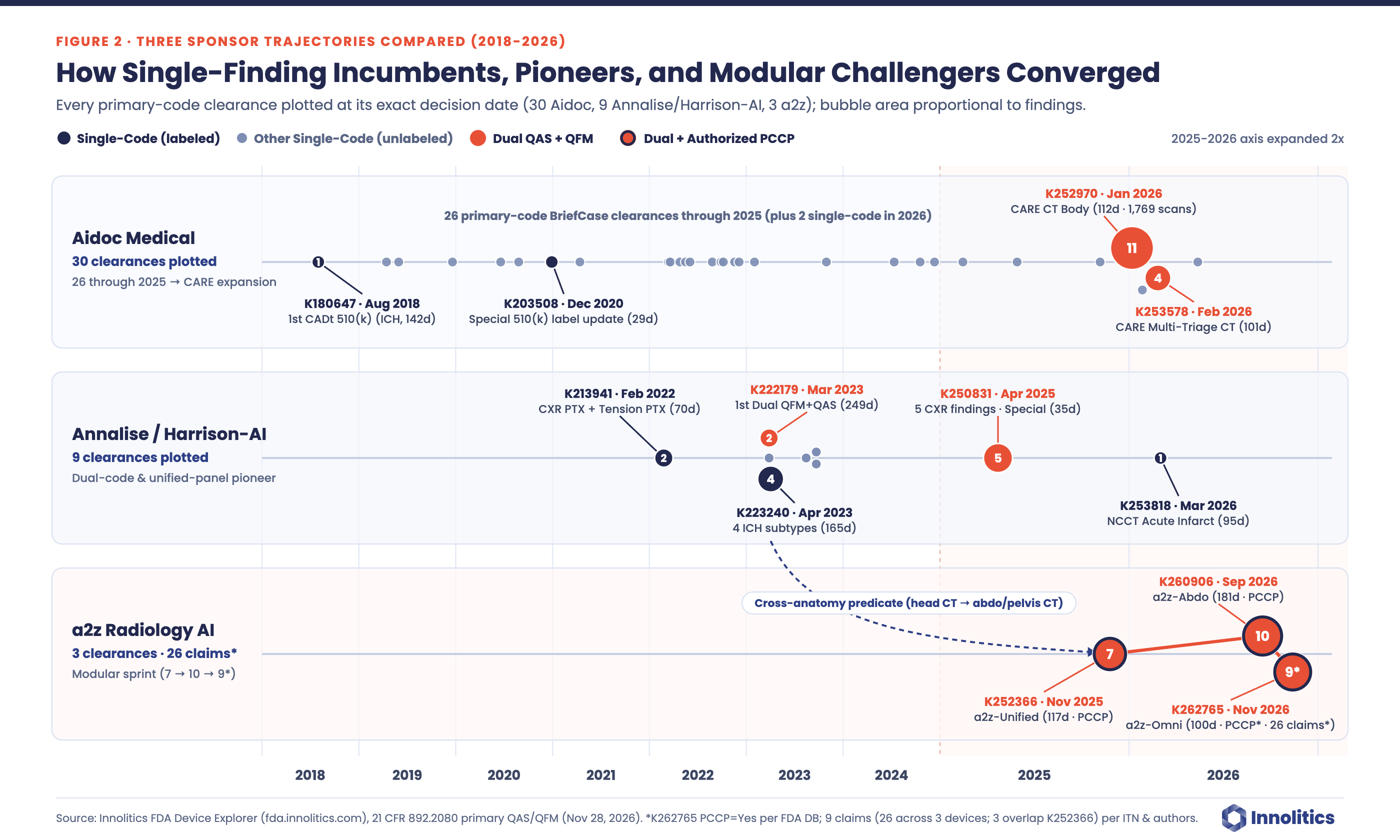
Figure 2. Swimlane trajectory comparing all 30 Aidoc, 9 Annalise/Harrison-AI, and 3 a2z Radiology AI primary-code CADt clearances (2018 to November 2026), with bubble area scaled to finding count.
### Era 1 (2018 to 2021): Predominantly Single-Finding Filings
The CADt category opened on February 13, 2018 with Viz.ai's De Novo authorization for [ContaCT (DEN170073)](https://fda.innolitics.com/device/DEN170073?doc=decision_summary&hl=1:ContaCT%20is%20a%20notification-only%2C%20parallel%20workflow%20tool%20for%20use%20by%20hospital%20networks%20and%20trained%20clinicians%20to%20identify%20and%20communicate%20images%20of%20specific%20patients%20to%20a%20specialist), authorized in 137 days for a single finding: suspected large vessel occlusion (LVO) on head CTA. Six months later, Aidoc cleared the category's first 510(k), [BriefCase (K180647)](https://fda.innolitics.com/device/K180647?doc=summary&hl=3:indicated%20for%20use%20in%20the%20analysis%20of%20non-enhanced%20head%20CT%20images.%20The%20device%20is%20intended%20to%20assist%20hospital%20networks%20and%20trained%20radiologists%20in%20workflow%20triage%20by%20flagging%20and%20communication%20of%20suspected%20positive%20findings%20of%20pathologies%20in%20head%20CT%20images%2C%20namely%20Intracranial%20Hemorrhage%20%28ICH%29), in 142 days for intracranial hemorrhage (ICH) on non-contrast head CT. In March 2019, CureMetrix introduced QFM with [cmTriage (K183285)](https://fda.innolitics.com/device/K183285?doc=summary&hl=3:cmTriage%20does%20not%20send%20a%20proactive%20alert%20directly%20to%20the%20radiologist.&hl=4:Radiological%20Computer-Assisted%20Prioritization%20Software), establishing passive worklist prioritization without proactive alerts.
Through 2021, most CADt clearances validated one pathology at a time. Aidoc built the largest CADt portfolio in the market (30 primary-code clearances in total, including 26 through 2025) predominantly through sequential pathology-by-pathology clearances: ICH (`K180647`), PE added alongside ICH labeling (`K190072`), C-spine fracture (`K190896`, 56 days), LVO (`K192383`), intra-abdominal free gas (`K193298`, 205 days), incidental PE (`K201020`, 131 days), and rib fractures (`K202992`). When Aidoc filed a multi-predicate Special 510(k) in December 2020 ([K203508](https://fda.innolitics.com/device/K203508?doc=summary&hl=12:Performance%20data%20was%20not%20needed%20to%20support%20this%20modification%20to%20BriefCase.), received November 30, 2020, cleared December 29, 2020 in 29 days), it broadened the intended user population across six previously cleared indications using separate Indications for Use forms and no new clinical performance testing.
Early single-code multi-finding exceptions did exist during Era 1: Qure.ai's `qER` ([`K200921`](https://fda.innolitics.com/device/K200921?doc=summary&hl=5:qER%20is%20an%20artificial%20intelligence%20software%20device%20that%20screens%20head%20CT%20scans%20for%20signs%20of%20ICH%2C%20mass%20effect%2C%20midline%20shift%20and%20cranial%20fractures), June 2020) cleared four head CT pathologies under QAS (ICH, cranial fracture, mass effect, and midline shift) with user-selectable toggles, Avicenna.ai cleared two-finding bundles (`K200855` CINA for ICH and LVO in June 2020; `K210237` CINA CHEST for PE and aortic dissection in May 2021), and Lunit cleared a two-finding QFM chest X-ray device (`K211733`, November 2021). Still, narrow task-specific convolutional networks kept one-indication-at-a-time filings the default.
### Era 2 (2022 to 2024): Dual-Code Bridging and Unified-Device Bundles
Between 2022 and 2024, two-finding single-code pairs became common across chest X-ray (pneumothorax plus pleural effusion in Qure.ai `K230899`, Milvue `K232410`, and VUNO `K241439`) and stroke CT (ICH plus LVO in Avicenna `K221716` and Brainomix `K232496`), while several single-pathology neuro clearances enumerated multiple vascular segments (`K220709`) or hemorrhage subtypes (`K221456`, `K241719`) under one aggregate triage target.
Annalise-AI (later Harrison-AI Medical) expanded the regulatory template further across 2022 and 2023. After clearing a two-finding QFM chest X-ray device for pneumothorax and tension pneumothorax ([`K213941`](https://fda.innolitics.com/device/K213941?doc=summary&hl=3:The%20device%20is%20designed%20to%20aid%20the%20clinical%20assessment%20of%20adult%20chest%20x-ray%20cases%20with%20features%20suggestive%20of%20pneumothorax%20and%20tension%20pneumothorax%20in%20the%20medical%20care%20environment.&hl=8:an%20AUC%20of%200.979%20%2895%25%20CI%3A%200.970-0.986%29%20and%200.988%20%2895%25%20CI%3A%200.981-0.993%29%20for%20pneumothorax%20and%20tension%20pneumothorax), February 2022, 70 days), Annalise established two precedents in consecutive weeks in spring 2023:
1. **First dual QFM + QAS bundle in the primary-code cohort:** On March 28, 2023, [Annalise Enterprise CXR Triage Trauma (K222179)](https://fda.innolitics.com/device/K222179?doc=summary&hl=4:Note%20that%20the%20product%20code%20QFM%20applies%20to%20pleural%20effusion.&hl=4:Note%20that%20the%20product%20code%20QAS%20applies%20to%20pneumoperitoneum.&hl=8:total%20dataset%20of%201269%20CXR%20cases%20%28positive%20n%3D582%20and%20negative%20n%3D687%29%2C%20collected%20consecutively%20from%20four%20US%20hospital%20network%20sites.) cleared two chest X-ray findings under one 510(k) by mapping pleural effusion to QFM and pneumoperitoneum to QAS, validated across [1,269 consecutive CXR cases from four U.S. hospital network sites](https://fda.innolitics.com/device/K222179?doc=summary&hl=4:Note%20that%20the%20product%20code%20QFM%20applies%20to%20pleural%20effusion.&hl=4:Note%20that%20the%20product%20code%20QAS%20applies%20to%20pneumoperitoneum.&hl=8:total%20dataset%20of%201269%20CXR%20cases%20%28positive%20n%3D582%20and%20negative%20n%3D687%29%2C%20collected%20consecutively%20from%20four%20US%20hospital%20network%20sites.&focus=3).
2. **Unified-device multi-finding head CT precedent:** Six days later, on April 3, 2023, [Annalise Enterprise CTB Triage Trauma (K223240)](https://fda.innolitics.com/device/K223240?doc=summary&hl=3:These%20findings%20are%20intended%20to%20be%20used%20together%20as%20one%20device.) cleared four intracranial hemorrhage subtypes (acute subdural/epidural hematoma, acute subarachnoid hemorrhage, intra-axial hemorrhage, and intraventricular hemorrhage) on non-contrast brain CT with the explicit Indications for Use clause: *"These findings are intended to be used together as one device."* Unlike earlier user-toggleable suites, the findings operated as a unified clinical panel.
Pioneering those two templates took calendar time: `K222179` required **249 days** and `K223240` required **165 days**. Once both summaries entered the public record, later sponsors had clear substantial-equivalence blueprints for dual-code mapping and unified multi-finding panels.
### Era 3 (2025 to 2026): Foundation-Model Cores, Modular Bundles, and PCCPs
In April 2025, Annalise became the first sponsor in the 132-record cohort to cross four distinct validated findings in one CADt 510(k), consolidating five chest X-ray findings under dual codes in [K250831](https://fda.innolitics.com/device/K250831?doc=summary&hl=6:Note%20that%20product%20code%20QAS%20only%20applies%20to%20clinical%20condition%20of%20interest%3A%20pneumoperitoneum.%20All%20other%20conditions%20are%20submitted%20under%20product%20code%20QFM.) (a 35-day Special 510(k) supported by a 3,252-case standalone evaluation across four previously acquired cohorts, mapping pneumoperitoneum to QAS and pleural effusion, pneumothorax, tension pneumothorax, and vertebral compression fracture to QFM). From late 2025 through November 2026, two distinct multi-indication scaling playbooks emerged.
#### Playbook A: a2z Radiology AI's Three-Device Modular Sprint (26 Finding Claims in 353 Days)
Between November 24, 2025 and November 12, 2026 (353 calendar days between first and third clearance), a2z Radiology AI cleared three dual-code (QAS + QFM), PCCP-authorized devices for abdominopelvic CT:
1. **[`K252366`](https://fda.innolitics.com/device/K252366?doc=summary&hl=7:While%20the%20anatomical%20regions%20of%20interest%20differ%20%28abdomen%2Fpelvis%20for%20the%20subject%20device%20vs.%20head%20for%20the%20predicate%29%2C%20the%20core%20technology%2C%20intended%20use%20for%20triage%2C%20and%20principles%20of%20operation%20are%20similar.&hl=13:The%20PCCP%20does%20not%20include%20provisions%20for%20implementation%20of%20adaptive%20algorithms%20that%20will%20continuously%20learn%20in%20the%20field.) (`a2z-Unified-Triage`, cleared Nov 24, 2025, 117 days, PCCP):** Cleared **7 findings**: 5 under QFM (acute cholecystitis, acute pancreatitis, acute diverticulitis, unruptured AAA, hydronephrosis; AUC > 0.95 and sensitivity/specificity > 80%) and 2 under QAS (free air, small bowel obstruction; sensitivity/specificity > 80%). Performance was validated on **675 analyzed cases** (678 reviewed, 643 unique patients) from 12 U.S. clinical sites. `K252366` cited Annalise's brain CT `K223240` as its sole predicate, arguing that [although the anatomical regions differed (abdomen/pelvis vs. head), the core technology, triage intended use, and principles of operation were similar](https://fda.innolitics.com/device/K252366?doc=summary&hl=7:While%20the%20anatomical%20regions%20of%20interest%20differ%20%28abdomen%2Fpelvis%20for%20the%20subject%20device%20vs.%20head%20for%20the%20predicate%29%2C%20the%20core%20technology%2C%20intended%20use%20for%20triage%2C%20and%20principles%20of%20operation%20are%20similar.&hl=13:The%20PCCP%20does%20not%20include%20provisions%20for%20implementation%20of%20adaptive%20algorithms%20that%20will%20continuously%20learn%20in%20the%20field.).
2. **[`K260906`](https://fda.innolitics.com/device/K260906?doc=summary&hl=13:The%20standalone%20performance%20assessment%20validated%2010%20abdominopelvic%20findings%20comprising%203%20QFM%20findings%20%28Hydroureter%2C%20Large%20volume%20ascites%2C%20Obstructing%20ureteral%20stone%29%20and%207%20QAS%20findings&hl=13:The%20PCCP%20does%20not%20authorize%20adaptive%20algorithms%20that%20continuously%20learn%20in%20the%20field.) (`a2z-Abdo-Triage`, cleared Sep 16, 2026, 181 days, PCCP):** Cited `K252366` as its own predicate to clear **10 findings** ([3 QFM findings with AUCs 0.984 to 0.995 and 7 QAS findings with AUCs 0.945 to 0.985](https://fda.innolitics.com/device/K260906?doc=summary&hl=13:The%20standalone%20performance%20assessment%20validated%2010%20abdominopelvic%20findings%20comprising%203%20QFM%20findings%20%28Hydroureter%2C%20Large%20volume%20ascites%2C%20Obstructing%20ureteral%20stone%29%20and%207%20QAS%20findings&hl=13:The%20PCCP%20does%20not%20authorize%20adaptive%20algorithms%20that%20continuously%20learn%20in%20the%20field.)): obstructing ureteral stone, hydroureter, large volume ascites, acute appendicitis, intraabdominopelvic abscess, hemoperitoneum or complex free fluid, retroperitoneal hematoma, and splenic, hepatic, and renal traumatic injury. All 10 were validated on **965 analyzed studies** (989 reviewed, 914 received patient pseudonyms, primarily across three identified U.S. sites) adjudicated by 2+1 U.S. board-certified radiologists.
3. **[`K262765`](https://highlight.innolitics.com/v/pp1p85c14Mlw#h=1) (`a2z-Omni-Triage`, cleared Nov 12, 2026, 100 days, PCCP confirmed):** Cleared under dual QAS + QFM codes 57 days after `K260906`. Per [ITN's report](https://highlight.innolitics.com/v/jLF0v46yMMDH#h=2), `a2z-Omni-Triage` covers **9 findings**: moderate or large layering pleural effusion, pneumothorax, complex pleural collection, bowel perforation, moderate or severe hydronephrosis, large aortic aneurysm (>= 5 cm), non-sacral pelvic fracture, sacral or coccygeal fracture, and soft tissue abscess.
*Clinical overlap note:* The sponsor's reported **26** represents cumulative cleared finding claims across three separate devices rather than 26 mutually exclusive abdominal pathologies. In our clinical comparison of `K252366` against the reported `K262765` list, three of Omni's nine claims refine severity, size, or etiology of finding families already cleared in `K252366` (moderate/severe hydronephrosis vs. hydronephrosis; aortic aneurysm >= 5 cm vs. unruptured AAA; bowel perforation vs. free air and perforated diverticulitis), and three (pleural effusion, pneumothorax, complex pleural collection) are lower-thoracic pleuropulmonary findings visible at the lung bases on abdominopelvic CT.
#### Playbook B: Aidoc's Foundation-Model Multi-Triage Expansion (`CARE Multi-Triage`)
After 26 primary-code `BriefCase` clearances through 2025 (and alongside two additional single-code clearances in early 2026), Aidoc expanded into dual-code (QAS + QFM) multi-triage bundles built on a foundation model, covering patients aged 18 and older (compared with 22 and older for a2z and Annalise):
- **[`K252970`](https://fda.innolitics.com/device/K252970?doc=summary&hl=11:Multi-triage%20module%2C%20locked%20artificial%20intelligence%20algorithm%20fine%20tuned%20from%20a%20foundation%20model.&hl=12:Each%20of%2011-clinical%20indications%20had%20a%20sample%20size%20of%20N%20%3D%20280%2C%20with%201769%20unique%20scans%20included%20across%20device%20indications.) (`BriefCase-Triage: CARE Multi-triage CT Body`, cleared Jan 7, 2026, 112 days):** Cleared **11 distinct clinical indications** in a single 510(k) on contrast and non-contrast CT of the chest, abdomen, and/or pelvis (diverticulitis, abdominal-pelvic abscess, appendicitis, intestinal ischemia/pneumatosis, obstructive renal stone, small bowel obstruction, large bowel obstruction, spleen injury, liver injury, kidney injury, and pelvic fracture), the highest distinct multi-pathology indication count across the entire 132-record `21 CFR 892.2080` cohort. FDA's summary describes the software as a [*"Multi-triage module, locked artificial intelligence algorithm fine tuned from a foundation model"*](https://fda.innolitics.com/device/K252970?doc=summary&hl=11:Multi-triage%20module%2C%20locked%20artificial%20intelligence%20algorithm%20fine%20tuned%20from%20a%20foundation%20model.&hl=12:Each%20of%2011-clinical%20indications%20had%20a%20sample%20size%20of%20N%20%3D%20280%2C%20with%201769%20unique%20scans%20included%20across%20device%20indications.).
- **[`K253578`](https://fda.innolitics.com/device/K253578?doc=summary&hl=10:Each%20of%204-clinical%20indications%20had%20a%20sample%20size%20of%20N%20%3D%20280%20each%2C%20with%20772%20unique%20scans%20included%20across%20device%20indications.) (`BriefCase-Triage: CARE Multi-Triage CT`, cleared Feb 26, 2026, 101 days):** Cleared **4 indications** on CT of the chest, abdomen, or chest/abdomen (pneumothorax, pericardial effusion, large aortic aneurysm, and shoulder fracture or dislocation) 50 days later. (Innolitics FDA Device Explorer and Aidoc's 510(k) Summary list QAS and QFM, while the signed SE cover letter lists QAS.)
### Landmark CADt Authorizations Compared
| Submission | Decision Date | Sponsor & Device | Codes | Findings | Review Days | Validation Cohort Design | PCCP |
|---|---|---|---:|---:|---:|---|---|
| [DEN170073](https://fda.innolitics.com/device/DEN170073?doc=decision_summary&hl=1:ContaCT%20is%20a%20notification-only%2C%20parallel%20workflow%20tool%20for%20use%20by%20hospital%20networks%20and%20trained%20clinicians%20to%20identify%20and%20communicate%20images%20of%20specific%20patients%20to%20a%20specialist) | 2018-02-13 | Viz.ai ContaCT | QAS | 1 | 137 | 300 CTA cases (category-creating De Novo) | No |
| [K180647](https://fda.innolitics.com/device/K180647?doc=summary&hl=3:indicated%20for%20use%20in%20the%20analysis%20of%20non-enhanced%20head%20CT%20images.%20The%20device%20is%20intended%20to%20assist%20hospital%20networks%20and%20trained%20radiologists%20in%20workflow%20triage%20by%20flagging%20and%20communication%20of%20suspected%20positive%20findings%20of%20pathologies%20in%20head%20CT%20images%2C%20namely%20Intracranial%20Hemorrhage%20%28ICH%29) | 2018-08-01 | Aidoc BriefCase (ICH) | QAS | 1 | 142 | First CADt 510(k); head CT standalone cohort | No |
| [K183285](https://fda.innolitics.com/device/K183285?doc=summary&hl=3:cmTriage%20does%20not%20send%20a%20proactive%20alert%20directly%20to%20the%20radiologist.&hl=4:Radiological%20Computer-Assisted%20Prioritization%20Software) | 2019-03-08 | CureMetrix cmTriage | QFM | 1 | 102 | First passive worklist QFM clearance | No |
| [K203508](https://fda.innolitics.com/device/K203508?doc=summary&hl=12:Performance%20data%20was%20not%20needed%20to%20support%20this%20modification%20to%20BriefCase.) | 2020-12-29 | Aidoc BriefCase | QAS | 6 prior | 29 | Special 510(k) user-label update; no new clinical testing | No |
| [K222179](https://fda.innolitics.com/device/K222179?doc=summary&hl=4:Note%20that%20the%20product%20code%20QFM%20applies%20to%20pleural%20effusion.&hl=4:Note%20that%20the%20product%20code%20QAS%20applies%20to%20pneumoperitoneum.&hl=8:total%20dataset%20of%201269%20CXR%20cases%20%28positive%20n%3D582%20and%20negative%20n%3D687%29%2C%20collected%20consecutively%20from%20four%20US%20hospital%20network%20sites.) | 2023-03-28 | Annalise CXR Trauma | QFM + QAS | 2 | 249 | 1,269 CXRs across 4 U.S. hospital network sites | No |
| [K223240](https://fda.innolitics.com/device/K223240?doc=summary&hl=3:These%20findings%20are%20intended%20to%20be%20used%20together%20as%20one%20device.) | 2023-04-03 | Annalise CTB Trauma | QAS | 4 | 165 | 1,485 thin + 1,878 thick CTBs, 5 U.S. network sites | No |
| [K250831](https://fda.innolitics.com/device/K250831?doc=summary&hl=6:Note%20that%20product%20code%20QAS%20only%20applies%20to%20clinical%20condition%20of%20interest%3A%20pneumoperitoneum.%20All%20other%20conditions%20are%20submitted%20under%20product%20code%20QFM.) | 2025-04-23 | Annalise Enterprise CXR | QFM + QAS | 5 | 35 | Special 510(k); 3,252 CXRs across 4 cohorts | No |
| [K252366](https://fda.innolitics.com/device/K252366?doc=summary&hl=7:While%20the%20anatomical%20regions%20of%20interest%20differ%20%28abdomen%2Fpelvis%20for%20the%20subject%20device%20vs.%20head%20for%20the%20predicate%29%2C%20the%20core%20technology%2C%20intended%20use%20for%20triage%2C%20and%20principles%20of%20operation%20are%20similar.&hl=13:The%20PCCP%20does%20not%20include%20provisions%20for%20implementation%20of%20adaptive%20algorithms%20that%20will%20continuously%20learn%20in%20the%20field.) | 2025-11-24 | a2z-Unified-Triage | QAS + QFM | 7 | 117 | 675 analyzed (678 reviewed, 643 patients), 12 sites, 2+1 | Yes |
| [K252970](https://fda.innolitics.com/device/K252970?doc=summary&hl=11:Multi-triage%20module%2C%20locked%20artificial%20intelligence%20algorithm%20fine%20tuned%20from%20a%20foundation%20model.&hl=12:Each%20of%2011-clinical%20indications%20had%20a%20sample%20size%20of%20N%20%3D%20280%2C%20with%201769%20unique%20scans%20included%20across%20device%20indications.) | 2026-01-07 | Aidoc CARE CT Body | QAS + QFM | 11 | 112 | `N = 280` per finding, 1,769 unique scans, 6 sites | No |
| [K253578](https://fda.innolitics.com/device/K253578?doc=summary&hl=10:Each%20of%204-clinical%20indications%20had%20a%20sample%20size%20of%20N%20%3D%20280%20each%2C%20with%20772%20unique%20scans%20included%20across%20device%20indications.) | 2026-02-26 | Aidoc CARE Multi-Triage CT | QAS + QFM | 4 | 101 | `N = 280` per finding, 772 unique scans, 6 sites | No |
| [K260906](https://fda.innolitics.com/device/K260906?doc=summary&hl=13:The%20standalone%20performance%20assessment%20validated%2010%20abdominopelvic%20findings%20comprising%203%20QFM%20findings%20%28Hydroureter%2C%20Large%20volume%20ascites%2C%20Obstructing%20ureteral%20stone%29%20and%207%20QAS%20findings&hl=13:The%20PCCP%20does%20not%20authorize%20adaptive%20algorithms%20that%20continuously%20learn%20in%20the%20field.) | 2026-09-16 | a2z-Abdo-Triage | QAS + QFM | 10 | 181 | 965 analyzed (989 reviewed, 914 pseudonyms), 3 sites, 2+1 | Yes |
| [K262765](https://highlight.innolitics.com/v/pp1p85c14Mlw#h=1) | 2026-11-12 | a2z-Omni-Triage | QAS + QFM | 9* | 100 | Summary PDF not yet posted in FDA's 510(k) database* | Yes* |
*\*Nine findings per [ITN (Nov 2026)](https://highlight.innolitics.com/v/jLF0v46yMMDH#h=2). Primary QAS, [subsequent QFM](https://highlight.innolitics.com/v/pp1p85c14Mlw#h=2), and [`PCCP Authorized: Yes`](https://highlight.innolitics.com/v/pp1p85c14Mlw#h=1) confirmed via [Innolitics FDA Device Explorer](https://fda.innolitics.com/device/K262765) and FDA's 510(k) record; PCCP scope remains unverified until the summary posts.*
---
## Four Regulatory Strategy Lessons for Radiology AI Teams
Comparing the 2025 and 2026 summaries highlights four concrete architectural choices for teams planning multi-indication CADt submissions.
### 1. Choose Your Cohort Architecture Deliberately: Shared Multi-Label vs. Per-Indication Sub-Cohorts
The two scaling sponsors took distinct statistical approaches to standalone validation:
- **Shared enriched multi-label cohort (a2z model):** In `K252366` (675 analyzed cases for 7 findings across 12 sites) and `K260906` (965 analyzed cases for 10 findings across 3 identified sites), every study is adjudicated across the full panel by 2+1 U.S. board-certified radiologists. Cases positive for one condition serve as clinically realistic negatives and co-occurring confounders for other conditions in the same scan. That keeps total scan volume under 1,000 studies (with 6.1% to 17.8% per-finding prevalence), though multi-label ground-truthing requires strict adjudication protocols to manage reader fatigue. In `K260906`, demographic, site, and scanner-vendor subgroup tables are explicitly descriptive rather than formally powered.
- **Per-indication sub-cohorts with scan overlap (Aidoc CARE model):** In [K252970](https://fda.innolitics.com/device/K252970?doc=summary&hl=11:Multi-triage%20module%2C%20locked%20artificial%20intelligence%20algorithm%20fine%20tuned%20from%20a%20foundation%20model.&hl=12:Each%20of%2011-clinical%20indications%20had%20a%20sample%20size%20of%20N%20%3D%20280%2C%20with%201769%20unique%20scans%20included%20across%20device%20indications.&focus=2) (11 findings) and [K253578](https://fda.innolitics.com/device/K253578?doc=summary&hl=10:Each%20of%204-clinical%20indications%20had%20a%20sample%20size%20of%20N%20%3D%20280%20each%2C%20with%20772%20unique%20scans%20included%20across%20device%20indications.) (4 findings), Aidoc built an approximately balanced (~1:1 enriched) `N = 280` cohort for each indication across 6 U.S. sites, drawn from a larger unique scan pool (`1,769` and `772` unique scans, respectively). Both summaries report sensitivity and specificity across default and four additional operating points alongside AUC, with different stated primary AUC goals: `K252970` specifies finding-level `AUC > 0.95`, whereas `K253578` explicitly specifies a 95% confidence interval lower bound `> 0.95` for AUC.
Aligning on cohort structure, enrichment ratios, primary acceptance bounds, and reader adjudication rules in a voluntary Pre-Submission (Q-Sub) reduces the risk of mid-review study redesign.
### 2. Why Modular 4-to-11-Finding Sprints Are the Observed Pattern
Both scaling sponsors in 2025 and 2026 grouped findings into modular waves (7, 10, and 9 claims for a2z; 11 and 4 for Aidoc CARE), and across all 132 primary-code CADt clearances no sponsor has cleared a 15-plus-finding mega-bundle. While public clearance records cannot reveal private sponsor motives or prove fewer holds, three planning considerations explain why modular waves are practical:
- **Decoupled hold risk:** FDA evaluates every claimed finding against its own prespecified acceptance criteria. In an oversized bundle, a single rare pathology with a wide confidence interval or a missing imaging confounder can trigger an Additional Information request (giving the sponsor up to 180 calendar days to respond) that pauses review for every other finding in the file. The elapsed times across a2z's three Traditional filings (`117d` for 7 findings, `181d` for 10, `100d` for 9) are consistent with manageable complexity at the 4-to-11-finding scale, though public records do not disclose whether `K260906` incurred an Additional Information hold.
- **Overlapping submission pipelines:** Splitting a roadmap into modular devices lets wave 1 enter FDA review while wave 2 finishes ground-truthing and wave 3 finishes training. `K262765` was received on August 4, 2026, six weeks before `K260906` cleared on September 16, 2026.
- **Cleaner predicate chaining:** Once wave 1 clears (`K252366`), subsequent waves (`K260906`) can cite the sponsor's own prior device on the exact same modality, anatomy, and software architecture instead of arguing cross-anatomy substantial equivalence again.
| Regulatory Strategy | Findings / Filing | Observed Review Examples | Planning Strengths | Key Planning Trade-Off |
|---|---:|---:|---|---|
| **Single-Finding v1** (Era 1 baseline) | 1 | 56 to 205 days (varies widely) | Narrowest validation and review scope | Repeats user fees and QMS overhead per finding; risks hospital "point-solution fatigue" |
| **Modular Sprint** (Observed 2025-26 Pattern: a2z `7/10/9*`, Aidoc CARE `11/4`) | 4 to 11 | 100 to 181 days (Traditional); 35 days (`K250831` Special) | Shared-cohort or scan-pool reuse; dual QAS + QFM coverage; staggered filings separate hold exposure | Requires disciplined multi-label ground-truthing and upfront QAS/QFM workflow alignment |
| **Monolithic Mega-Bundle** (0 clearances across all 132 records) | 15 to 25+ | No precedent in `21 CFR 892.2080` | Single user fee on paper | One weak rare finding can pause the entire file; heavy annotation spend before first revenue |
### 3. Align on QAS vs. QFM Classification and Performance Endpoints Up Front
Teams scoping a multi-finding triage device sometimes assume QAS vs. QFM maps cleanly to clinical acuity or alert routing alone. Published clearances show that alert routing alone cannot predict the product code:
- **Routing does not map one-to-one to product code.** QAS-only [K223240](https://fda.innolitics.com/device/K223240?doc=summary&hl=3:These%20findings%20are%20intended%20to%20be%20used%20together%20as%20one%20device.) routes study-level output to an image and order management system for PACS/RIS worklist prioritization. Dual-code [K250831](https://fda.innolitics.com/device/K250831?doc=summary&hl=6:Note%20that%20product%20code%20QAS%20only%20applies%20to%20clinical%20condition%20of%20interest%3A%20pneumoperitoneum.%20All%20other%20conditions%20are%20submitted%20under%20product%20code%20QFM.) uses that same worklist output for all five CXR findings yet assigns pneumoperitoneum to [QAS](https://highlight.innolitics.com/v/maV4mtmNuRN2#h=1) and places even **tension pneumothorax** under [QFM](https://highlight.innolitics.com/v/AmyiUigQF7PE#h=1). Likewise, [`K252366`](https://fda.innolitics.com/device/K252366?doc=summary&hl=7:While%20the%20anatomical%20regions%20of%20interest%20differ%20%28abdomen%2Fpelvis%20for%20the%20subject%20device%20vs.%20head%20for%20the%20predicate%29%2C%20the%20core%20technology%2C%20intended%20use%20for%20triage%2C%20and%20principles%20of%20operation%20are%20similar.&hl=13:The%20PCCP%20does%20not%20include%20provisions%20for%20implementation%20of%20adaptive%20algorithms%20that%20will%20continuously%20learn%20in%20the%20field.) assigns acute cholecystitis, acute pancreatitis, and acute diverticulitis to QFM. Rather than assuming a fixed rule from alert routing, sponsors scoping multi-finding panels should weigh workflow labeling, clinical urgency, and predicate lineage as planning considerations and confirm each finding's product code directly with FDA in a voluntary Q-Sub.
- **QFM does not replace sensitivity and specificity with AUC.** Published QFM summaries (including [`K213941`](https://fda.innolitics.com/device/K213941?doc=summary&hl=3:The%20device%20is%20designed%20to%20aid%20the%20clinical%20assessment%20of%20adult%20chest%20x-ray%20cases%20with%20features%20suggestive%20of%20pneumothorax%20and%20tension%20pneumothorax%20in%20the%20medical%20care%20environment.&hl=8:an%20AUC%20of%200.979%20%2895%25%20CI%3A%200.970-0.986%29%20and%200.988%20%2895%25%20CI%3A%200.981-0.993%29%20for%20pneumothorax%20and%20tension%20pneumothorax&focus=2) and [`K252366`](https://fda.innolitics.com/device/K252366?doc=summary&hl=7:While%20the%20anatomical%20regions%20of%20interest%20differ%20%28abdomen%2Fpelvis%20for%20the%20subject%20device%20vs.%20head%20for%20the%20predicate%29%2C%20the%20core%20technology%2C%20intended%20use%20for%20triage%2C%20and%20principles%20of%20operation%20are%20similar.&hl=13:The%20PCCP%20does%20not%20include%20provisions%20for%20implementation%20of%20adaptive%20algorithms%20that%20will%20continuously%20learn%20in%20the%20field.)) validate **both** `AUC > 0.95` **and** operating-point sensitivity and specificity above 80%, while QAS findings typically center on sensitivity and specificity `>= 80%` at cleared operating points. Confirming each finding's product-code mapping and both AUC and operating-point acceptance goals in a voluntary Q-Sub prevents mid-review misalignment.
### 4. Plan Around What Published CADt PCCPs Actually Cover
Across the 132 primary-code authorizations, **at least 6** carry an authorized PCCP: two in 2025 (Aidoc's Special 510(k) [K253265](https://highlight.innolitics.com/v/3r61d7uINGlI#h=1) and a2z's [`K252366`](https://fda.innolitics.com/device/K252366?doc=summary&hl=7:While%20the%20anatomical%20regions%20of%20interest%20differ%20%28abdomen%2Fpelvis%20for%20the%20subject%20device%20vs.%20head%20for%20the%20predicate%29%2C%20the%20core%20technology%2C%20intended%20use%20for%20triage%2C%20and%20principles%20of%20operation%20are%20similar.&hl=13:The%20PCCP%20does%20not%20include%20provisions%20for%20implementation%20of%20adaptive%20algorithms%20that%20will%20continuously%20learn%20in%20the%20field.&focus=2)) and four in 2026 (iSchemaView's [`K261085`](https://fda.innolitics.com/device/K261085?doc=summary&hl=10:Rapid%20VO%20has%20an%20authorized%20Predetermined%20Change%20Control%20Plan%20%28PCCP%29.%20All%20modification%20types%20are%20restricted%20to%20the%20CT%20Angiography%20%28CTA%29) Rapid Vessel Occlusion and [`K262301`](https://fda.innolitics.com/device/K262301?doc=summary&hl=9:Rapid%20ICH%20has%20an%20authorized%20Predetermined%20Change%20Control%20Plan%20%28PCCP%29.%20All%20modification%20types%20are%20restricted%20to%20non-enhanced%20head%20CT) Rapid ICH v4.0, which enumerates four hemorrhage subtypes under an aggregate ICH endpoint, plus a2z's [`K260906`](https://fda.innolitics.com/device/K260906?doc=summary&hl=13:The%20standalone%20performance%20assessment%20validated%2010%20abdominopelvic%20findings%20comprising%203%20QFM%20findings%20%28Hydroureter%2C%20Large%20volume%20ascites%2C%20Obstructing%20ureteral%20stone%29%20and%207%20QAS%20findings&hl=13:The%20PCCP%20does%20not%20authorize%20adaptive%20algorithms%20that%20continuously%20learn%20in%20the%20field.&focus=2) and [`K262765`](https://highlight.innolitics.com/v/pp1p85c14Mlw#h=1)).
Founders often ask whether an authorized PCCP lets them add net-new pathologies to a cleared triage model without a new 510(k). **None of the four published CADt PCCP summaries examined include new clinical findings.** (The PCCP scopes of [`K253265`](https://highlight.innolitics.com/v/3r61d7uINGlI#h=1) and [`K262765`](https://highlight.innolitics.com/v/pp1p85c14Mlw#h=1) are not detailed in posted summaries.) Both published a2z summaries ([K252366](https://fda.innolitics.com/device/K252366?doc=summary&hl=7:While%20the%20anatomical%20regions%20of%20interest%20differ%20%28abdomen%2Fpelvis%20for%20the%20subject%20device%20vs.%20head%20for%20the%20predicate%29%2C%20the%20core%20technology%2C%20intended%20use%20for%20triage%2C%20and%20principles%20of%20operation%20are%20similar.&hl=13:The%20PCCP%20does%20not%20include%20provisions%20for%20implementation%20of%20adaptive%20algorithms%20that%20will%20continuously%20learn%20in%20the%20field.&focus=2) and [K260906](https://fda.innolitics.com/device/K260906?doc=summary&hl=13:The%20standalone%20performance%20assessment%20validated%2010%20abdominopelvic%20findings%20comprising%203%20QFM%20findings%20%28Hydroureter%2C%20Large%20volume%20ascites%2C%20Obstructing%20ureteral%20stone%29%20and%207%20QAS%20findings&hl=13:The%20PCCP%20does%20not%20authorize%20adaptive%20algorithms%20that%20continuously%20learn%20in%20the%20field.&focus=2)) exclude continuous field adaptation and scope planned retraining, architecture refinements, and operating-point updates to the conditions already cleared in each submission, while iSchemaView's two PCCPs ([`K261085`](https://fda.innolitics.com/device/K261085?doc=summary&hl=10:Rapid%20VO%20has%20an%20authorized%20Predetermined%20Change%20Control%20Plan%20%28PCCP%29.%20All%20modification%20types%20are%20restricted%20to%20the%20CT%20Angiography%20%28CTA%29) and [`K262301`](https://fda.innolitics.com/device/K262301?doc=summary&hl=9:Rapid%20ICH%20has%20an%20authorized%20Predetermined%20Change%20Control%20Plan%20%28PCCP%29.%20All%20modification%20types%20are%20restricted%20to%20non-enhanced%20head%20CT)) cover device-input compatibility, scanner expansion, performance improvement, and processing-time optimization. Under `FD&C Act § 515C(b)` and [FDA's PCCP guidance](https://fda.innolitics.com/guidance/marketing-submission-recommendations-predetermined-change-control-plan-artificial-intelligence?v=gfb23b96999e-80f0f423efe0c810&hl=26:Modifications%20included%20in%20a%20PCCP%20must%20maintain%20the%20device%20within%20the%20device%27s%20intended%20use), modifications must maintain the device's intended use, and indication-for-use changes in a PCCP are treated narrowly; teams planning net-new clinical pathologies should plan on a new 510(k) under `21 CFR 807.81(a)(3)`.
---
## Frequently Asked Questions
### How many indications can you bundle in a single CADt 510(k)?
There is no statutory cap under `21 CFR 892.2080`. Across all 132 primary-code CADt authorizations in our Innolitics FDA Device Explorer census, FDA has cleared up to **11 distinct clinical findings** in a single 510(k) ([`K252970`](https://fda.innolitics.com/device/K252970?doc=summary&hl=11:Multi-triage%20module%2C%20locked%20artificial%20intelligence%20algorithm%20fine%20tuned%20from%20a%20foundation%20model.&hl=12:Each%20of%2011-clinical%20indications%20had%20a%20sample%20size%20of%20N%20%3D%20280%2C%20with%201769%20unique%20scans%20included%20across%20device%20indications.&focus=2), Aidoc CARE Multi-triage CT Body) and **10 findings** in a single shared-cohort abdominopelvic CT submission ([`K260906`](https://fda.innolitics.com/device/K260906?doc=summary&hl=13:The%20standalone%20performance%20assessment%20validated%2010%20abdominopelvic%20findings%20comprising%203%20QFM%20findings%20%28Hydroureter%2C%20Large%20volume%20ascites%2C%20Obstructing%20ureteral%20stone%29%20and%207%20QAS%20findings&hl=13:The%20PCCP%20does%20not%20authorize%20adaptive%20algorithms%20that%20continuously%20learn%20in%20the%20field.), a2z-Abdo-Triage). In 2025 and 2026, scaling sponsors cleared **4 to 11 findings per filing**; future teams choosing a bundle size must weigh cohort reuse against annotation cost and hold exposure.
### What is the difference between FDA product codes QAS and QFM?
Both are Class II special-controls codes under `21 CFR 892.2080`. FDA classifies [QAS](https://highlight.innolitics.com/v/maV4mtmNuRN2#h=1) as *radiological computer-aided triage and notification software* and [QFM](https://highlight.innolitics.com/v/AmyiUigQF7PE#h=1) as *radiological computer-assisted prioritization software for lesions* (first cleared with [`K183285`](https://fda.innolitics.com/device/K183285?doc=summary&hl=3:cmTriage%20does%20not%20send%20a%20proactive%20alert%20directly%20to%20the%20radiologist.&hl=4:Radiological%20Computer-Assisted%20Prioritization%20Software) for passive PACS worklist flags without proactive alerts). Alert routing alone cannot predict the assigned code: QAS-only [`K223240`](https://fda.innolitics.com/device/K223240?doc=summary&hl=3:These%20findings%20are%20intended%20to%20be%20used%20together%20as%20one%20device.) and dual-code [`K250831`](https://fda.innolitics.com/device/K250831?doc=summary&hl=6:Note%20that%20product%20code%20QAS%20only%20applies%20to%20clinical%20condition%20of%20interest%3A%20pneumoperitoneum.%20All%20other%20conditions%20are%20submitted%20under%20product%20code%20QFM.) both route study-level outputs to PACS/RIS worklists, and `K250831` assigns pneumoperitoneum to QAS while placing four other CXR findings (including tension pneumothorax) under QFM. Multi-finding submissions increasingly combine QAS and QFM, so sponsors should consider workflow labeling, clinical urgency, and predicate lineage early and confirm each finding's code and validation criteria (including both AUC and sensitivity/specificity operating-point goals) with FDA.
### Can an FDA PCCP let a radiology AI company add new triage indications without a new 510(k)?
None of the four published CADt PCCP summaries examined cover adding net-new clinical conditions; they govern bounded locked-model updates (retraining, architecture refinements, operating-point adjustments, or input/scanner expansion) within already-cleared conditions. Because [FDA guidance](https://fda.innolitics.com/guidance/marketing-submission-recommendations-predetermined-change-control-plan-artificial-intelligence?v=gfb23b96999e-80f0f423efe0c810&hl=26:Modifications%20included%20in%20a%20PCCP%20must%20maintain%20the%20device%20within%20the%20device%27s%20intended%20use) treats indication-for-use changes in a PCCP narrowly and `21 CFR 807.81(a)(3)` requires a new 510(k) for major intended-use changes or modifications that could significantly affect safety or effectiveness, plan on a new 510(k) when adding new pathologies.
### How long does a multi-indication CADt 510(k) take to clear?
Across all 132 primary-code CADt authorizations since 2018, the median total calendar review time (receipt to decision) is **113.0 days**. Observed review times for recent multi-finding dual-code bundles span **35 days** for Annalise's Special 510(k) ([`K250831`](https://fda.innolitics.com/device/K250831?doc=summary&hl=6:Note%20that%20product%20code%20QAS%20only%20applies%20to%20clinical%20condition%20of%20interest%3A%20pneumoperitoneum.%20All%20other%20conditions%20are%20submitted%20under%20product%20code%20QFM.)) and **100 to 181 days** across five Traditional 510(k)s ([`K262765`](https://highlight.innolitics.com/v/pp1p85c14Mlw#h=1): 100d, [`K253578`](https://fda.innolitics.com/device/K253578?doc=summary&hl=10:Each%20of%204-clinical%20indications%20had%20a%20sample%20size%20of%20N%20%3D%20280%20each%2C%20with%20772%20unique%20scans%20included%20across%20device%20indications.): 101d, [`K252970`](https://fda.innolitics.com/device/K252970?doc=summary&hl=11:Multi-triage%20module%2C%20locked%20artificial%20intelligence%20algorithm%20fine%20tuned%20from%20a%20foundation%20model.&hl=12:Each%20of%2011-clinical%20indications%20had%20a%20sample%20size%20of%20N%20%3D%20280%2C%20with%201769%20unique%20scans%20included%20across%20device%20indications.): 112d, [`K252366`](https://fda.innolitics.com/device/K252366?doc=summary&hl=7:While%20the%20anatomical%20regions%20of%20interest%20differ%20%28abdomen%2Fpelvis%20for%20the%20subject%20device%20vs.%20head%20for%20the%20predicate%29%2C%20the%20core%20technology%2C%20intended%20use%20for%20triage%2C%20and%20principles%20of%20operation%20are%20similar.&hl=13:The%20PCCP%20does%20not%20include%20provisions%20for%20implementation%20of%20adaptive%20algorithms%20that%20will%20continuously%20learn%20in%20the%20field.): 117d, [`K260906`](https://fda.innolitics.com/device/K260906?doc=summary&hl=13:The%20standalone%20performance%20assessment%20validated%2010%20abdominopelvic%20findings%20comprising%203%20QFM%20findings%20%28Hydroureter%2C%20Large%20volume%20ascites%2C%20Obstructing%20ureteral%20stone%29%20and%207%20QAS%20findings&hl=13:The%20PCCP%20does%20not%20authorize%20adaptive%20algorithms%20that%20continuously%20learn%20in%20the%20field.): 181d).
---
## Planning a Multi-Indication CADt Roadmap?
Scoping a multi-finding triage submission is as much an architectural and biostatistical decision as a regulatory one. Choosing the right bundle size, predicate chain, cohort enrichment plan, and QAS/QFM workflow split early can save months of rework.
At Innolitics, our medical imaging engineers, regulatory specialists, and clinical study leads help radiology AI teams scope multi-indication 510(k) strategies, design voluntary Q-Submissions and multi-label validation protocols, author PCCPs, and build FDA-ready SaMD. [Talk with our team](https://innolitics.com/contact/) to map out your next CADt filing.
### Companion Printable Brief
Download the 1-page landscape brief with 34 clickable links to primary FDA summaries, guidance, and source reports: [From Single-Finding Filings to Multi-Indication CADt (2018-2026) PDF](/pdf/cadt-evolution-landscape-1pager.pdf).