---
Publish Now: null
author:
- Yujan Shrestha
cta_button_text: Pressure-test your strategy
cta_case_studies:
- 9d57159a-cced-4c6f-b0a9-2b8812e61494
- a4b2d790-f1ff-47bb-93b2-09b0d4619030
- 30abd5b7-a754-8063-90d4-ea45a37122f6
- 35cbd5b7-a754-80f4-9a3c-cc0e62e41d52
cta_hero_details: 'The models fail the questions on this page in the most dangerous
  way possible: confidently, and in the direction of maximum cost. Hire experts who
  know how to leverage AI to save you time and guarantee success.'
cta_hero_text: One wrong judgment call costs 9 to 18 months. Catch it before you commit.
date: '2026-07-09'
description: 'Can a frontier AI model replace your FDA regulatory consultant? We built
  a private 1,200-question benchmark, an opinionated distillation of 15 years of consulting
  judgment, and ran 18 frontier models against it. Every one failed the questions
  that cost the most: 4 to 18 months and seven figures per miss.'
related:
- 2c9bd5b7-a754-8027-b8a9-cadfec7d277a
- 4d785472-04a0-445d-9c3d-63d28731a855
- 34fbd5b7-a754-809e-90b3-e822c5692a61
- 2a8bd5b7-a754-808f-88ab-e741a8691576
- 355bd5b7-a754-805b-94ab-f189ea27611d
- 272bd5b7-a754-8081-9405-c3b2697d8b5e
- 27cbd5b7-a754-8070-9fdd-c23b215547d4
- 4c5f66bd-3f63-41fa-861a-8cd5062b3e95
title: Can AI Replace a Consultant? We Built a 1,200-Question Benchmark to Find Out.
topics:
- AI/ML
- Regulatory
---

No. Not even close. We built a private evaluation benchmark of more than 1,200 FDA regulatory judgment questions, an opinionated answer key distilled from 15 years of my consulting experience, and ran 18 frontier AI models against it. Every model failed the questions that cost the most. If you are deciding right now whether a model can carry your FDA strategy, read the five questions below before you commit to a company ending mistake.

One thing this article is not: a jab against AI. We are an AI-forward firm. We use AI to deliver faster and more thorough service than possible before. The difference between us and other firms is we know AI limits by measuring them and know when the AI+human team is better than the human or AI alone. It is remarkably similar to the AI SaMD we support.

AI augments our speed and quality. Its superhuman ability to surface evidence collapses days of precedent review into minutes, though asking the right question remains the hard part. It raised our quality: our consultants now sweep the entire published record behind every recommendation, no stone left unturned. However, it did not lower our cost. Projects cost us more to run now than they used to, but the speed and certainty improvements are worth it.

**18 frontier AI models. More than 1,200 questions. One pattern.** On the regulatory judgment calls that carry the highest cost of error, the ones that decide whether a submission takes six months or eighteen, the best AI models available today reliably choose the answer that sounds safest but costs the most.

We know because we tested it. Over 15 years of software-as-a-medical-device consulting, the same strategic situations rhyme: how lean to make a submission, when to hold a study in reserve, where the device boundary actually sits, what evidence FDA will accept versus what a cautious team assumes it demands. We distilled more than 1,200 of these recurring advisory scenarios into a benchmark: each question a realistic situation, four defensible-sounding options, and one answer that reflects the position I actually take in practice.

Then I ran the models. Two ways: multiple choice, where the model picks among four options (a recognition test), and free text, where the model writes the recommendation from scratch and a three-judge AI panel scores it against my documented position on a two-of-three majority. Two runs per condition. A strict held-out question set that no part of our tooling ever touches.

As an aside, a single full run of this benchmark costs us in the thousands of dollars in API pricing. AI (when done right) is many things. Cheap is not one of them.

### The leaderboard

<figure>
  <img src="/img/articles/Can_AI_Replace_a_Consultant_We_Built_a_1200-Question_Benchmark_to_Find_Out.-55a551c23f1c4affbd31a8f3cdc2b397.svg">
  <figcaption>
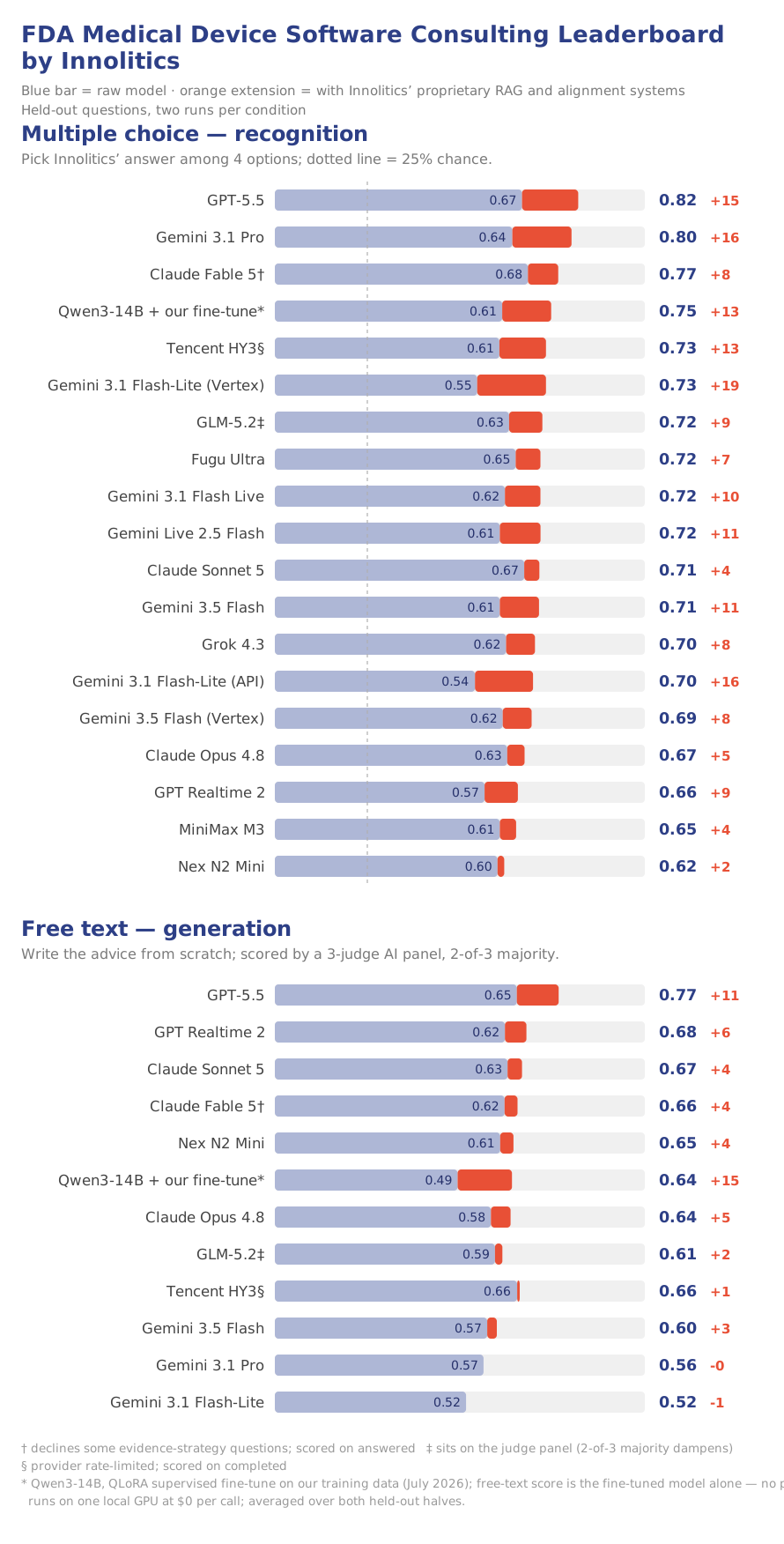
    FDA Medical Device Software Consulting Leaderboard. Blue bar = the model
    as shipped; orange extension = the same model running inside our
    proprietary RAG and alignment system. Multiple choice measures
    recognition; free text measures generation. Held-out questions, two runs
    per question model pair. Qwen3-14B fine-tuned on our training data (rows
    marked *).
  </figcaption>
</figure>

Three takeaways. First, raw frontier models cluster in the same band. On judgment, the leading labs are more alike than different, because they are all trained on the same public regulatory orthodoxy. Second, our alignment systems move every model up on recognition, and the strongest models up on generation. The gap between those two numbers is itself a finding. A model that can pick the right answer from a list but cannot produce it unprompted has not learned judgment; it has learned to recognize it. Third, and most important: even the best aligned configuration plateaus well short of a ceiling.

There is a fourth reading, and it is the uncomfortable one. These models are trained on what the industry publishes: the guidance recaps, the webinars, the conference panels, the consultant blog posts. A frontier model is the industry\'s written consensus, compressed and made fluent. So when every model picks the cautious, expensive answer, that is not only a verdict on the models. It is a verdict on the training data. We cannot run the rest of the industry through this benchmark, but we suspect much of it would score closer to the raw models than to our answer key. That gap is our key differentiator, and it is the difference between a \$15M + 24 month program and a \$5M + 6 month one.

Another way to say it: the models have learned the average regulatory consultant\'s answer. An average is a smoothing operation. The true decision boundary is jagged, and the mean of a thousand published opinions sands off exactly the corners where the judgment lives. This is why model output sounds plausible and correct every time, and why it is subtly wrong almost as often, in ways all but the top experts fail to spot. The plausibility and the wrongness have the same cause.

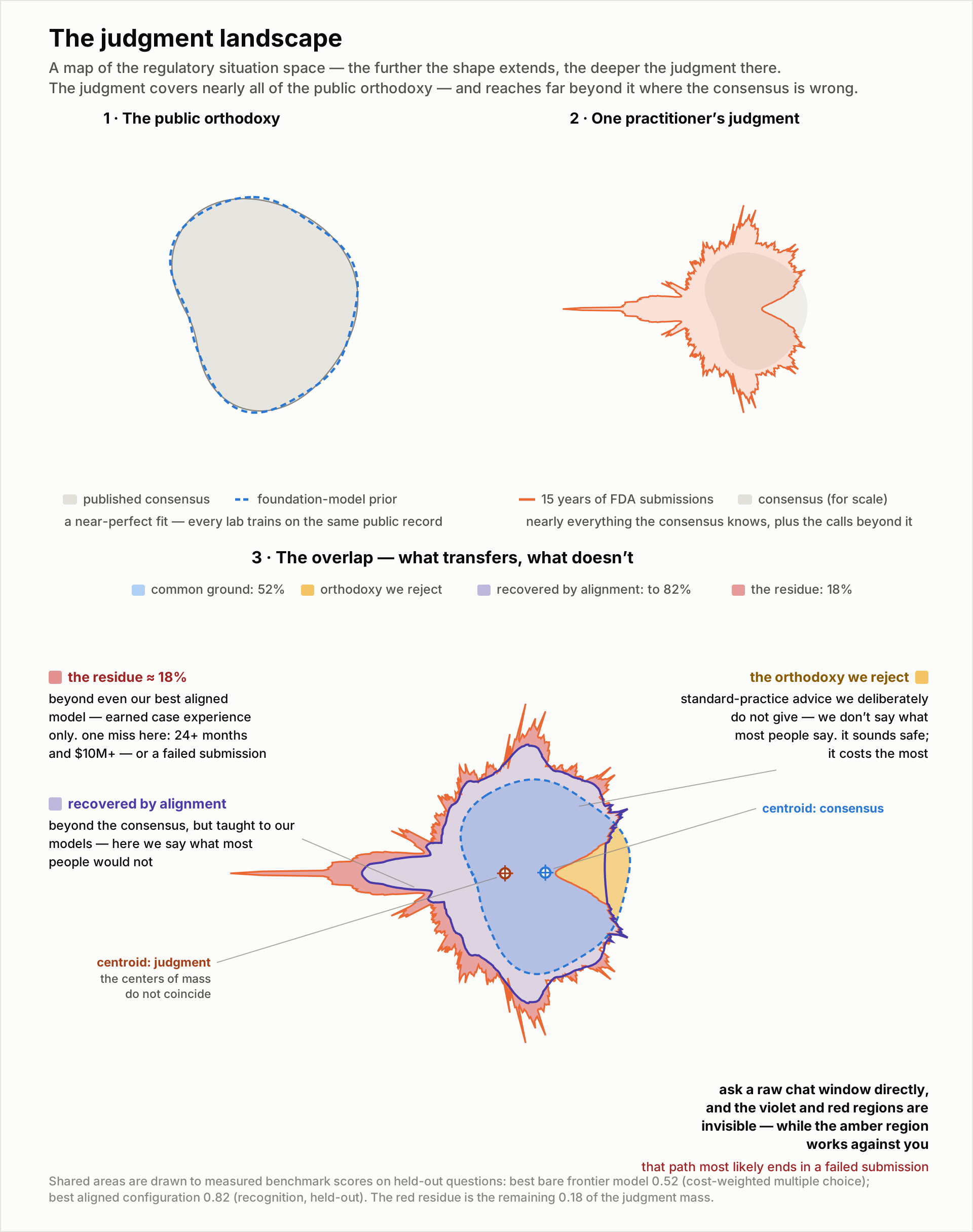
Here is the same finding as geometry. Picture the space of regulatory situations as a map. The published consensus is one territory on that map, a smooth, learnable shape, and a foundation model traces it almost perfectly; that is what pre-training on the public record buys you. Our answer key is a different kind of object, and we have drawn it the way its edge actually behaves: like the Mandelbrot set. It covers nearly everything the consensus knows, then extends past it into a boundary that is infinitely detailed, zoom into any stretch of it and it never becomes simple. That is the deep reason the models plateau: pre-training and alignment can fit the smooth manifold, but real judgment has no smooth manifold to fit.

<figure>
  <img src="/img/articles/Can_AI_Replace_a_Consultant_We_Built_a_1200-Question_Benchmark_to_Find_Out.-74fed500c7614b5f89bcab66bc91fdd2.svg">
  <figcaption>
    The judgment landscape, a map of regulatory situation space; the further
    a shape extends, the deeper the judgment there. Foundation models trace
    the published consensus almost perfectly (1): pre-training captures the
    smooth manifold. One practitioner's judgment is a different kind of
    object, drawn here as the Mandelbrot set, because that is how its edge
    behaves: covers nearly everything the consensus knows, then extends into
    an infinitely detailed boundary that never simplifies no matter how far
    you zoom in (2). No smooth manifold can be laid over it. The overlay (3)
    splits into four territories, drawn to measured benchmark scores on
    held-out questions: blue common ground (52%, the bare-model baseline);
    amber orthodoxy we reject, standard-practice advice we deliberately
    don't give; violet recovered by alignment, beyond-consensus calls our
    tuned models have learned (to 82%); and the red residue (18%), beyond
    even our best aligned model, where one miss costs 24+ months and $10M+,
    or a failed submission. Ask a raw chat window and the violet and red
    regions are invisible while the amber region works against you, that
    path most likely ends in a failed submission.
  </figcaption>
</figure>

Read the overlay as four territories. The blue core is common ground, about half the judgment, which is exactly where the raw models overlap well. The amber sliver is the orthodoxy we reject: advice the standard consulting playbook would give that we deliberately do not, because the safe-sounding answer is the one that burns months of time and runway. The violet band is what alignment recovers: positions beyond the consensus that we have taught our models to take, lifting coverage to 82%. The red fringe is the residue, the 18% no prior reaches, where a single miss costs 24+ months and \$10M+, or the submission itself. Now trace the two ways people actually use AI. Paste your question into a raw chat window and the violet and red regions are invisible to you, while the amber region is actively steering you wrong; that path most likely ends in a failed submission. Run our best aligned system, the strongest configuration we know how to build, and you still face the red fringe. That fringe is why a human who has sat across from FDA reviews every call, and it is what the rest of this article is about.

### Right together, wrong together

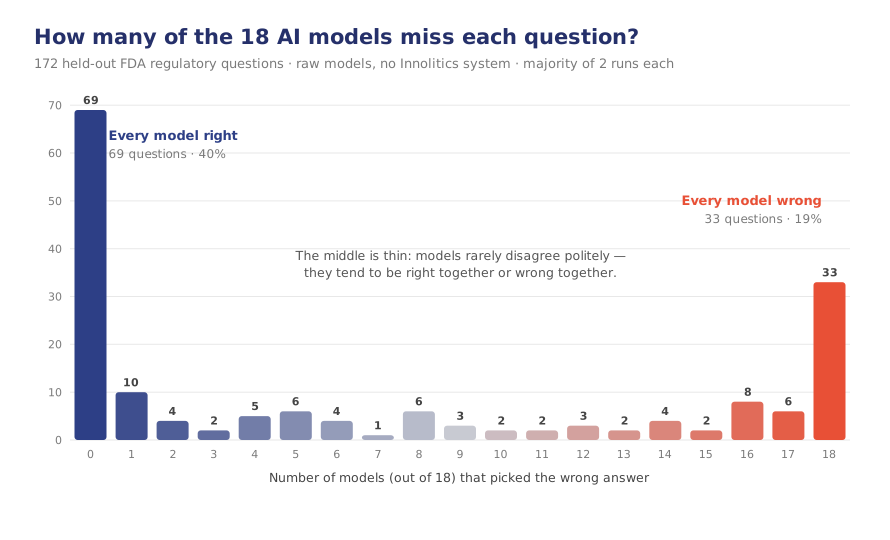
The leaderboard compresses each model to one number, and that number hides an interesting question: are the 18 models missing the same questions, or different ones? If each model failed in its own idiosyncratic way, you could stack them like independent witnesses and vote your way to near-perfect accuracy. So we lined up all 18 raw models against each of the 172 held-out questions and counted, question by question, how many picked the wrong answer.

<figure>
  <img src="/img/articles/Can_AI_Replace_a_Consultant_We_Built_a_1200-Question_Benchmark_to_Find_Out.-7806d80e498c4f30bcc8e561fbc6e760.svg">
  <figcaption>
    For each of the 172 held-out questions: how many of the 18 raw models
    picked the wrong answer. A model counts as missing a question when it
    answers wrong in the majority of its two runs, and models are scored
    only on questions they answered.
  </figcaption>
</figure>

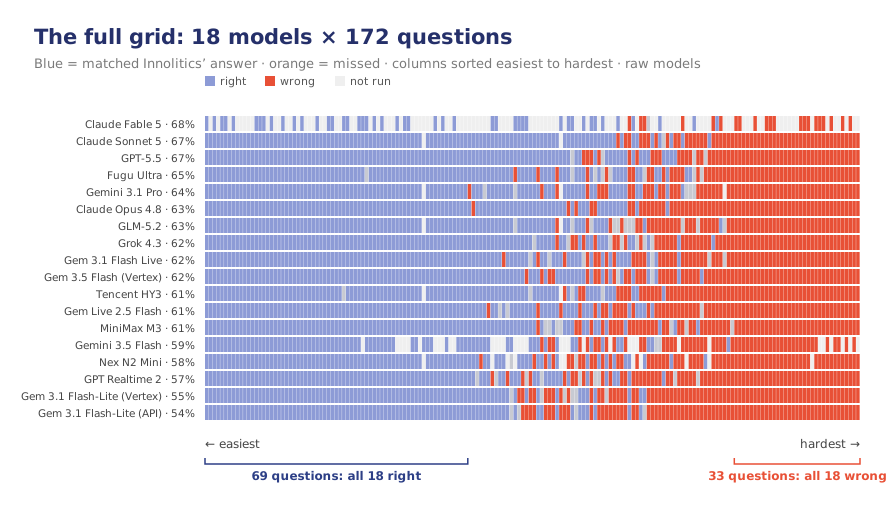
On 69 questions, 40 percent of the set, every single model matches our answer. On 33 questions every single model gets it wrong. The grid below shows the same data at single-cell resolution, every model against every question.

<figure>
  <img src="/img/articles/Can_AI_Replace_a_Consultant_We_Built_a_1200-Question_Benchmark_to_Find_Out.-eeb41dfbe0364d8f88b7347de2481bd2.svg">
  <figcaption>
    The full grid: one row per model, sorted by accuracy; one column per
    question, sorted easiest to hardest. Blue = matched Innolitics' answer,
    orange = missed, light gray = not run (Claude Fable 5 ran half the
    held-out set; a few models hit provider errors on scattered questions).
  </figcaption>
</figure>

That kills the most tempting workaround: the committee. Put all 18 models to a vote and the committee scores 65 percent, worse than the best single model, because the models share their wrong answers. And even a perfect referee who could somehow recognize the right answer whenever any of the 18 produced it would top out at 80 percent, because on one question in five, no model produces it at all. The remaining fifth is not a capability gap the next model release will close. Each new model is another copy of the industry-average answer, and the industry-average answer is not optimal.

### What a single wrong answer costs

These are not trivia questions. For every wrong option in the benchmark we estimate two numbers: calendar months of delay, and full-time-equivalent months of labor a team would burn following that answer instead of ours. The expensive misses run **9 to 18 months and 10 to 20 FTE-months**: a whole clinical study bought that FDA never asked for, a hardware testing burden a boundary decision would have avoided, a reader study volunteered upfront that should have been a negotiating concession. At loaded consulting and engineering rates, a single one of these misses is a seven-figure event.

Below are five questions from the benchmark, published here in full. We selected them for two properties: nearly every frontier model gets them wrong raw (collectively the models went **2 for 151** on these five), and the wrong answer is expensive. Read the options before the verdict. Better, paste each one into the model your team already uses and see what comes back. The wrong answers do not sound wrong. That is the scary part.

#### 1. What is the fallback if FDA rejects our diagnostic cut points?

*The team anticipates FDA may object to diagnostic threshold cut points on the device\'s outputs without a large evidence burden. A competitor removed hard cut points and displayed a continuous colored scale, which kept the product from being regulated as a medical device. The team is weighing this as a contingency.*

**A.** Keep the diagnostic cut points and invest in the clinical validation studies FDA requires, submitting the full evidence package through the standard clearance pathway to support your thresholds.

**B.** Retain the cut points but reframe them as wellness or lifestyle guidance rather than diagnostic thresholds, relying on the general wellness policy to avoid device classification entirely.

**C.** Request a pre-submission meeting with FDA to negotiate an acceptable evidence standard for your thresholds, then adjust the cut points to whatever levels the agency indicates it supports.

**D.** If FDA rejects the cut points, drop them entirely and present only the measured value on a continuous scale, potentially making it a non device.

<details class="[&_svg.faq-plus-icon]:open:translate-y-[calc(100%+10px)] [&_svg.faq-plus-icon]:open:opacity-0 [&_svg.faq-minus-icon]:open:translate-y-0 [&_svg.faq-minus-icon]:open:opacity-100 bg-white my-4 py-4 px-3 sm:px-6 rounded border-solid border border-gray"><summary class="flex items-center list-none cursor-pointer [&::-webkit-details-marker]:hidden not-prose"><span class="relative text-center text-xl text-white font-medium mr-4 mt-0 w-[28px] h-[28px] shrink-0 flex justify-center items-center overflow-hidden rounded-full bg-secondary"><svg class="faq-plus-icon absolute transition block w-[12px] h-[12px] fill-inherit" viewBox="0 0 14 14"><path fill-rule="evenodd" clip-rule="evenodd" d="M7 0C7.55228 0 8 0.447715 8 1V6H13C13.5523 6 14 6.44772 14 7C14 7.55228 13.5523 8 13 8H8V13C8 13.5523 7.55228 14 7 14C6.44771 14 6 13.5523 6 13V8H1C0.447715 8 0 7.55228 0 7C0 6.44772 0.447715 6 1 6H6V1C6 0.447715 6.44772 0 7 0Z" fill="currentColor"></path></svg><svg xmlns="http://www.w3.org/2000/svg" class="faq-minus-icon absolute transition block w-[12px] h-auto fill-inherit translate-y-[calc(-100%-10px)] opacity-0" viewBox="0 0 24 24" stroke-width="4" stroke="currentColor" fill="none" stroke-linecap="round" stroke-linejoin="round"><path d="M0 0h24v24H0z" stroke="none"/><path d="M5 12h14"/></svg></span><h3 class="text-heading m-0"><strong>Reveal answer and what the AI models did</strong></h3></summary><div class="mr-2 mt-6 [&_ul]:list-image-[url(/img/icons/ul-img.png)]"><p><strong>My call: D.</strong> If FDA rejects the cut points, drop them
entirely and present only the measured value on a continuous scale,
potentially making it a non device. </p>
<p>Models overwhelmingly picked <strong>A</strong>: fund the studies.
That answer buys the entire clinical evidence burden the fallback exists
to avoid: <strong>est. 12–18 months, ~20 FTE-months</strong>. The
winning move is standing in a different place on the regulatory map, not
paying the toll where you already stand. Only 2 of 30 model after
alignment got this right.</p>
</div></details>

#### 2. Should a combined hardware/software product be structured as software-only for FDA?

*A client pairs a physical capture device with AI software and asks whether both must be cleared. The team is weighing hardware testing burden against a software-centric path.*

**A.** Establish a defensible boundary that classifies the offering as Software as a Medical Device, situating the regulated function in the software to sidestep electrical safety and hardware testing obligations.

**B.** Submit the offering as a combined device, since the AI depends on your specific capture hardware whose performance directly affects clinical safety, making hardware testing unavoidable within your overall regulatory strategy.

**C.** Redesign the software to be fully hardware-agnostic and then validate it across multiple third-party capture devices, subsequently pursuing the software-only pathway on that independent, device-neutral basis.

**D.** Split the product into two entirely separate submissions, clearing the capture hardware as a standalone device and the software independently, then market them together commercially.

<details class="[&_svg.faq-plus-icon]:open:translate-y-[calc(100%+10px)] [&_svg.faq-plus-icon]:open:opacity-0 [&_svg.faq-minus-icon]:open:translate-y-0 [&_svg.faq-minus-icon]:open:opacity-100 bg-white my-4 py-4 px-3 sm:px-6 rounded border-solid border border-gray"><summary class="flex items-center list-none cursor-pointer [&::-webkit-details-marker]:hidden not-prose"><span class="relative text-center text-xl text-white font-medium mr-4 mt-0 w-[28px] h-[28px] shrink-0 flex justify-center items-center overflow-hidden rounded-full bg-secondary"><svg class="faq-plus-icon absolute transition block w-[12px] h-[12px] fill-inherit" viewBox="0 0 14 14"><path fill-rule="evenodd" clip-rule="evenodd" d="M7 0C7.55228 0 8 0.447715 8 1V6H13C13.5523 6 14 6.44772 14 7C14 7.55228 13.5523 8 13 8H8V13C8 13.5523 7.55228 14 7 14C6.44771 14 6 13.5523 6 13V8H1C0.447715 8 0 7.55228 0 7C0 6.44772 0.447715 6 1 6H6V1C6 0.447715 6.44772 0 7 0Z" fill="currentColor"></path></svg><svg xmlns="http://www.w3.org/2000/svg" class="faq-minus-icon absolute transition block w-[12px] h-auto fill-inherit translate-y-[calc(-100%-10px)] opacity-0" viewBox="0 0 24 24" stroke-width="4" stroke="currentColor" fill="none" stroke-linecap="round" stroke-linejoin="round"><path d="M0 0h24v24H0z" stroke="none"/><path d="M5 12h14"/></svg></span><h3 class="text-heading m-0"><strong>Reveal answer and what the AI models did</strong></h3></summary><div class="mr-2 mt-6 [&_ul]:list-image-[url(/img/icons/ul-img.png)]"><p><strong>My call: A.</strong> Establish a defensible boundary that
classifies the offering as Software as a Medical Device, situating the
regulated function in the software to sidestep electrical safety and
hardware testing obligations.</p>
<p>Models picked <strong>B</strong>: clear everything. IEC 60601
electrical safety, EMC testing, hardware V&amp;V: <strong>est. 6–12
months, ~10 FTE-months</strong>, all avoidable with a boundary decision
made on day one. 0 of 35 model runs got this right.</p>
</div></details>

#### 3. How large should a multi-algorithm validation test set be for submission?

*A medical imaging AI team is assembling a shared external validation set from unique institutions to evaluate multiple quantitative algorithms at once. They are unsure whether roughly a few hundred cases is enough or whether they should over-collect up front, before annotation begins.*

**A.** Over-collect 500 to 1,000-plus diverse cases upfront to preserve statistical power across every indication, subgroup, scanner, and demographic once the multiple-testing penalty shrinks your effective per-algorithm sample size.

**B.** Start with about 250 unique-institution cases, which is likely sufficient based on precedent.

**C.** Skip fixed case counts and size the set from a pre-specified statistical plan targeting the most demanding claim: rarest finding, tightest equivalence margin, and required confidence-interval width across all algorithms.

**D.** Power the set to the worst-case subgroup and over-collect at least 1,000 cases before annotation, since augmenting a locked validation set after seeing results compromises the independence FDA requires.

<details class="[&_svg.faq-plus-icon]:open:translate-y-[calc(100%+10px)] [&_svg.faq-plus-icon]:open:opacity-0 [&_svg.faq-minus-icon]:open:translate-y-0 [&_svg.faq-minus-icon]:open:opacity-100 bg-white my-4 py-4 px-3 sm:px-6 rounded border-solid border border-gray"><summary class="flex items-center list-none cursor-pointer [&::-webkit-details-marker]:hidden not-prose"><span class="relative text-center text-xl text-white font-medium mr-4 mt-0 w-[28px] h-[28px] shrink-0 flex justify-center items-center overflow-hidden rounded-full bg-secondary"><svg class="faq-plus-icon absolute transition block w-[12px] h-[12px] fill-inherit" viewBox="0 0 14 14"><path fill-rule="evenodd" clip-rule="evenodd" d="M7 0C7.55228 0 8 0.447715 8 1V6H13C13.5523 6 14 6.44772 14 7C14 7.55228 13.5523 8 13 8H8V13C8 13.5523 7.55228 14 7 14C6.44771 14 6 13.5523 6 13V8H1C0.447715 8 0 7.55228 0 7C0 6.44772 0.447715 6 1 6H6V1C6 0.447715 6.44772 0 7 0Z" fill="currentColor"></path></svg><svg xmlns="http://www.w3.org/2000/svg" class="faq-minus-icon absolute transition block w-[12px] h-auto fill-inherit translate-y-[calc(-100%-10px)] opacity-0" viewBox="0 0 24 24" stroke-width="4" stroke="currentColor" fill="none" stroke-linecap="round" stroke-linejoin="round"><path d="M0 0h24v24H0z" stroke="none"/><path d="M5 12h14"/></svg></span><h3 class="text-heading m-0"><strong>Reveal answer and what the AI models did</strong></h3></summary><div class="mr-2 mt-6 [&_ul]:list-image-[url(/img/icons/ul-img.png)]"><p><strong>My call: B.</strong> Start with about 250 unique-institution
cases, which is likely sufficient based on precedent.</p>
<p>Models overwhelmingly picked <strong>C</strong>: derive the number
from a statistical plan sized to the most demanding claim. It sounds
unimpeachable. It also front-loads <strong>est. 4–8 months and ~5
FTE-months</strong> of collection and annotation before anyone knows
whether the extra cases were needed, and the over-collect options run to
6–9 months. The judgment call is an asymmetry the models miss: cleared
precedent shows a few hundred cases is usually enough, and adding cases
later is cheap, while over-collecting up front is expense you never
recover. Start lean, expand only if asked. 0 of 24.</p>
</div></details>

#### 4. Do validation readers for a simple data-extraction step need to be licensed clinicians?

*A client validated an automated LLM based data-extraction step in their device using medical students and graduate-level analysts; pre-sub feedback objected that they weren\'t licensed clinicians. The team believes checking whether the extraction is correct requires no medical expertise, but worries FDA will insist.*

**A.** Submit as-is with technician-level readers; extraction-checking requires no clinical expertise, and the pre-sub objection likely reflected unread material, so comply with clinician panels only if FDA explicitly insists.

**B.** Redo the validation using licensed specialists to establish clinical ground truth, since FDA judges clinical software against clinician authority and submitting as-is risks rejection and a major deficiency letter.

**C.** Redo the validation with licensed clinicians who can catch subtle contextual errors; treat the pre-sub feedback as definitive FDA expectation and align now.

**D.** Request a follow-up meeting with FDA to clarify reader qualifications, presenting task error-rate data and negotiating acceptable reader competency before committing to any revalidation.

<details class="[&_svg.faq-plus-icon]:open:translate-y-[calc(100%+10px)] [&_svg.faq-plus-icon]:open:opacity-0 [&_svg.faq-minus-icon]:open:translate-y-0 [&_svg.faq-minus-icon]:open:opacity-100 bg-white my-4 py-4 px-3 sm:px-6 rounded border-solid border border-gray"><summary class="flex items-center list-none cursor-pointer [&::-webkit-details-marker]:hidden not-prose"><span class="relative text-center text-xl text-white font-medium mr-4 mt-0 w-[28px] h-[28px] shrink-0 flex justify-center items-center overflow-hidden rounded-full bg-secondary"><svg class="faq-plus-icon absolute transition block w-[12px] h-[12px] fill-inherit" viewBox="0 0 14 14"><path fill-rule="evenodd" clip-rule="evenodd" d="M7 0C7.55228 0 8 0.447715 8 1V6H13C13.5523 6 14 6.44772 14 7C14 7.55228 13.5523 8 13 8H8V13C8 13.5523 7.55228 14 7 14C6.44771 14 6 13.5523 6 13V8H1C0.447715 8 0 7.55228 0 7C0 6.44772 0.447715 6 1 6H6V1C6 0.447715 6.44772 0 7 0Z" fill="currentColor"></path></svg><svg xmlns="http://www.w3.org/2000/svg" class="faq-minus-icon absolute transition block w-[12px] h-auto fill-inherit translate-y-[calc(-100%-10px)] opacity-0" viewBox="0 0 24 24" stroke-width="4" stroke="currentColor" fill="none" stroke-linecap="round" stroke-linejoin="round"><path d="M0 0h24v24H0z" stroke="none"/><path d="M5 12h14"/></svg></span><h3 class="text-heading m-0"><strong>Reveal answer and what the AI models did</strong></h3></summary><div class="mr-2 mt-6 [&_ul]:list-image-[url(/img/icons/ul-img.png)]"><p><strong>My call: A.</strong> Submit as-is with technician-level
readers; extraction-checking requires no clinical expertise, and the
pre-sub objection likely reflected unread material, so comply with
clinician panels only if FDA explicitly insists.</p>
<p>Models split between <strong>D</strong> (ask FDA) and
<strong>C</strong> (redo everything). Both expensive: the redo is
<strong>est. 4–6 months and ~8 FTE-months</strong> of scarce clinician
hours spent on a reading task, and asking FDA a question whose likely
answer weakens your position is how you convert a soft objection into a
binding requirement. Match rater rigor to the true task. 0 of 36.</p>
</div></details>

#### 5. Do reader-study readers need to be board certified?

*A medical imaging AI client finalizing a reader study to support a breakthrough device designation for a CADe claim asks whether all participating readers must be board certified.*

**A.** Select readers qualified through relevant training, experience, and licensing to represent the device\'s intended users, which may include residents or non-certified practitioners depending on the clinical indication.

**B.** Ensure readers are appropriately qualified and representative of intended users, prospectively justifying any non-board-certified readers within the protocol and confirming acceptability through a Q-Submission whenever uncertain.

**C.** Require board certification only for the reference-standard readers who establish ground truth, while permitting board-eligible specialists without full certification to serve as participating readers.

**D.** Require every reader participating in the reader study to be board certified, as full board certification across all readers is necessary to support a defensible regulatory claim.

<details class="[&_svg.faq-plus-icon]:open:translate-y-[calc(100%+10px)] [&_svg.faq-plus-icon]:open:opacity-0 [&_svg.faq-minus-icon]:open:translate-y-0 [&_svg.faq-minus-icon]:open:opacity-100 bg-white my-4 py-4 px-3 sm:px-6 rounded border-solid border border-gray"><summary class="flex items-center list-none cursor-pointer [&::-webkit-details-marker]:hidden not-prose"><span class="relative text-center text-xl text-white font-medium mr-4 mt-0 w-[28px] h-[28px] shrink-0 flex justify-center items-center overflow-hidden rounded-full bg-secondary"><svg class="faq-plus-icon absolute transition block w-[12px] h-[12px] fill-inherit" viewBox="0 0 14 14"><path fill-rule="evenodd" clip-rule="evenodd" d="M7 0C7.55228 0 8 0.447715 8 1V6H13C13.5523 6 14 6.44772 14 7C14 7.55228 13.5523 8 13 8H8V13C8 13.5523 7.55228 14 7 14C6.44771 14 6 13.5523 6 13V8H1C0.447715 8 0 7.55228 0 7C0 6.44772 0.447715 6 1 6H6V1C6 0.447715 6.44772 0 7 0Z" fill="currentColor"></path></svg><svg xmlns="http://www.w3.org/2000/svg" class="faq-minus-icon absolute transition block w-[12px] h-auto fill-inherit translate-y-[calc(-100%-10px)] opacity-0" viewBox="0 0 24 24" stroke-width="4" stroke="currentColor" fill="none" stroke-linecap="round" stroke-linejoin="round"><path d="M0 0h24v24H0z" stroke="none"/><path d="M5 12h14"/></svg></span><h3 class="text-heading m-0"><strong>Reveal answer and what the AI models did</strong></h3></summary><div class="mr-2 mt-6 [&_ul]:list-image-[url(/img/icons/ul-img.png)]"><p><strong>My call: D.</strong> Require every reader participating in
the reader study to be board certified, as full board certification
across all readers is necessary to support a defensible regulatory
claim.</p>
<p>Models picked <strong>B</strong>, the flexible, guidance-flavored
answer. Note the direction of this miss: here the models were <em>too
aggressive</em> and we are the conservative ones. A breakthrough-claim
reader study challenged on reader qualifications is a partial redo:
<strong>est. 6–9 months, ~8 FTE-months</strong>. Judgment is not a
lean-in-all-directions dial. It is knowing which direction to lean on
which question. 0 of 26.</p>
</div></details>

### The three-nines problem

In a one-hour strategy call with a client, we typically field **ten or more** questions of exactly this kind: live, unrehearsed, each one a fork where the wrong branch costs months. A typical 510(k) engagement runs three months with up to three of those calls every week which amounts to **roughly 390 high-stakes judgment calls per engagement**.

Now compound the error rates. The best raw model on this benchmark answers about two-thirds of these questions correctly; its probability of completing one flawless engagement is 10^−68, which is zero for all purposes. A hypothetical 90%-accurate advisor, better than anything on the leaderboard, gets through 390 questions clean about once per 10^18 engagements. Even at 99.9% per question, one engagement in three can still contain at least one seven-figure mistake.

To have even coin-flip odds of a flawless engagement, the per-question accuracy has to be **99.8%**. To be 90% confident (the standard a client is actually paying for), it has to be **99.97%**. Three-plus nines, sustained across a quarter, on questions that arrive live and unrehearsed. That is the operating spec for this job, and it is what the failure math demands when each miss costs months of calendar and millions in labor. This level of fidelity does not exist in AI systems today and unlikely to materialize with the current transformer based technology.

And the cherry on top: the answer key moves. FDA guidance gets rewritten, draft guidances land, review programs open and close, precedent shifts with each new clearance: sometimes drastically, sometimes overnight, invalidating a whole block of previously correct answers at once. A model\'s weights are frozen at training time; the regulatory landscape is not. When the answers change, it is humans who notice first.

<div class="pl-3 border-solid border-0 border-l-4 border-gray" custom-style="Block Quote" markdown="1" role="blockquote">

The fractal edge of the judgment landscape is too sharp to encode in a context window, even a two-million-token one.

</div>

And we do not expect that to change soon. The pattern in our data is consistent: alignment systems transfer the parts of judgment that generalize: the standing positions, the negotiation posture, the burden-of-proof instincts. What does not transfer is the conditional structure underneath: *this* move, but only with *this* reviewer posture, *this* predicate landscape, *this* client risk appetite. Every case we handle adds another vertex to that edge. A model can be pressed toward the shape of the judgment (our own systems demonstrably do it), but the fine structure is earned case experience, and it generates faster than it can be encoded.

### How we actually use AI

None of this is an argument against AI. We are the opposite of AI skeptics. We run frontier models inside our practice every day, and this benchmark exists because we measure what we deploy.

It recalls the entire cleared-device record at once: every predicate, every special control, every acceptance criterion FDA has previously blessed. It assembles the precedent case for your submission with a thoroughness no human can match. It drafts, cross-references, and audits submission documents in hours instead of weeks. Used this way, AI makes our service **faster and higher quality**.

It does not make it cheaper. The benchmark run alone costs thousands of dollars in inference; our internal AI systems cost multiples of that to build, evaluate, and keep aligned. Anyone selling AI-powered regulatory consulting at a discount is telling you where they cut: the trained humans who catch the ten-per-hour judgment calls the model gets wrong. AI compresses the labor of recall and drafting. It does not compress the judgment, and the judgment is what makes or breaks submissions.