---
Publish Now: null
author:
- Yujan Shrestha
date: '2026-05-04'
description: For founders, CEOs, and CFOs at AI/ML medical device companies trying
to decide how much to spend on a 510(k). A meta-analysis of 35 post-IPO AI/ML SaMD
clearances shows \$51.2M of submission cost produced \$1.54B of attributable equity
within 14 trading days, a 30x cohort ROI, plus \$2.77B of incremental trading volume
and \$1.12B of post-clearance private financing. Treat regulatory as a profit center,
not a cost center, and budget the submission against what it earns.
related: []
title: How much will an FDA Clearance Cost?
topics:
- Regulatory
- AI/ML
---
Wrong question. The right question is: \"How much will an FDA clearance **earn**?\"
If you treat regulatory as a cost center, you'll delay it, chase risky loopholes, hire the cheapest consultant you can find, waste more time finding a cheaper one, and spend time comparing apples to pears. You will end up undercapitalizing the asset and set yourself up for failure. It is like putting a lowball job offer and wondering why it is taking so long to fill the role, and then getting angry at the applicant for going with a higher offer.
If you treat regulatory as a profit center you'll move fast, scope the indication for maximum strategic impact, hire the team that has shipped one before, and engineer the submission to win on the first try. It is like putting in a strong, competitive offer for the candidate you actually want. They accept fast, ramp up, and start shipping while the lowball hirers are still wondering why no one will return their calls. Could it have been done cheaper, or heck even for free? Sure. But you'll be waiting a long time while the market moves on.
That is the thesis. Now the proof.
## The Meta-Analysis
We pulled 35 major AI/ML Software as a Medical Device (SaMD) clearances from publicly traded companies, since the market reaction is observable and quantifiable. We tracked pre- and post-clearance market caps across three time windows. We applied a conservative attribution discount to separate the regulatory event from concurrent catalysts. Then we compared the resulting equity creation against the all-in cost of a submission.
The headline result: a combined submission cost of **\$51.2 million** produced **\$1.54 billion** in attributable equity value within 14 trading days, a **30.0x cohort ROI** (90 percent confidence interval 2.3x to 63.7x). Extend the window to 63 trading days and the cohort ROI grows to **40.9x**. The mechanism is not a single home run. It is a portfolio: 65 percent of clearances generated a net positive market-cap delta within three weeks, and the cohort total compounds across the wins and losses alike.
Clearances also unlock the liquidity required to actually realize those returns. Across the same 34 events, our cohort traded **\$2.77 billion of incremental dollar volume above baseline** in the +14 trading day windows. That is the trading tape founders, employees, and early investors need in order to exit positions, rebalance funds, or finance the next round.
### The Dataset
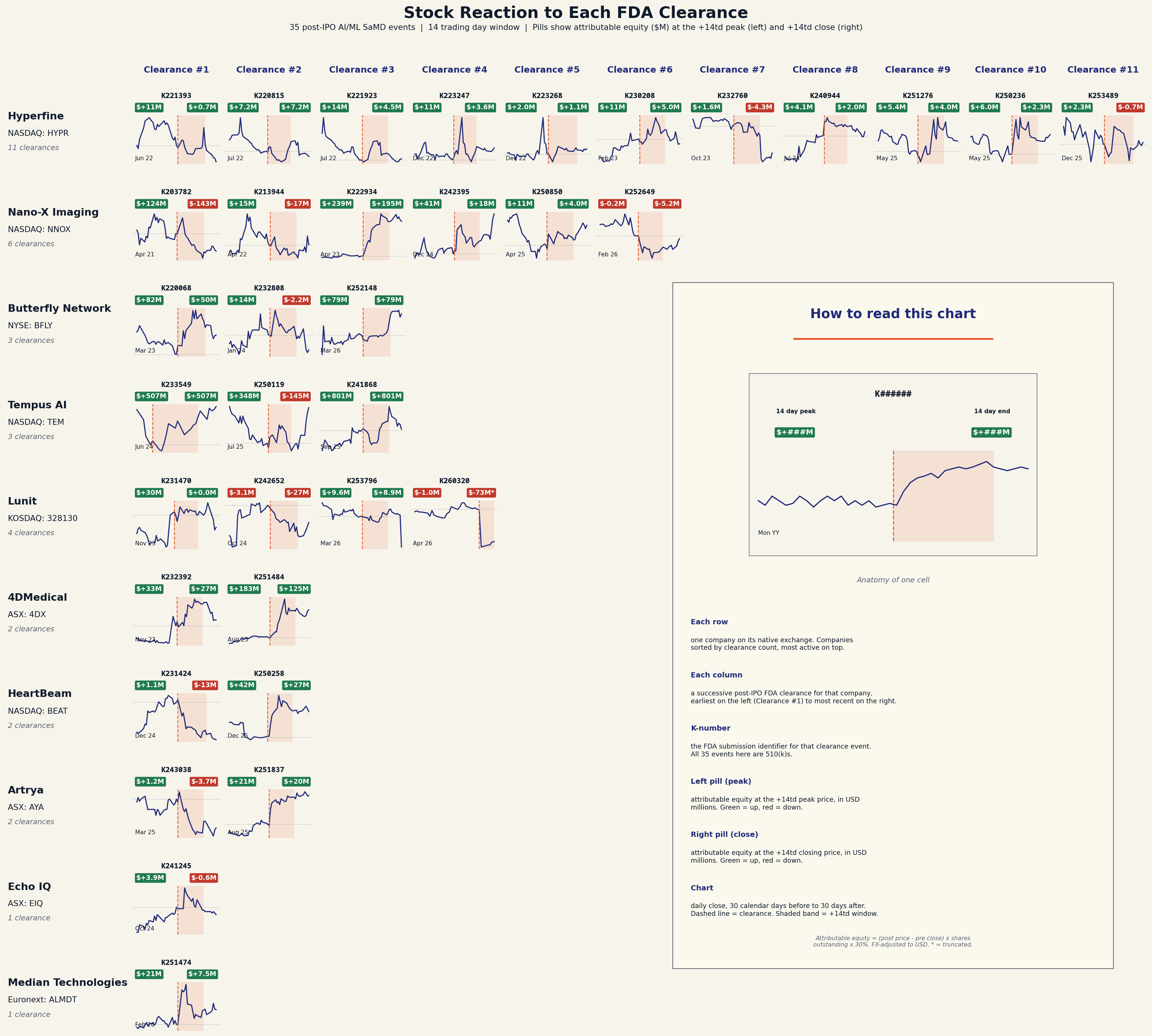
A visualization showing stock price movements centered on 510(k) and De
Novo announcements. Each column is a specific announcement. The badges
are 14 day peak and 14 day close market cap changes in millions of USD.
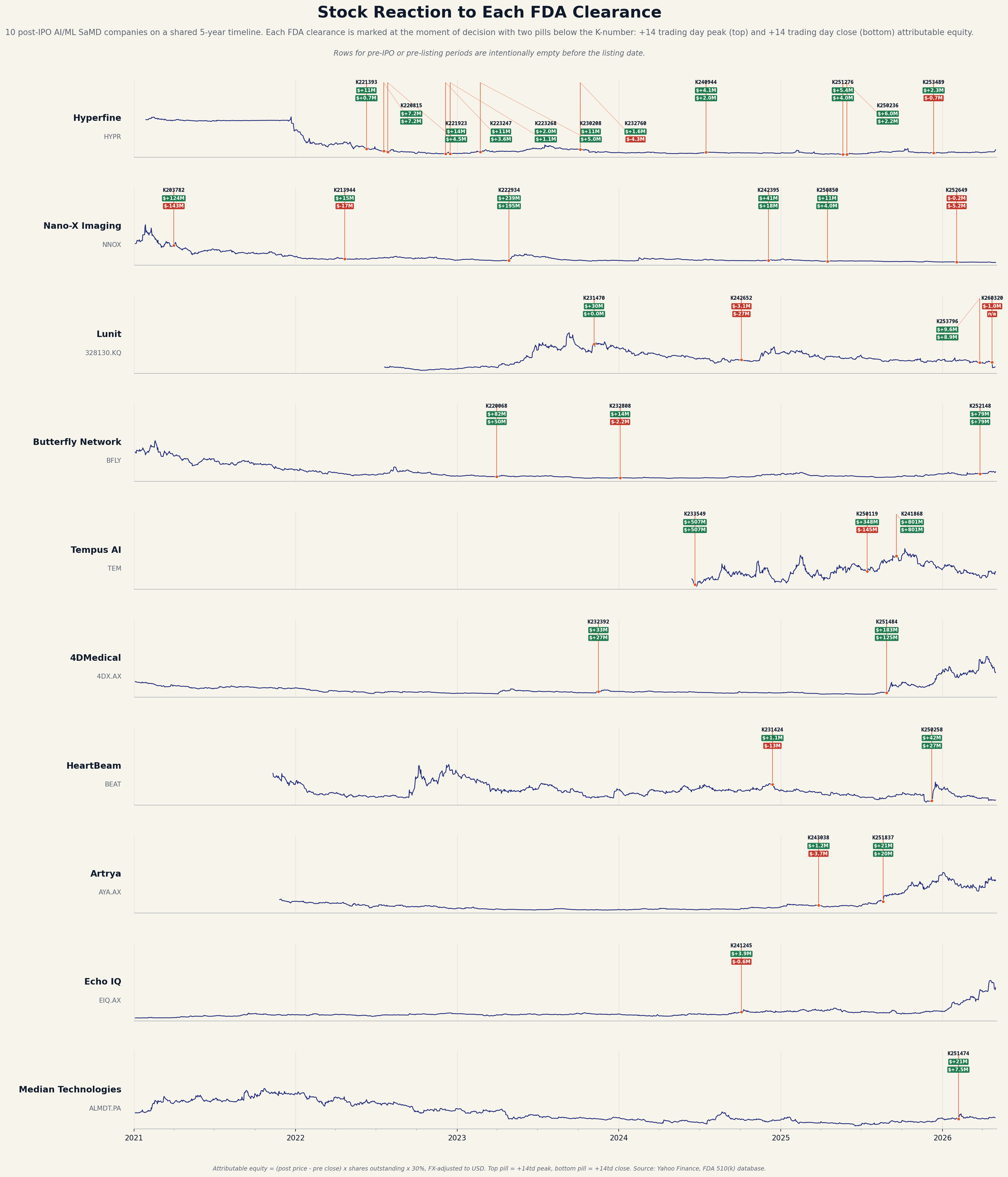
The same visualization but zoomed out to show the last 5 years for all
the companies together.
We analyzed 35 publicly disclosed regulatory events where the FDA decision date occurred after the company\'s IPO, ensuring the subsequent public market response was quantifiable. Stock prices move for many reasons, so we applied a uniform 30 percent attribution share to each event: if a company announced a clearance, we attributed only a fraction of the subsequent market-cap move to the clearance itself. The rest of the analysis works in raw dollars. Each event gets measured in \$M of attributable equity, and we aggregate wins and losses into a single cohort ROI: total dollars created divided by total dollars of submission cost.
| Company | Ticker | Post-IPO Clearances | Total Submission Cost | Total Attributable Equity (+14td) | Cohort ROI |
|-------------------------|-----------|---------------------|-----------------------|-----------------------------------|------------|
| **Tempus AI** | TEM | 3 | \$5.0M | \$1,163M | 233x |
| **Nano-X Imaging** | NNOX | 6 | \$9.9M | \$52M | 5.3x |
| **4DMedical** | 4DX.AX | 2 | \$3.3M | \$152M | 46x |
| **Butterfly Network** | BFLY | 3 | \$5.0M | \$127M | 25x |
| **Hyperfine** | HYPR | 11 | \$18.2M | \$26M | 1.4x |
| **HeartBeam** | BEAT | 2 | \$3.3M | \$14M | 4.2x |
| **Artrya** | AYA.AX | 2 | \$3.3M | \$16M | 5.0x |
| **Median Technologies** | ALMDT.PA | 1 | \$1.65M | \$7.5M | 4.5x |
| **Echo IQ** | EIQ.AX | 1 | \$1.65M | -\$0.6M | -0.4x |
| **Lunit** | 328130.KQ | 4 | \$4.95M | -\$18M | -3.6x |
*Costs are modeled at \$1.65M for Traditional 510(k)s, \$1.0M for Special 510(k)s, \$2.5M for De Novos, and \$5.0M for PMAs. Cohort ROI per company is total attributable equity at +14td divided by total submission cost.*
#### Per-event stock reaction
35 post-IPO AI/ML SaMD clearances. 14 trading day window. Cohort ROI: +14td peak 52.3x, +14td close 30.0x.
| \# | Company | Ticker | K-number | Type | Device | Decision | Pre | Peak | Peak Attrib \$M | Close Attrib \$M |
|-----|---------------------|--------|----------|-------------|------------------------------------------|------------|----------|----------|-----------------|------------------|
| 1 | Hyperfine | HYPR | K221393 | Special | Swoop Portable MR Imaging System | 2022-06-10 | \$2.20 | \$2.70 | +\$0.7M | +\$0.7M |
| 2 | Hyperfine | HYPR | K220815 | Traditional | BrainInsight | 2022-07-19 | \$1.57 | \$1.89 | +\$7.2M | +\$7.2M |
| 3 | Hyperfine | HYPR | K221923 | Special | Swoop Portable MR Imaging System | 2022-07-28 | \$1.28 | \$1.92 | +\$14M | +\$4.5M |
| 4 | Hyperfine | HYPR | K223247 | Special | Swoop Portable MR Imaging System | 2022-12-06 | \$0.73 | \$1.23 | +\$11M | +\$3.6M |
| 5 | Hyperfine | HYPR | K223268 | Traditional | BrainInsight | 2022-12-16 | \$0.80 | \$0.89 | +\$2.0M | +\$1.1M |
| 6 | Hyperfine | HYPR | K230208 | Special | Swoop Portable MR Imaging System | 2023-02-22 | \$1.38 | \$1.88 | +\$11M | +\$5.0M |
| 7 | Hyperfine | HYPR | K232760 | Special | Swoop Portable MR Imaging System | 2023-10-06 | \$1.90 | \$1.97 | +\$1.6M | -\$4.3M |
| 8 | Hyperfine | HYPR | K240944 | Special | Swoop Portable MR Imaging System | 2024-07-16 | \$1.06 | \$1.24 | +\$4.1M | +\$2.0M |
| 9 | Hyperfine | HYPR | K251276 | Special | Swoop Portable MR Imaging System | 2025-05-21 | \$0.62 | \$0.86 | +\$5.4M | +\$4.0M |
| 10 | Hyperfine | HYPR | K250236 | Traditional | Swoop Portable MR Imaging System | 2025-05-30 | \$0.60 | \$0.86 | +\$6.0M | +\$2.3M |
| 11 | Hyperfine | HYPR | K253489 | Special | Swoop Portable MR Imaging System | 2025-12-12 | \$1.00 | \$1.10 | +\$2.3M | -\$0.7M |
| 12 | Nano-X Imaging | NNOX | K203782 | Traditional | Nanox Cart X-ray System | 2021-04-01 | \$41.45 | \$48.55 | +\$124M | -\$143M |
| 13 | Nano-X Imaging | NNOX | K213944 | Traditional | HealthOST | 2022-04-22 | \$10.17 | \$11.03 | +\$15M | -\$17M |
| 14 | Nano-X Imaging | NNOX | K222934 | Traditional | Nanox.ARC | 2023-04-28 | \$6.13 | \$19.89 | +\$239M | +\$195M |
| 15 | Nano-X Imaging | NNOX | K242395 | Traditional | Nanox.ARC | 2024-12-04 | \$6.01 | \$8.38 | +\$41M | +\$18M |
| 16 | Nano-X Imaging | NNOX | K250850 | Traditional | Nanox.ARC X | 2025-05-16 | \$4.70 | \$5.32 | +\$11M | +\$4.0M |
| 17 | Nano-X Imaging | NNOX | K252649 | Traditional | TAP2D | 2026-02-02 | \$2.73 | \$2.72 | -\$0.2M | -\$5.2M |
| 18 | Butterfly Network | BFLY | K220068 | Traditional | Butterfly iQ/iQ+ Ultrasound System | 2023-03-31 | \$1.64 | \$2.82 | +\$82M | +\$50M |
| 19 | Butterfly Network | BFLY | K232888 | Traditional | Butterfly iQ3 Ultrasound System | 2024-01-04 | \$1.02 | \$1.22 | +\$14M | -\$2.2M |
| 20 | Butterfly Network | BFLY | K252148 | Traditional | Butterfly Gestational Age Tool | 2026-03-26 | \$4.15 | \$5.29 | +\$79M | +\$79M |
| 21 | Tempus AI | TEM | K233549 | Traditional | Tempus ECG-AF | 2024-06-21 | \$27.26 | \$37.50 | +\$507M | +\$507M |
| 22 | Tempus AI | TEM | K250119 | Traditional | Tempus ECG-Low EF | 2025-07-15 | \$57.82 | \$64.86 | +\$348M | -\$145M |
| 23 | Tempus AI | TEM | K241868 | Traditional | xR IVD | 2025-09-19 | \$87.07 | \$103.25 | +\$801M | +\$801M |
| 24 | Lunit | 328130 | K231470 | Traditional | Lunit INSIGHT DBT | 2023-11-06 | 90,300 | 96,600 | +\$30M | +\$0.0M |
| 25 | Lunit | 328130 | K242652 | Special | Lunit INSIGHT DBT v1.1 | 2024-10-04 | 43,650 | 43,000 | -\$3.1M | -\$27M |
| 26 | Lunit | 328130 | K253796 | Traditional | Lunit INSIGHT DBT (V1.2) | 2026-03-26 | 35,100 | 37,100 | +\$9.6M | +\$8.9M |
| 27 | Lunit | 328130 | K260320 | Special | Lunit INSIGHT MMG (v1.1.10) | 2026-04-23 | 35,950 | 35,750 | -\$1.0M | n/a |
| 28 | 4DMedical | 4DX | K232392 | Traditional | CT Lung Ventilation Analysis Software | 2023-11-16 | AUD 0.67 | AUD 1.00 | +\$33M | +\$27M |
| 29 | 4DMedical | 4DX | K251484 | Traditional | CT:VQ | 2025-08-28 | AUD 0.51 | AUD 2.31 | +\$183M | +\$125M |
| 30 | HeartBeam | BEAT | K231424 | Traditional | HeartBeam AIMIGo(TM) System | 2024-12-13 | \$3.05 | \$3.12 | +\$1.1M | -\$13M |
| 31 | HeartBeam | BEAT | K250258 | Traditional | HeartBeam AIMIGo with 12-L ECG synthesis | 2025-12-08 | \$0.73 | \$3.44 | +\$42M | +\$27M |
| 32 | Artrya | AYA | K243038 | Traditional | Salix Central | 2025-03-27 | AUD 0.82 | AUD 0.87 | +\$1.2M | -\$3.7M |
| 33 | Artrya | AYA | K251837 | Traditional | Salix Coronary Plaque (V1.0.0) | 2025-08-20 | AUD 1.34 | AUD 2.22 | +\$21M | +\$20M |
| 34 | Echo IQ | EIQ | K241245 | Traditional | EchoSolv AS | 2024-10-04 | AUD 0.25 | AUD 0.31 | +\$3.9M | -\$0.6M |
| 35 | Median Technologies | ALMDT | K251474 | Traditional | Median LCS | 2026-02-06 | EUR 4.30 | EUR 6.59 | +\$21M | +\$7.5M |
*Cohort total: 34 submissions. Cost: \$51.2M. Attributable equity at +14td peak: \$2.68B. Attributable equity at +14td close: \$1.54B. Net positive: 22/34 (65 percent). Attributable equity = (post-clearance price minus pre-clearance close) × shares outstanding × 30 percent attributable share. Pre and Peak shown in local currency; attributable equity in USD millions.*
## Three Windows of Value
Day one press releases are noise. Real revaluation takes weeks.
We measured the market cap delta across three horizons.
1. **The immediate pop (+1 trading day).** Only 37 percent of events were net positive on day one. The cohort total attributable equity was just **\$34M**, against \$51M of submission cost. **Cohort ROI: 0.7x.** Markets do not reprice a medical device company on a regulatory headline alone.
2. **The attribution window (+14 trading days).** Roughly three calendar weeks. The most defensible attribution horizon. Long enough for analysts to update their models, short enough to escape multi-quarter confounds. At this mark, 65 percent of events were net positive, with **\$1.54 billion** of attributable equity created across the cohort. **Cohort ROI: 30.0x** (90 percent CI 2.3x to 63.7x).
3. **The +3 month window (+63 trading days).** Roughly three calendar months. This shows whether the clearance translated into sustained commercial momentum. At this mark, 55 percent of events were net positive, with **\$2.10 billion** of attributable equity. **Cohort ROI: 40.9x.** The biggest contributors are the events where the clearance unlocked a sustained re-rating, not just a pop.

### Case study: Butterfly Network
Take Butterfly. On March 30, 2026, Butterfly announced FDA clearance for its Gestational Age tool.

The day before, Butterfly was worth roughly \$960 million. The day after, the stock was down 5.5 percent. Three weeks later, it had climbed to roughly \$1.22 billion. It pushed higher into late April, peaking near \$1.4 billion in market cap over the 63 day window.

Inside the strict 14 trading day attribution window, that is \$264.8 million of market cap appreciation. Attribute a conservative 30 percent of that to the clearance and you still get **\$79 million in attributable equity** off a single \$1.65 million submission. Before a single new unit ships under the new label, the submission has already paid for itself many times over.
## Wall Street Treats Clearances as Buy Signals
When Tempus AI secured 510(k) clearance for its updated Pixel cardiac imaging platform in September 2025, H.C. Wainwright raised its price target from \$90 to \$98, Buy reiterated, with the clearance named as the catalyst.

Two months later, BTIG analyst Mark Massaro raised his Tempus target from \$96 to \$105, pointing at Pixel and a follow-on ECG-Low ejection fraction clearance as the growth drivers.

The pattern holds sector wide. As HeartBeam approached FDA clearance for its 12-lead ECG synthesis software in late 2025, ROTH Capital initiated coverage with a Buy rating and a \$4 price target ahead of the anticipated FDA clearance. Roth/MKM followed with an \$8 target on the same regulatory progress.

For 4DMedical, the FDA 510(k) clearance for CT:VQ lung imaging plus CMS Category III reimbursement triggered a wave of upgrades. By late October 2025, the consensus 4DMedical price target had jumped 27 percent, going from A\$1.43 to A\$1.82 per share.

Even the giants get rerated. When GE HealthCare secured FDA clearance for its Photonova Spectra photon-counting CT system in March 2026, Stifel reiterated Buy and a \$98 target. The stock jumped 6.19 percent intraday on the note and the milestone.

For Hyperfine, B. Riley analyst Yuan Zhi reiterated Buy with a \$1 target in June 2025, anchored on the FDA 510(k) clearance for the Swoop next-generation system.

When William Blair initiated coverage on Butterfly Network, analyst Andrew Brackmann tied the Outperform thesis directly to the company\'s FDA-cleared portfolio, writing that the clearances expanded the uses and opportunities for its technology substantially.

Analysts don't treat regulatory affairs as a compliance checklist. They treat a clearance as a de-risking event that opens up the TAM and justifies a higher multiple, and they say it in print every time.
## Liquidity: The Hidden Half of the Return
Price tells you what the market thinks the company is worth. Volume tells you whether anyone can actually trade on that opinion. For founders, employees, board observers, and early investors, the ability to *exit* a position without crushing the price is just as valuable as the price itself.
FDA clearances do not just move the stock. They wake up the order book.
We ran the same event study against trading volume instead of price. For each of the 34 post-IPO clearances, we took average daily volume in the 30 trading days before the FDA decision as the baseline, and compared it to average daily volume in the +1, +14, and +63 trading day windows after.
The headline numbers, in absolute \$M of incremental dollar volume traded above the 30-day pre-event baseline:
| Window | Cohort total (\$M) | Per-event median (\$M) | Per-event mean (\$M) | Share of events with positive lift |
|----------------------|--------------------|------------------------|----------------------|------------------------------------|
| **+1 trading day** | -\$15M | -\$0.04M | -\$0.4M | 38% |
| **+14 trading days** | **+\$2,773M** | **+\$5.8M** | **+\$81.6M** | **68%** |
| **+63 trading days** | -\$8,310M | +\$5.3M | -\$244M | 59% |
The fourteen day window is the meaningful one. Day one is too short to clear the trade. The 63 day window is dominated by a small number of large-cap reversals (notably Tempus K250119, where a single post-clearance dump erased \$19 billion of dollar volume against baseline). What matters operationally is the three week post-clearance tape, and across the cohort that tape carries an extra **\$2.77 billion** of dollar volume above the pre-event run rate.

Two thirds of clearances open a positive liquidity window. The standout events open the door to nine and ten figure tapes.
#### Standout liquidity events
Ranked by absolute \$M of incremental dollar volume traded:
1. **Nano-X Imaging, April 2021.** First post-IPO clearance (K203782) opened **+\$1.55 billion** of incremental dollar volume above baseline. The IPO had only just placed the float; the FDA clearance announced the company to the institutional market.
2. **Nano-X Imaging, April 2023.** Clearance K222934 added **+\$1.33 billion** of incremental dollar volume. Pre-event \$3.2M daily dollar volume. Post-event roughly \$98M daily.
3. **HeartBeam, December 2025.** The 12-lead ECG synthesis 510(k) (K250258) added **+\$1.29 billion**. The clearance announcement was a liquidity event in its own right.
4. **4DMedical, August 2025.** CT:VQ clearance (K251484) added **+\$249 million** of incremental dollar volume, going from roughly A\$0.7M average daily dollar volume to A\$18.5M.
5. **Lunit, November 2023.** First clearance (K231470) added **+\$198 million** of incremental dollar volume on KOSDAQ.
## The Private Market Multiplier

Private markets are noisier and harder to chart. The relationship is even tighter. For private AI SaMD startups, an FDA clearance is often the literal gating milestone for the next round, or even the exit.
A few recent timelines:
1. **Aidoc\'s \$150M Series E.** January 2026: Aidoc secured a landmark FDA clearance for its CARES foundation model, covering 11 newly cleared indications. Three months later, in April 2026, Aidoc closed a \$150 million Series E led by Goldman Sachs Alternatives. Clearance proved the platform scaled. Capital followed.

2. **HeartFlow\'s \$1.54B IPO.** July 18, 2025: HeartFlow secured an updated FDA clearance for its Plaque Analysis platform. August 7, twenty days later: the company priced an upsized \$364 million IPO at a \$1.54 billion implied valuation. The stock surged 58 percent in its first two days.

3. **Caption Health\'s acquisition.** Caption secured a De Novo for AI-guided ultrasound in February 2020, an expedited follow-on in May 2020, and a \$53 million Series B immediately after. Three years later, GE HealthCare acquired the company and folded the cleared AI into its \$3 billion ultrasound business.

4. **Cleerly\'s \$106M Series C extension.** Cleerly built its foundation on multiple FDA-cleared cardiovascular AI products. December 2024: a \$106 million Series C extension led by Insight Partners, bringing total funding past \$500 million.

5. **Vista AI\'s \$29.5M Series B.** January 2026: \$29.5 million explicitly to build on its FDA-cleared and commercially available cardiac MRI platform. The clearance was the prerequisite, not the consequence.

1. **a2z Radiology AI\'s seed round.** December 2025: a Boston startup closed a \$4.5 million seed fresh off its first FDA clearance. The regulatory win was the catalyst that closed the round.

In private markets, a 510(k) is a rounding error against the round it unlocks. A \$1.65 million line item that gates a \$30 million Series B, or a \$150 million Series E, is the highest-leverage thing on your balance sheet.
## The ROI of a 510(k)
Reframe the budgeting conversation.
Leaders: stop asking your VP of Regulatory what a submission costs. Start asking yourself what it will earn.
We ran a bootstrap analysis (10,000 iterations) to put 90 percent confidence intervals around the cohort return profile across both market types.

For publicly traded companies, the cohort created **\$1.54 billion** of attributable equity within 14 trading days against **\$51 million** of submission cost. That is a **30.0x cohort ROI**, with a 90 percent confidence interval from 2.3x to 63.7x. Two thirds of all clearances generated net positive equity creation. The cohort sum compounds across both the wins and the losses, weighted by the actual market-cap response of each event rather than by an artificial ratio.
For privately held companies we deliberately do not report a single cohort ratio. Submission costs and round sizes are not symmetric across stages, and constructing a multiple of one over the other obscures the underlying signal. Instead, the absolute round sizes are the signal: across eight directly traceable post-clearance financings (Tempus pre-IPO C, HeartFlow Series E, Aidoc Series E, Cleerly Series C extension, Viz.ai Series D, Rad AI Series C, Caption Series B, Vista AI Series B), companies raised **\$1.12 billion of fresh capital** within 12 months of an FDA clearance. The median round was \$103 million. The smallest was \$30 million on a single 510(k). In private markets, the submission cost is a rounding error against the round it gates.
If you're building AI SaMD, don't optimize for the cheapest 510(k). Optimize for the fastest, strongest clearance you can credibly run. The cost of an FDA clearance is usually a drop in the bucket compared to the value it unlocks.
## Build and Clear with Innolitics
That last line is where most companies get stuck. They believe the math. They just don't know how to actually run the play. That is what we do.
Innolitics is a done-for-you AI SaMD shop with physicians, engineers, and regulatory consultants all in-house, all pointed at the same problem: get your AI enabled device to market on the fastest credible timeline without cutting corners on safety or efficacy. We've contributed to 60+ AI/ML FDA authorizations and built our own submission software so a process that usually drags out for a quarter compresses to a few weeks. For devices that qualify, our **Guaranteed 510(k) Clearance** program guarantees an FDA clearance if the device hits the acceptance criteria and evidence burden Innolitics believes FDA will require for clearance (or some of your money back). We can offer this because, unlike most firms, we have decades of combined clinical, engineering, and regulatory experience under one roof, fine-tuned templates, and custom-built submission software backing every project.
If your algorithm is done and the clearance matters more than anything else on your roadmap, let's put a date on your submission calendar.