---
AI Summary: "\\- Developed a cloud-based MRI QA tool to quantify geometric distortion\
\ in MRI images. \n- Utilized DICOM data management, fiducial localization, and\
\ registration algorithms. \n- Implemented a convolutional neural network for false\
\ positive rejection. \n- Created a user-friendly web application for automated\
\ analysis and reporting."
Anonymous: false
Assignee:
- J. David Giese
Last Edited Time: '2026-01-26T00:12:00+00:00'
case_study_510ks: []
client_logo:
- 18abd5b7-a754-80af-a1b6-ce2d76812460
client_name: CIRS (Now Sun Nuclear)
date: '2017-03-26'
featured: false
medical_panel: Radiation Oncology
name: We Built the Algorithms, Trained the ML, and Delivered a Cloud-Based MRI QA
Tool
services:
- 9dc4f55a-b5cb-419f-8bae-5e11d6b11fee
summary: We built the image processing, trained the neural network, and delivered
a cloud app. Fully automated.
tags:
- Image Processing
- Web-App
testimonials:
- a3ae7aa6-c2a5-4212-a133-ae1921d54e23
---
## Project Overview
MRI scanners introduce geometric distortion into their images. This distortion, which can be as much as several millimeters, is problematic when the image is being used for radiation therapy or precision neurosurgical planning.
CIRS builds several grid phantoms for geometric distortion characterization. We collaborated with CIRS's engineering team to design and develop software to characterize an MRI scanner's geometric distortion and track it over time.
Our role on the project involved:
- Uploading, parsing, and managing raw imaging (DICOM) data.
- Developing and validating a precise fiducial localization algorithm.
- Developing and validating a registration algorithm that performs well in the presence of distortion, noise, false positives, and false negatives.
- Designing, training, and validating a convolutional neural network (deep learning algorithm) to reject false positives. The performance of this stage ensures that the full process can be automated.
- Designing and developing a web application user interface and associated PDF reports.
Through out the project we worked closely with the CIRS engineering team.
We developed an open-source fast implementation of 3D natural neighbor interpolation for this project. You can [see the source code here](https://github.com/innolitics/natural-neighbor-interpolation).
## Screenshots
CIRS's 603A Phantom mimic's the tissue properties of a human head, but
contains a grid that can be used to characterize geometric distortion in
MRI scanners.
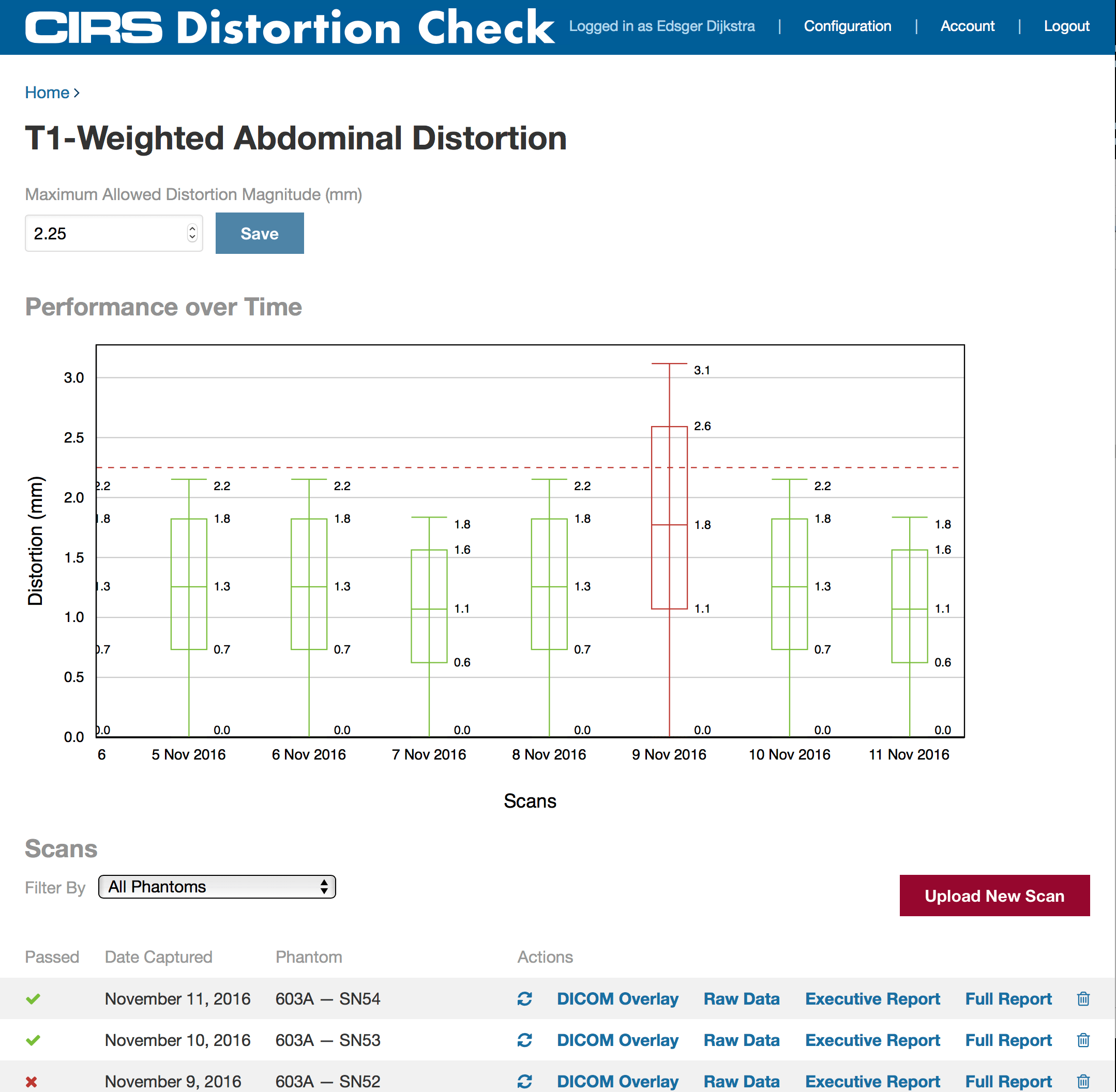
Screenshot of the software we developed, showing the maximum detected
geometric distortion, tracked over time.
Screenshot of the Detected and actual grid intersection fiducials
calculated by the algorithm we developed.
## About MRI Distortion Check
### **Automated Analysis of Distortion in MRgRT**
Used with MRI Grid phantoms, Distortion Check software quickly and automatically quantifies distortion in MRI images. Simply scan the phantom, upload images, review reports and trend analysis, and export DICOM overlays.
The software registers either a ground truth CAD or CT scan to the detected control points. An interpolation is then performed to generate the 3D distortion vector fields.
Results can be reported in a variety of output formats including scatter plots, contour plots, box and whisker plots for trending, and DICOM overlays that can be exported to third-party software.
### **Software Features**
- Quickly and automatically analyze complete MR data sets
- Density of control points optimized to bring interpolation close to linearity
- User-friendly cloud-based solution
- Detailed format in NEMA MS 12 standard recommendations
- Easily analyze and track multiple machines, imaging sequences and phantoms
- Establish distortion tolerance thresholds specific to different imaging sequences
[Read more on the company website →](https://www.sunnuclear.com/products/srs-mr-distortion-phantom)