
Executive Summary 🔗
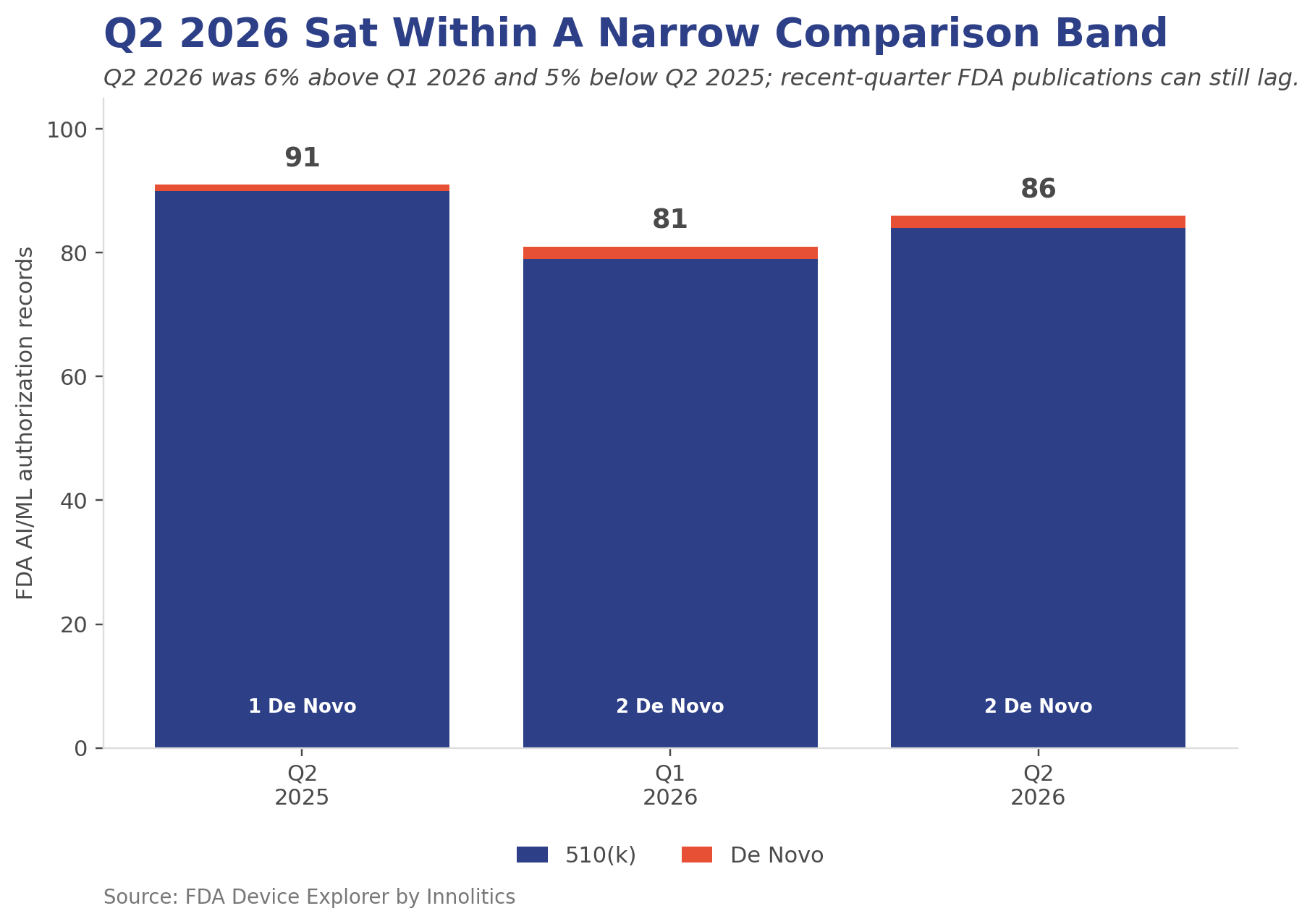
- FDA authorized 86 AI/ML devices in Q2 2026: 84 through 510(k) and two through De Novo.
- Authorization volume held steady. Q1 2026 produced 81 records; Q2 2025 produced 91.
- The 84 510(k)s are not the interesting number. The 12 Special 510(k)s are.
- Those Specials changed deployment architecture, model outputs, patient populations, acquisition workflows, and clinical integrations. First clearance was the starting line.
- Twelve records referenced PCCPs.
- The two De Novos created new categories for neurological classification and burn-wound assessment.
- Route selection changed runway: the observed median was 170.5 days for Traditional 510(k)s and 29 days for Specials. The two De Novos took 328 and 485 days.
86 Authorizations 🔗
FDA authorized 86 AI/ML devices in Q2 2026, five more than Q1 2026 and five fewer than Q2 2025. This was a steady quarter in a market operating at scale.
Radiology still led with 59 records, but FDA also authorized AI devices across cardiovascular, neurology, GI/urology, anesthesiology, orthopedics, dental, surgery, hematology, pathology, clinical chemistry, and microbiology. The market has moved well beyond chest X-ray triage and radiology quantification.
Two De Novos Created the Next Predicate Opportunities 🔗
Automated Imaging Diagnostics received DEN240071 for neuropacs, which classifies diffusion-MRI patterns associated with Parkinson's disease, multiple system atrophy Parkinsonian variant, and progressive supranuclear palsy. FDA bounded the claim tightly: the output supplements neurological assessment and other clinical tests, clinicians must rule out other causes of Parkinsonism, and the software cannot stand alone.
The special controls require diagnostic accuracy and reproducibility against a clinically relevant reference standard, along with software verification, validation, hazard analysis, and technical descriptions of model inputs and outputs. Future neurological classification devices now have a framework to inherit.
SpectralMD received DEN250028 for the DeepView AI System. It combines optical imaging with AI to identify deep burn tissue, predict regions unlikely to heal within 21 days with conservative treatment, and calculate wound area and percent total body surface area. FDA required standalone performance, sensitivity and specificity, segmentation accuracy, subgroup analysis, and evidence that users improve diagnostic characterization compared with unaided assessment.
The 12 Special 510(k)s Are the Story 🔗
Twelve Special 510(k)s show where AI device work moves after first clearance.
Aidoc shifted head CTA triage toward a Linux-based cloud environment. Lunit changed its mammography model and outputs. Imeka expanded diffusion-MRI analysis to adolescents. Dexcom added AI-generated glucose insights. DESKi, Sonio, Fujifilm, and Therapixel changed acquisition guidance, fetal-ultrasound workflow, PACS software, and mammography analysis.
Architecture. Outputs. Populations. Workflow.
I would not build an AI device roadmap around first clearance alone. These records show the harder operating model: preserve the intended use while the product, infrastructure, and clinical workflow keep changing.
PCCPs Are Product Architecture 🔗
Twelve authorizations referenced a PCCP. Eleven used the Traditional 510(k) pathway. Only DESKi's HeartFocus paired a PCCP with a Special 510(k) but upon closer examination they had already cleared the PCCP in the previous traditional 510(k).
Plan accordingly. A PCCP can define the authorized change envelope, but it does not turn a substantive submission into lightweight maintenance.
Set the model-update boundaries before verification closes. Define what can change, how performance will be tested, and which changes stay inside the authorized plan. Engineering, quality, and regulatory need one roadmap.
Route Selection Changes Runway 🔗
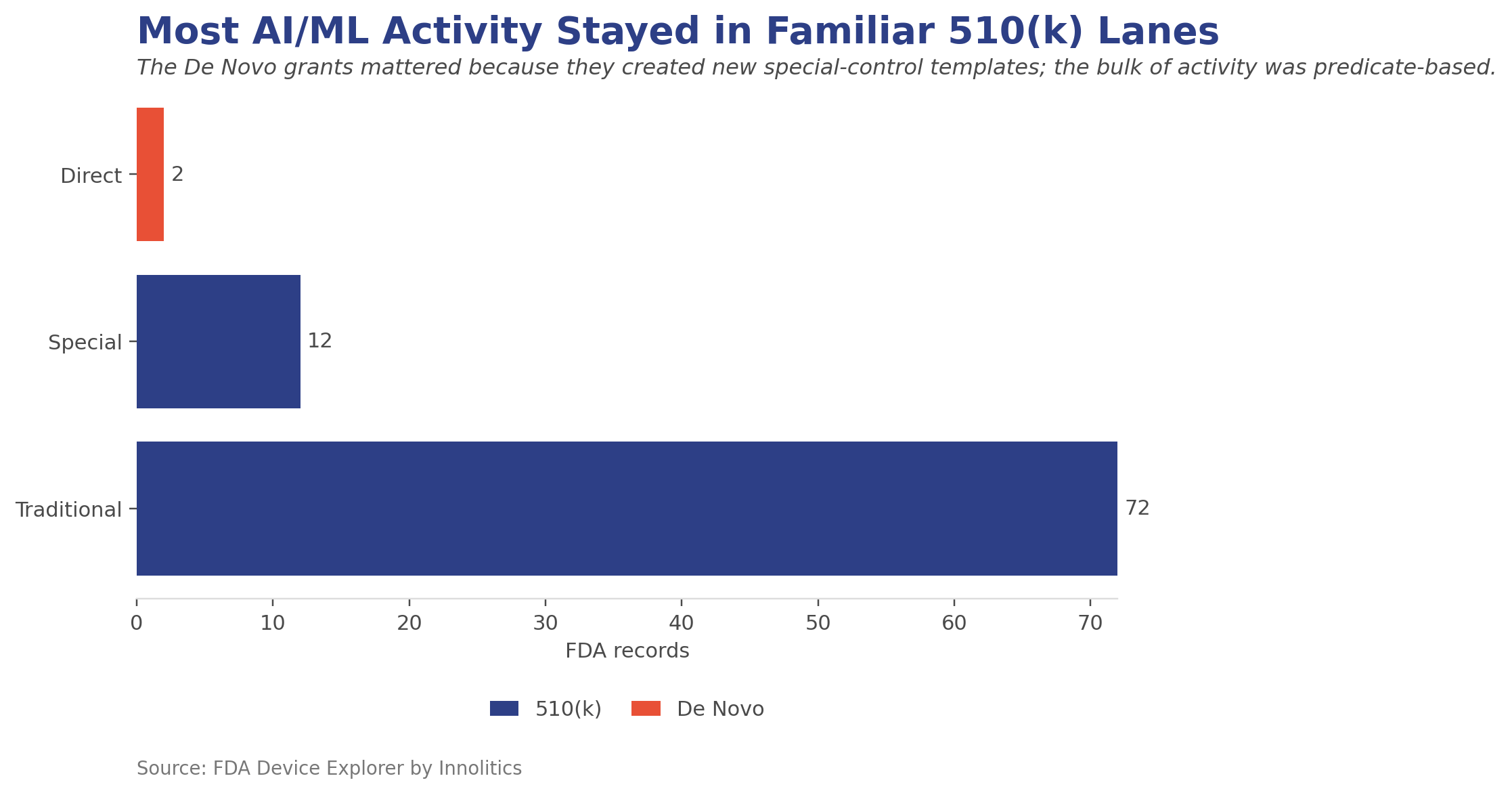
Traditional 510(k)s had a median received-to-decision interval of 170.5 days. Specials had a median of 29 days. The two De Novos took 328 and 485 days.
Those are observed intervals, not promises from FDA. The planning conclusion is firm: route assumptions change runway, launch sequencing, and fundraising milestones.
Choose the predicate, architecture, and release roadmap together. A commercial feature can become a new validation program with one scope decision.
Three Decisions for Leadership 🔗
Define the claim boundary before the architecture hardens. Both De Novos constrained who uses the output, what the output means, and how clinicians incorporate it. Narrow claims created new categories.
Design the lifecycle before first clearance. Put model updates, data sources, thresholds, population expansions, infrastructure changes, and workflow integrations on one roadmap. Decide which changes need a PCCP, a Special 510(k), or a new Traditional submission.
Fund the route you are actually taking. A 29-day observed median and a 170.5-day observed median produce different launch plans. A De Novo can consume more than a year between receipt and decision.
Stable authorization volume is the surface story. The competitive work has moved downstream: change control, evidence continuity, and the ability to improve a cleared product without losing the regulatory position that made it valuable.
Master Clearance Table 🔗
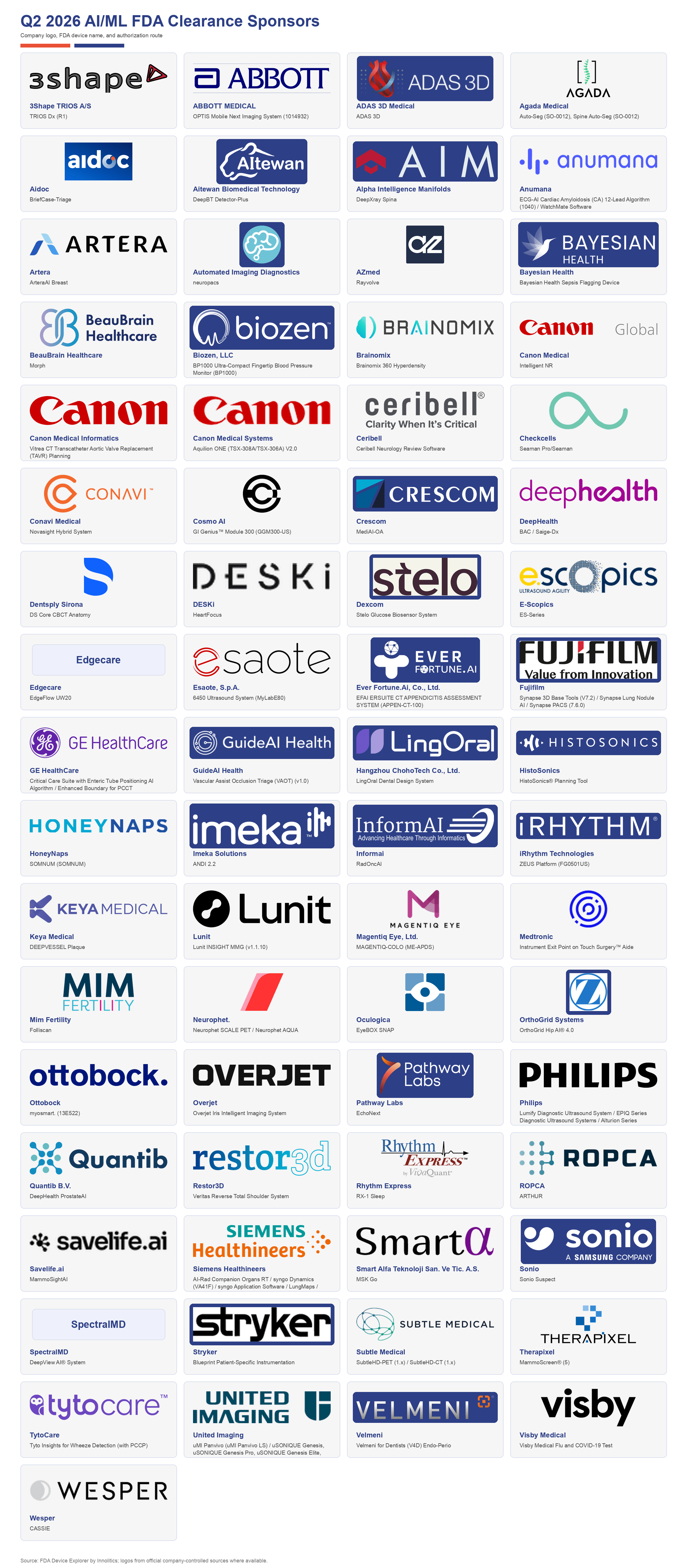
The table below includes all 86 AI/ML records returned by the refreshed FDA Device Explorer cohort query.
| Date | Device | Device Story | FDA ID | Route | Company | Panel | Code | SaMD | PCCP |
|---|---|---|---|---|---|---|---|---|---|
| 2026-04-03 | neuropacs | diffusion MRI data -> MSAp/PSP classification report -> neuroradiologists/neurologists differentiate Parkinsonian syndromes to guide clinical management | DEN240071 | De Novo | Automated Imaging Diagnostics | Neurology | SHO | Yes | No |
| 2026-04-03 | Blueprint Patient-Specific Instrumentation | DICOM CT scans -> 3D reconstruction, implant selection, and planning report -> surgeons perform precise shoulder arthroplasty/instability procedures | K253674 | 510(k) | Stryker | Orthopedics | PHX | Yes | No |
| 2026-04-03 | uMI Panvivo (uMI Panvivo LS) | PET radiopharmaceutical and CT attenuation data -> anatomical and functional PET/CT images -> physicians diagnose, stage, and plan radiotherapy | K260524 | 510(k) | United Imaging | Radiology | KPS | No | No |
| 2026-04-03 | MAGENTIQ-COLO (ME-APDS) | Colonoscopy video -> CADe polyp markers -> gastroenterologist targets lesion identification to improve mucosal detection rates | K260724 | 510(k) | Magentiq Eye, Ltd. | Gastroenterology / Urology | QNP | Yes | No |
| 2026-04-06 | 6450 Ultrasound System (MyLabE80) | T2-weighted MRI and B-Mode ultrasound -> prostate gland segmentation -> clinician reviews contours to guide biopsy procedures | K253288 | 510(k) | Esaote, S.p.A. | Radiology | IYN | No | No |
| 2026-04-07 | ECG-AI Cardiac Amyloidosis (CA) 12-Lead Algorithm (1040) | 12-lead ECG voltage time series -> binary cardiac amyloidosis classification -> clinician identifies patients requiring further diagnostic workup | K253801 | 510(k) | Anumana | Cardiovascular | SHP | Yes | Yes |
| 2026-04-09 | Seaman Pro/Seaman | semen sample video recordings -> quantitative sperm parameter report -> clinicians assess male fertility status | K252228 | 510(k) | Checkcells | Hematology | POV | No | No |
| 2026-04-10 | DeepBT Detector-Plus | T1W+C and T2W MRI images -> automated GTV segmentation -> clinicians review/modify contours for radiation therapy planning | K252190 | 510(k) | Aitewan Biomedical Technology | Radiology | QKB | Yes | No |
| 2026-04-10 | AI-Rad Companion Organs RT | DICOM CT/MR images -> automated anatomical and brain metastases segmentation -> radiation oncologists expedite treatment planning workflows | K252548 | 510(k) | Siemens Healthineers | Radiology | QKB | Yes | No |
| 2026-04-10 | syngo Dynamics (VA41F) | DICOM cardiac/vascular images -> AI-based quantification and view classification -> clinicians perform disease detection and patient management | K253689 | 510(k) | Siemens Healthineers | Radiology | QIH | Yes | Yes |
| 2026-04-10 | Overjet Iris Intelligent Imaging System | 2D dental radiographs -> automated image quality advisory indicators -> clinicians optimize diagnostic image capture to minimize patient retakes | K253930 | 510(k) | Overjet | Radiology | QIH | Yes | No |
| 2026-04-10 | TRIOS Dx (R1) | 3D intraoral scans -> caries, wear, recession, and plaque quantification -> clinicians enhance patient communication and diagnostic accuracy | K260082 | 510(k) | 3Shape TRIOS A/S | Dental | SHQ | Yes | No |
| 2026-04-14 | Critical Care Suite with Enteric Tube Positioning AI Algorithm | Frontal chest/abdominal X-ray images -> enteric tube/airway/diaphragm segmentation -> clinicians verify tube placement for patient safety | K253502 | 510(k) | GE HealthCare | Radiology | QIH | Yes | No |
| 2026-04-17 | EdgeFlow UW20 | B-mode/harmonic ultrasound images -> automated bladder segmentation and volume measurement -> clinicians monitor bladder status to reduce manual scanning | K252237 | 510(k) | Edgecare | Radiology | IYO | No | No |
| 2026-04-17 | Novasight Hybrid System | IVUS/OCT signals -> automated lumen/EEL/stent segmentation -> physician guides coronary interventions and assesses stent placement | K252945 | 510(k) | Conavi Medical | Cardiovascular | OBJ | No | Yes |
| 2026-04-20 | Folliscan | Transvaginal ultrasound cine-loops -> follicle count and size quantification -> clinician verifies results to standardize ovulation monitoring | K252332 | 510(k) | Mim Fertility | Radiology | QIH | Yes | No |
| 2026-04-22 | EFAI ERSUITE CT APPENDICITIS ASSESSMENT SYSTEM (APPEN-CT-100) | Contrast-enhanced abdominal CT images -> text-based appendicitis triage alert -> clinician prioritizes review for earlier suspected case assessment | K253163 | 510(k) | Ever Fortune.Ai, Co., Ltd. | Radiology | QAS | Yes | No |
| 2026-04-22 | myosmart. (13E522) | Surface myoelectric signals -> prosthetic movement classification -> clinician calibrates personalized control for intuitive upper limb prosthetic function. | K253256 | 510(k) | Ottobock | Neurology | GXY | No | No |
| 2026-04-23 | Lunit INSIGHT MMG (v1.1.10) | DICOM FFDM images -> CADe/x malignancy scores and heatmaps -> radiologist improves breast cancer detection accuracy | K260320 | 510(k) | Lunit | Radiology | QDQ | Yes | No |
| 2026-04-23 | DS Core CBCT Anatomy | CBCT and digital impression scans -> anatomical segmentation and registration -> dental professionals optimize diagnostic review and treatment planning | K260785 | 510(k) | Dentsply Sirona | Radiology | QIH | Yes | No |
| 2026-04-24 | OPTIS Mobile Next Imaging System (1014932) | OCT imaging and pressure wire inputs -> automated morphology assessment and physiological parameters -> physician determines coronary intervention necessity | K253459 | 510(k) | ABBOTT MEDICAL | Cardiovascular | NQQ | No | No |
| 2026-04-27 | CASSIE | PPG and SpO2 waveforms -> sleep stage classification and respiratory indices -> clinicians diagnose sleep disorders to manage patient care | K252628 | 510(k) | Wesper | Anesthesiology | MNR | Yes | No |
| 2026-04-29 | DeepHealth ProstateAI | T2W, ADC, DWI MRI and prostate mask -> ROI segmentation and suspicion classification -> radiologist identifies prostate cancer lesions | K253682 | 510(k) | Quantib B.V. | Radiology | QDQ | Yes | No |
| 2026-04-29 | syngo Application Software | DICOM medical images -> 3D volumes, overlays, and navigation guidance -> physicians perform minimally invasive procedures with enhanced accuracy | K254184 | 510(k) | Siemens Healthineers | Radiology | QIH | No | No |
| 2026-04-30 | Bayesian Health Sepsis Flagging Device | 115 EHR parameters -> Sepsis Risk High triage alert -> HCPs facilitate timely sepsis intervention for adults | K250680 | 510(k) | Bayesian Health | Gastroenterology / Urology | SAK | Yes | No |
| 2026-04-30 | Intelligent NR | Fluoroscopic image data -> noise-reduced images/videos -> clinicians visualize anatomy more clearly to aid diagnostic decision-making | K252503 | 510(k) | Canon Medical | Radiology | OWB | Yes | No |
| 2026-04-30 | Synapse 3D Base Tools (V7.2) | DICOM CT/MR images -> automated segmentation and quantitative measurements -> clinicians perform surgical planning and diagnostic reporting | K254189 | 510(k) | Fujifilm | Radiology | QIH | Yes | No |
| 2026-05-04 | MammoSightAI | 2D FFDM and 3D DBT images -> 'Suspicious' triage alert -> radiologist prioritizes critical cases for earlier review | K252954 | 510(k) | Savelife.ai | Radiology | QFM | Yes | No |
| 2026-05-04 | ArteraAI Breast | H&E breast WSI + clinical variables -> 5/10-year distant metastasis risk score -> physician informs adjuvant therapy planning | K254115 | 510(k) | Artera | Pathology | SHW | Yes | Yes |
| 2026-05-05 | Lumify Diagnostic Ultrasound System | Abdominal ultrasound video loops -> real-time anatomical CADe labeling -> clinicians perform faster, more accurate trauma assessments. | K252558 | 510(k) | Philips | Radiology | IYN | Yes | No |
| 2026-05-06 | BP1000 Ultra-Compact Fingertip Blood Pressure Monitor (BP1000) | Fingertip PPG, pressure, and accelerometer signals -> blood pressure measurement -> providers manage patient health via home spot-checks | K253152 | 510(k) | Biozen, LLC | Cardiovascular | DXN | No | Yes |
| 2026-05-07 | Veritas Reverse Total Shoulder System | Patient CT scans -> AI-segmented anatomical models -> surgeons design patient-specific implants to restore shoulder function | K253992 | 510(k) | Restor3D | Orthopedics | PHX | No | No |
| 2026-05-08 | LingOral Dental Design System | 3D mesh and DICOM images -> orthodontic/prosthetic CAD designs -> clinicians fabricate customized dental appliances for patient treatment | K260419 | 510(k) | Hangzhou ChohoTech Co., Ltd. | Dental | PNN | Yes | No |
| 2026-05-11 | Velmeni for Dentists (V4D) Endo-Perio | Digital bitewing, periapical, and panoramic radiographs -> ML-driven segmentation and landmark detection -> dentists improve efficiency and accuracy in radiographic assessment. | K252953 | 510(k) | Velmeni | Radiology | MYN | Yes | No |
| 2026-05-12 | Rayvolve | Musculoskeletal X-ray images -> CADe/CADx fracture and effusion markers -> radiologists and emergency physicians improve diagnostic accuracy | K260378 | 510(k) | AZmed | Radiology | QBS | Yes | No |
| 2026-05-13 | Morph | 2D/3D T1-weighted MR images -> brain structure segmentation and volumetric quantification -> clinicians assess neurodegeneration in adult patients | K260032 | 510(k) | BeauBrain Healthcare | Radiology | QIH | Yes | No |
| 2026-05-14 | SubtleHD-PET (1.x) | PET/CT or PET DICOM images -> noise-reduced PET images -> radiologists improve diagnostic confidence for patients undergoing PET imaging. | K254013 | 510(k) | Subtle Medical | Radiology | LLZ | Yes | Yes |
| 2026-05-14 | BriefCase-Triage | Head CTA/mCTA DICOM images -> LVO and MeVO triage alert -> radiologist prioritizes time-sensitive critical cases | K261317 | 510(k) | Aidoc | Radiology | QAS | Yes | No |
| 2026-05-15 | Neurophet SCALE PET | 3D T1-weighted MRI and PET scans -> SUVR and Centiloid quantification -> clinicians assess neurodegeneration and amyloid accumulation | K252563 | 510(k) | Neurophet. | Radiology | QIH | Yes | No |
| 2026-05-15 | uSONIQUE Genesis, uSONIQUE Genesis Pro, uSONIQUE Genesis Elite, uSONIQUE Genesis Super, uSONIQUE Pulse, uSONIQUE Pulse Pro, uSONIQUE Pulse Elite, uSONIQUE Pulse Super, uSONIQUE Venus, uSONIQUE Venus Pro, uSONIQUE Venus Elite, uSONIQUE Venus Super | Ultrasound signals and images -> automated segmentation and biometry -> clinicians achieve standardized, efficient diagnostic workflows. | K253716 | 510(k) | United Imaging | Radiology | IYN | No | No |
| 2026-05-15 | SubtleHD-CT (1.x) | DICOM CT images -> noise-reduced enhanced images -> radiologist reviews improved image quality for pediatric and adult patients | K254120 | 510(k) | Subtle Medical | Radiology | QIH | Yes | No |
| 2026-05-15 | Neurophet AQUA | 3D T1 and FLAIR MRI -> brain structure/lesion segmentation and volumetric quantification -> physician assesses neurodegenerative disease progression | K261273 | 510(k) | Neurophet. | Radiology | QIH | Yes | No |
| 2026-05-20 | Aquilion ONE (TSX-308A/TSX-306A) V2.0 | Raw X-ray volume data -> diagnostic cross-sectional images -> radiologist assesses anatomy and pathology for treatment planning. | K253596 | 510(k) | Canon Medical Systems | Radiology | JAK | No | No |
| 2026-05-21 | DeepView AI® System | Thermal burn optical images -> deep tissue segmentation and TBSA measurement -> physicians guide burn management and treatment planning | DEN250028 | De Novo | SpectralMD | Surgery | SHY | No | No |
| 2026-05-21 | uSONIQUE Nova, uSONIQUE Nova Elite, uSONIQUE Vita, uSONIQUE Vita Elite, uSONIQUE Grace, uSONIQUE Grace Elite | ultrasonic echoes -> automated cardiac/obstetric quantification -> clinicians improve diagnostic efficiency and measurement consistency for patient care | K253720 | 510(k) | United Imaging | Radiology | IYN | No | No |
| 2026-05-21 | BAC | FFDM and DBT mammography images -> BAC presence classification and spatial localization -> physicians identify incidental calcifications to improve reporting accuracy | K254131 | 510(k) | DeepHealth | Radiology | QIH | Yes | Yes |
| 2026-05-21 | MSK Go | B-mode ultrasound image streams -> anatomical segmentation and detection overlays -> clinicians enhance MSK ultrasound workflow efficiency | K260234 | 510(k) | Smart Alfa Teknoloji San. Ve Tic. A.S. | Radiology | QIH | Yes | Yes |
| 2026-05-21 | Stelo Glucose Biosensor System | Interstitial glucose measurements -> glucose values and metabolic insights -> users monitor lifestyle impacts without taking medical action | K261359 | 510(k) | Dexcom | Clinical chemistry | SAF | No | No |
| 2026-05-22 | uMR Astra | MR signals and patient data -> diagnostic anatomical/functional images and quantifications -> physician diagnosis with reduced scan times | K260113 | 510(k) | United Imaging | Radiology | LNH | No | No |
| 2026-05-22 | Vitrea CT Transcatheter Aortic Valve Replacement (TAVR) Planning | CTA DICOM images -> automated segmentation and anatomical measurements -> cardiologists plan TAVR approach and device sizing | K260324 | 510(k) | Canon Medical Informatics | Radiology | QIH | Yes | No |
| 2026-05-27 | Visby Medical Flu and COVID-19 Test | Anterior nasal swab sample -> qualitative classification of respiratory viral RNA -> lay user facilitates timely clinical follow-up | K253971 | 510(k) | Visby Medical | Microbiology | SIA | Yes | No |
| 2026-05-27 | Synapse Lung Nodule AI | Non-contrast chest CT images -> nodule detection, segmentation, and quantification -> radiologist improves diagnostic accuracy and reduces reading time | K254075 | 510(k) | Fujifilm | Radiology | OEB | Yes | No |
| 2026-05-27 | EPIQ Series Diagnostic Ultrasound Systems | Ultrasound images of breast or thyroid lesions -> CADx diagnostic classification -> clinician assesses nodules to improve diagnostic accuracy | K260680 | 510(k) | Philips | Radiology | IYN | No | No |
| 2026-05-28 | ANDI 2.2 | Diffusion-weighted and T1-weighted MRI -> brain structure volumetric quantification and reports -> neurologists inform clinical decision-making | K261405 | 510(k) | Imeka Solutions | Radiology | QIH | Yes | No |
| 2026-05-29 | ZEUS Platform (FG0501US) | Zio monitor ECG recordings -> annotated arrhythmia classification and reports -> clinicians diagnose cardiac events to manage patient symptoms | K252859 | 510(k) | iRhythm Technologies | Cardiovascular | DQK | Yes | No |
| 2026-05-29 | HistoSonics® Planning Tool | CT/MRI DICOM images -> ML-based organ segmentation and 3D rendering -> physicians plan histotripsy procedures to reduce anesthetic time. | K252947 | 510(k) | HistoSonics | Radiology | QTZ | Yes | No |
| 2026-05-29 | OrthoGrid Hip AI® 4.0 | 2D fluoroscopic images -> automated landmark/implant measurement -> surgeon optimizes THA component positioning for improved surgical precision. | K260077 | 510(k) | OrthoGrid Systems | Radiology | QIH | Yes | No |
| 2026-05-29 | GI Genius™ Module 300 (GGM300-US) | Live white-light endoscopic video -> CADe polyp markers -> endoscopist improves real-time detection of colonic lesions during screening | K261369 | 510(k) | Cosmo AI | Gastroenterology / Urology | QNP | No | No |
| 2026-06-02 | Tyto Insights for Wheeze Detection (with PCCP) | 6-12 second lung audio files -> wheeze binary classification -> clinician interprets result alongside patient data for assessment | K252844 | 510(k) | TytoCare | Anesthesiology | PHZ | Yes | Yes |
| 2026-06-03 | HeartFocus | Real-time ultrasound stream -> acquisition-quality guidance and auto-capture -> clinician standardizes 2D-TTE views for diagnostic review | K260780 | 510(k) | DESKi | Radiology | QJU | Yes | Yes |
| 2026-06-04 | Instrument Exit Point on Touch Surgery™ Aide | Live endoscopic video -> instrument exit prediction/last-seen overlay -> surgeon locates instruments to improve procedural efficiency and safety | K253984 | 510(k) | Medtronic | Surgery | SFE | Yes | No |
| 2026-06-04 | DEEPVESSEL Plaque | CCTA DICOM images -> coronary plaque/stenosis quantification reports -> clinicians assess coronary anatomy to guide treatment paths | K260497 | 510(k) | Keya Medical | Radiology | QIH | Yes | No |
| 2026-06-04 | Sonio Suspect | Fetal ultrasound images -> CADe/CADx abnormal findings -> clinician identifies fetal anomalies to guide patient management | K261519 | 510(k) | Sonio | Radiology | POK | Yes | No |
| 2026-06-05 | EyeBOX SNAP | Eye-tracking metrics and symptom severity -> SNAP Score classification -> clinician aids concussion diagnosis for patients 15-25 | K254086 | 510(k) | Oculogica | Neurology | QEA | No | No |
| 2026-06-08 | EchoNext | 12-lead ECG waveforms and demographics -> SHD and sub-label classification -> clinicians identify patients requiring further structural heart disease follow-up | K260332 | 510(k) | Pathway Labs | Cardiovascular | QXO | Yes | No |
| 2026-06-09 | ES-Series | Transabdominal ultrasound raw data -> liver/spleen stiffness and HDFF quantification -> clinicians manage adult liver steatosis and disease | K260748 | 510(k) | E-Scopics | Radiology | IYN | Yes | No |
| 2026-06-10 | DeepXray Spina | Frontal lumbar spine or KUB radiographs -> binary BMD classification report -> radiologist prompts clinical bone health assessment | K253192 | 510(k) | Alpha Intelligence Manifolds | Radiology | SAO | Yes | No |
| 2026-06-12 | Brainomix 360 Hyperdensity | NCCT head scans -> intracranial hyperdensity segmentation and volumetric quantification -> physician reviews findings to expedite acute hemorrhage diagnostic workup | K260406 | 510(k) | Brainomix | Radiology | QIH | Yes | Yes |
| 2026-06-15 | MediAI-OA | DICOM knee X-rays -> KL grade and OA feature classification -> clinicians assess degenerative arthritis status | K253172 | 510(k) | Crescom | Radiology | QIH | Yes | No |
| 2026-06-15 | LungMaps | 2D lung MR time series -> lung segmentation, perfusion/ventilation maps, and statistics -> radiologist assists lung function diagnosis | K253690 | 510(k) | Siemens Healthineers | Radiology | QIH | Yes | No |
| 2026-06-15 | Saige-Dx | DBT and 2D mammography images -> CADe/CADx suspicion levels and reports -> radiologist identifies lesions to improve screening accuracy | K253825 | 510(k) | DeepHealth | Radiology | QDQ | Yes | No |
| 2026-06-15 | WatchMate Software | 2D TEE video inputs -> 3D mesh and landing zone measurements -> clinicians size LAAC devices to improve procedural planning | K260300 | 510(k) | Anumana | Radiology | QIH | Yes | No |
| 2026-06-16 | ACUSON Sequoia Diagnostic Ultrasound System | Ultrasound echo data -> AI-based valve/chamber quantification and hepatic steatosis index -> physicians guide clinical diagnosis and management | K260844 | 510(k) | Siemens Healthineers | Radiology | IYN | No | No |
| 2026-06-18 | RadOncAI | CT scans and RT structure sets -> 3D dose distribution prediction -> clinicians optimize head and neck treatment plans | K253050 | 510(k) | Informai | Radiology | MUJ | Yes | No |
| 2026-06-18 | ARTHUR | Patient hand anatomy and ultrasound signals -> automated joint image capture -> clinician reviews musculoskeletal images for diagnosis | K260190 | 510(k) | ROPCA | Radiology | IYO | No | No |
| 2026-06-18 | Vascular Assist Occlusion Triage (VAOT) (v1.0) | CTA images -> triage alert for arterial occlusion -> radiologist prioritizes reading queue to improve workflow efficiency | K260729 | 510(k) | GuideAI Health | Radiology | QAS | Yes | No |
| 2026-06-18 | Synapse PACS (7.6.0) | DICOM/non-DICOM medical images -> automated segmentation, quantification, and structured reports -> clinicians improve diagnostic workflow and treatment planning | K261713 | 510(k) | Fujifilm | Radiology | QIH | Yes | No |
| 2026-06-22 | RX-1 Sleep | ECG, accelerometer, and SpO2 inputs -> AHI and sleep/wake classification report -> HCP diagnoses sleep apnea severity to guide patient treatment | K253148 | 510(k) | Rhythm Express | Anesthesiology | MNR | Yes | No |
| 2026-06-24 | Enhanced Boundary for PCCT | Head CT images -> soft tissue boundary enhancement -> radiologist improves diagnostic confidence in brain structure assessment | K253560 | 510(k) | GE HealthCare | Radiology | JAK | No | No |
| 2026-06-24 | Ceribell Neurology Review Software | EEG recordings -> artifact-reduced traces and epileptiform abnormality markers -> neurologists improve efficiency in clinical assessment | K260998 | 510(k) | Ceribell | Neurology | OMB | Yes | No |
| 2026-06-25 | syngo.CT Coronary Cockpit | CCTA volume datasets -> coronary vessel segmentation and plaque quantification -> physicians confirm lesions and plan treatment | K253786 | 510(k) | Siemens Healthineers | Radiology | QIH | Yes | Yes |
| 2026-06-26 | MammoScreen® (5) | FFDM and DBT mammography images -> CADe/CADx findings and suspicion scores -> radiologist improves screening interpretation accuracy | K260714 | 510(k) | Therapixel | Radiology | QDQ | Yes | No |
| 2026-06-27 | SOMNUM (SOMNUM) | PSG physiological signals -> automated sleep stage/event classification -> clinicians diagnose sleep disorders with improved efficiency | K253390 | 510(k) | HoneyNaps | Neurology | OLZ | Yes | No |
| 2026-06-29 | Auto-Seg (SO-0012), Spine Auto-Seg (SO-0012) | CT DICOM images -> 3D vertebrae and pelvis segmentation/labeling -> surgeons perform musculoskeletal assessment and surgical planning | K253628 | 510(k) | Agada Medical | Radiology | QIH | Yes | No |
| 2026-06-29 | ADAS 3D | DICOM MR and CTA images -> 3D cardiac segmentation and fibrosis quantification -> electrophysiologists plan cardiac procedures | K253969 | 510(k) | ADAS 3D Medical | Radiology | QIH | Yes | No |
| 2026-06-29 | Alturion Series Diagnostic Ultrasound System | Ultrasound images (C5-1/C9-2) -> semi-automated kidney/spleen dimension measurements -> clinician reviews/adjusts measurements to improve workflow efficiency. | K260667 | 510(k) | Philips | Radiology | IYN | No | No |