

Smile Dx cleared FDA on May 14, 2025 (K242437), nine months after submission. We built the application, trained the models, ran the MRMC study, and carried the submission through to decision.
The Problem
Dentists face significant challenges in accurately detecting caries (cavities), periodontal disease (gum disease), and periapical radiolucencies in X-ray images. Traditional diagnostic methods often lead to missed or delayed diagnoses, which can result in more severe dental issues for patients. These undetected problems may progress, potentially requiring more invasive and costly treatments in the future. The need for a more reliable and efficient diagnostic tool has been a pressing concern in the dental community, as it directly impacts patient care and long-term oral health outcomes.
Highlights
- Our engagement with Cube Click went from concept to a fully engineered web application. 510(k) cleared May 14, 2025 (K242437): primary product code MYN (CADe, 21 CFR 892.2070) with LLZ secondary, cleared against Overjet Caries Assist (K212519) as predicate, with Second Opinion (K210365) and Overjet Dental Assist (K210187) as reference devices.
- The application, Smile Dx, significantly improves the performance of detecting caries (cavities) and periapical radiolucencies for most categories of patients and imaging equipment.
What We Did

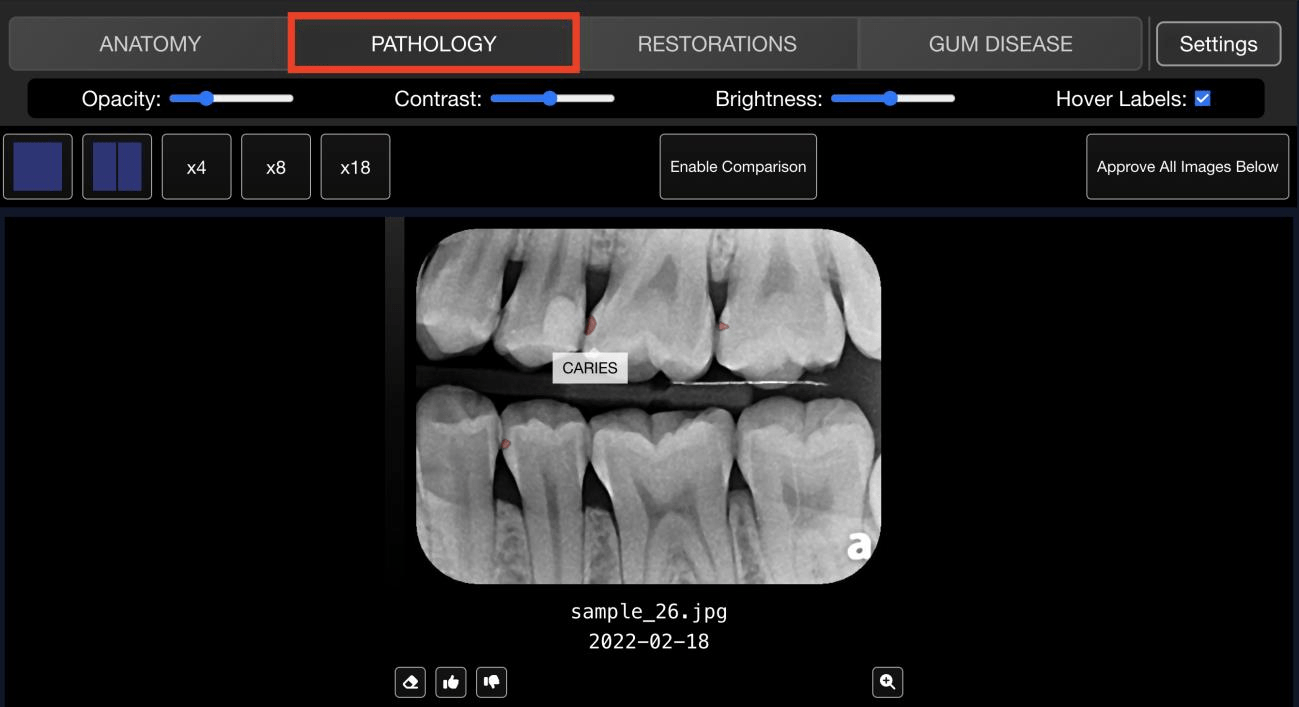

Cube Click developed Smile Dx, an innovative AI-powered dental diagnostic tool designed to assist dentists in identifying dental caries and periapical radiolucencies. Here's what we accomplished:
- Built a robust web application using modern frameworks for both frontend and backend development
- Implemented and trained deep-learning models for the automatic segmentation of dental anatomy in radiographs
- Developed a user-friendly interface allowing dentists to upload, view, and analyze multiple dental X-rays simultaneously
- Integrated advanced, custom image-processing techniques to enhance the visibility of dental structures and potential issues
- Created a secure login system with tiered access privileges based on subscription types
- Implemented an exam approval system and a patient portal for viewing approved results
- Ensured compliance with regulatory requirements, including comprehensive documentation and risk management
Clearing FDA
The regulatory work ran in parallel with engineering, not after it. Standalone performance testing (completed December 2023) established model accuracy against expert ground truth. The MRMC study (completed March 2024) demonstrated that dentists reading with Smile Dx outperform dentists reading without it: the evidence FDA accepted for the CADe indication. All documentation was authored in Medtech OS, assembled into eSTAR, and we handled FDA correspondence through to the decision.
Key Technologies
- Svelte-based web UI
- Django-based web server
- Tensorflow-based ML models
Timeline
- July 2021: Project started. Proof of concept developed, including initial model training with a small dataset and basic frontend functionality. Demo deployed using ngrok.
- September 2021: Work on bone segmentation. Exploration of different approaches for handling various image types and edge cases.
- January 2022: Updated model training with additional data. Generation of performance reports.
- March 2022: SMILE Dx prototype completed
- June 2022: Refinement of FDA pre-submission documents. Addressing security considerations and penetration testing.
- July 2022: Completion of verification and validation testing. Finalization of regulatory documents and user manual.
- June 2023: FDA pre-submission
- December 2023: FDA standalone performance testing completed
- March 2024: FDA multi reader multi case (MRMC) study completed for CADe indication
- August 2024: 510(k) submitted
- May 2025: 510(k) cleared (K242437). Nine months from submission to decision.

The Predicate Network
Smile Dx now sits inside a growing dental CADe predicate network. Since K242437, the space has kept moving: Pearl's Second Opinion CS (K243234) cleared in June 2025 and DTX Studio Assist (K252086) in November 2025, both on the same MYN foundation. Each clearance creates reference points for the next. We cleared inside that network once, and we know exactly which claims, endpoints, and study designs FDA has already accepted.