
Did you know that even real-time intraoperative endoscopy video AI can be a software-only medical device? In fact, at least 88 AI software-as-a-medical-device clearances cite a predicate that is not SaMD, and 50 of them are cases where a software-only device is predicated on a physical instrument, console, or hardware-integrated system. Seventeen of those operated live, during the procedure or at the bedside: colonoscopy, atrial fibrillation ablation, robotic surgery, ICU hemodynamics.
GI Genius (DEN200055), the De Novo that created real-time colonoscopy CADe, is a hardware-integrated video box wired into the endoscopy stack. CADDIE (K240044) cited it as a predicate and cleared as a cloud-hosted SaMD, adding a cecal landmark feature on top of the same real-time polyp detection claim. FDA treated the missing box as a technological difference, addressed in the comparison table, rather than as a different device.
We screened all 1,483 AI/ML-flagged records in the Innolitics FDA Device Explorer to find every case like it, then split the results by clinical domain to see where the play is still needed.
Why you should care 🔗
A software-only device is generally faster and easier to bring through FDA clearance and gives you far more distribution flexibility than a software–hardware combination. You can update and improve the software without redesigning, manufacturing, or revalidating the hardware. You also avoid much of the additional work and cost associated with electrical safety testing, biocompatibility, PCB design, manufacturing, and supply-chain management.
As a rough planning estimate, the pathway to market for a software-only device may be 10 to 20 times faster than for a comparable software–hardware combination. The exact difference depends on the device, its intended use, and the evidence FDA requires, but the strategic advantage is substantial: less hardware to build and test, fewer operational constraints, and more ways to distribute and update the product.
What we measured 🔗
Of the 1,483 AI/ML records, 985 are flagged SaMD and 951 cite at least one predicate. We resolved all 738 unique cited predicate records against the full corpus and kept the pairs where the predicate is not SaMD: 88 clearances, 120 citations. We verified each one using a panel of AI models and kept only the strict cases: a software-only subject citing a hardware/software combo predicate; this left 50 clearances spanning 1998 to 2026. The 34 records with no predicate were De Novos or PMAs (yes you can predicate off of a PMA if it gets down-classified to class II), and the three whose citations a parser would have missed, are accounted for in the Method section.

The oldest crossing in the set cleared in 1998, when the Neurometric Analysis System (K974748) predicated a bunch of EEG machines (back when split predicates were still very much in style). 41 of the 50 cleared since 2020.
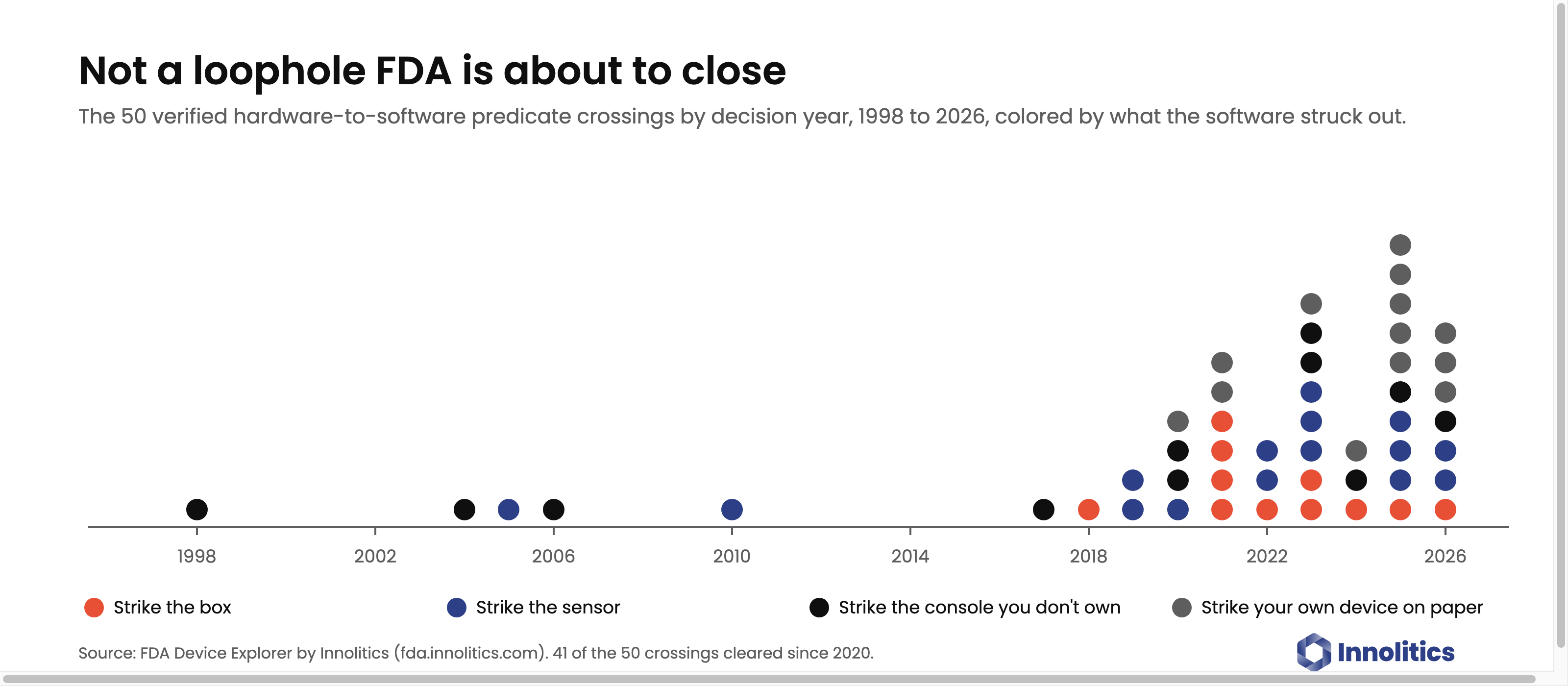
The four plays 🔗
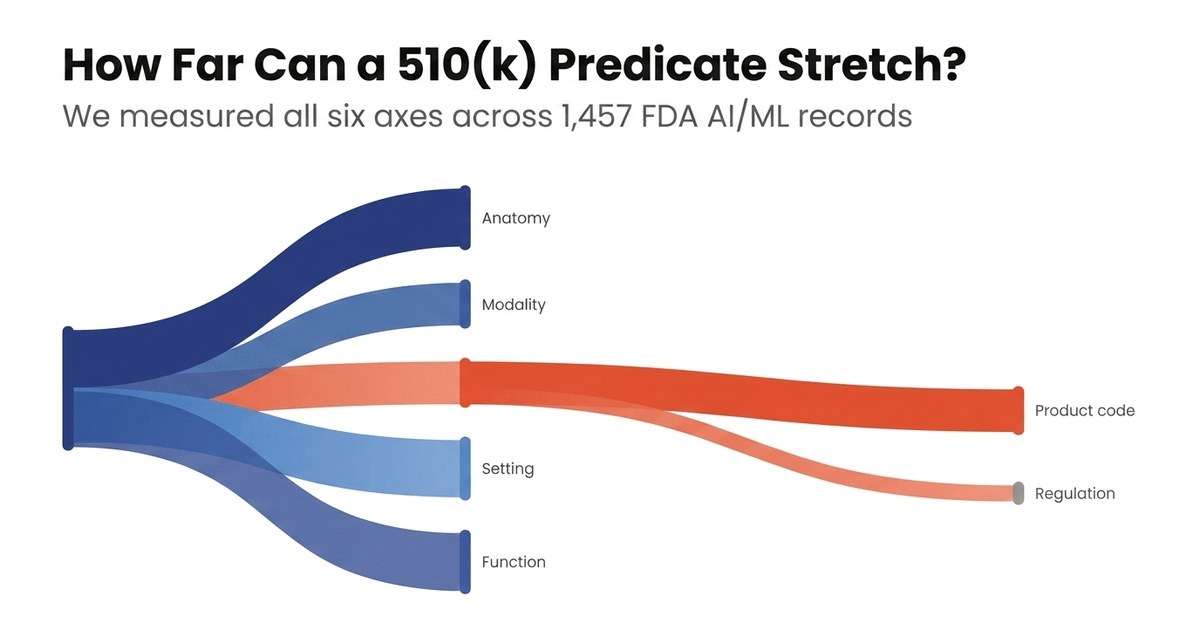
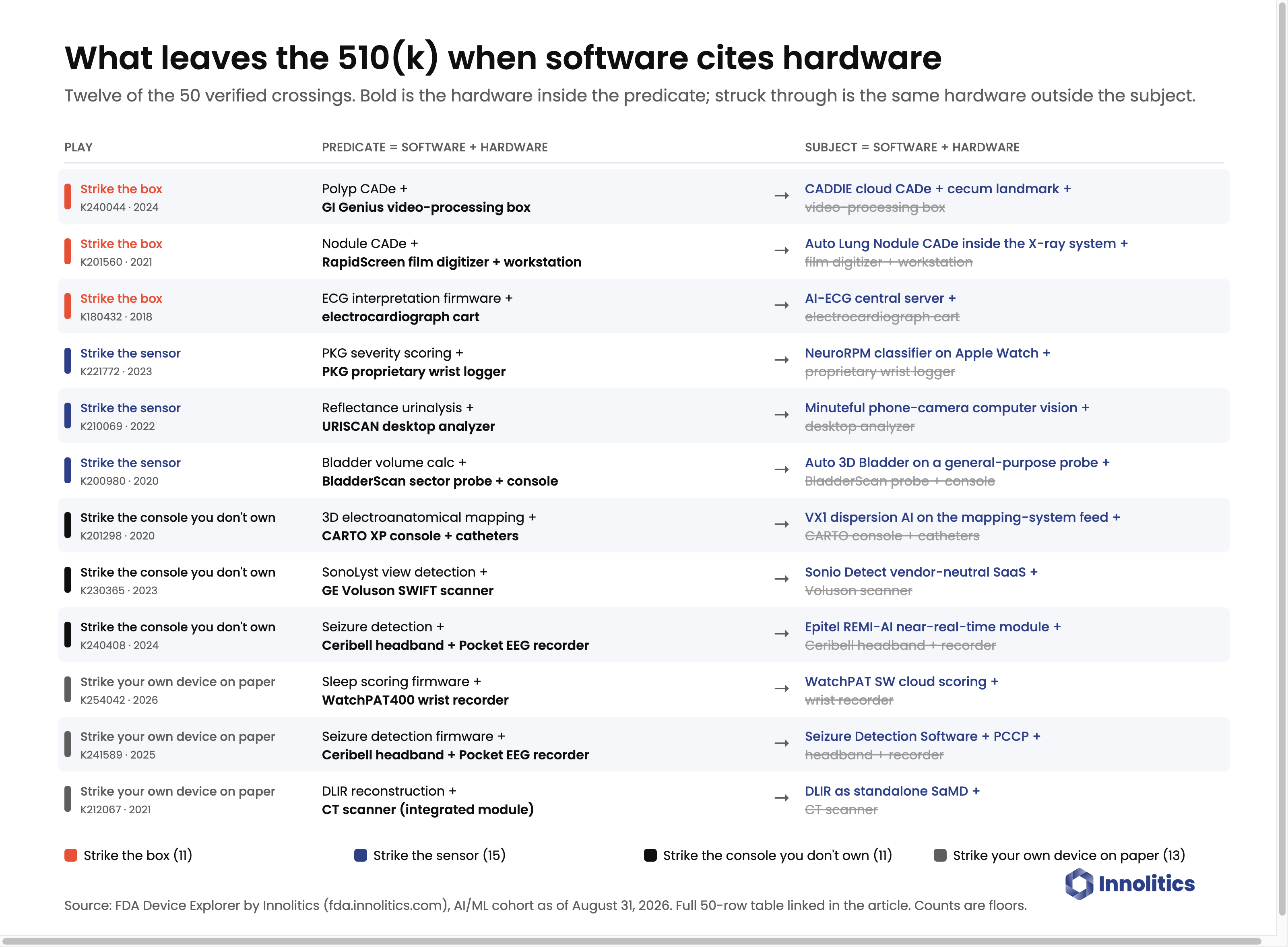
Line the 50 up as predicate on the left, subject on the right, and the pattern is the same every time: the software stays, one piece of hardware gets crossed out. What differs is which piece, and each one changes what you have to prove and what you no longer have to build.
Play 1: strike the box 🔗

Eleven clearances kept the acquisition hardware and removed the proprietary compute that sat between it and the clinician. GI Genius (hardware and software) seeded four software-only children: SKOUT (K213686), Fujifilm's EW10-EC02 (K230751), Wision AI's EndoScreener (K211326), and CADDIE (K252586). Samsung (K201560) and Imagen (K210666) both cited RapidScreen, a film digitizer plus CAD workstation approved under a PMA in 2001, and moved the same nodule-detection claim into the X-ray system and into the cloud. Carewell took ECG interpretation out of the cart firmware and onto a central server (K180432).
What FDA asked for: latency and failure-mode analysis where the output is live, cybersecurity for the new deployment, and evidence that the algorithm performs the same without the box. What leaves your submission: the box's electrical safety, EMC, and hardware verification.
Play 2: strike the sensor 🔗
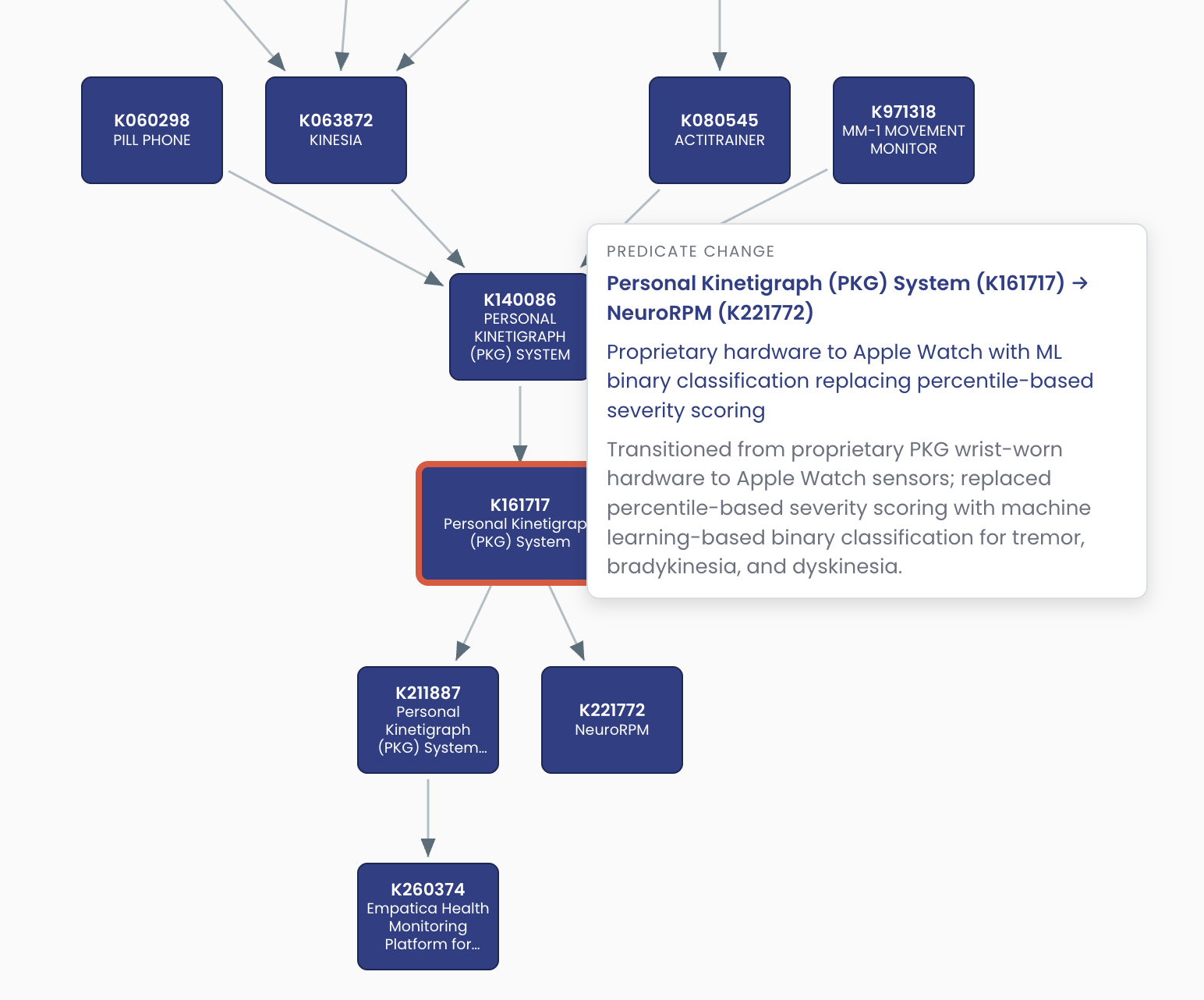
Fifteen clearances removed the thing that touched the patient. The signal now comes from a phone, a watch, a camera, a general-purpose probe, or a recording the hospital was already making. NeuroRPM (K221772) and Rune Labs (K213519) replaced a proprietary Parkinson's wrist logger with the Apple Watch. Healthy.io replaced a desktop urinalysis analyzer with a phone camera and a color card (K210069). Butterfly replaced Verathon's single-purpose bladder scanner with a U-Net on its own general-purpose probe (K200980). Nelli replaced a wrist biosensor with a room camera and microphone (K251506). Lifescreen derived respiration from Holter ECG that was already being recorded, in 2005 (K042745).
What FDA asked for: an input-equivalence argument, meaning performance on the new sensor's data against the old sensor's, plus the usual standalone validation. What leaves your submission: biocompatibility, electrical safety, and the entire patient-contact hardware chapter. It removes the most from the file. It is also the play where a competitor can predicate the sensor you spent years building.
Play 3: strike the console you don't own 🔗
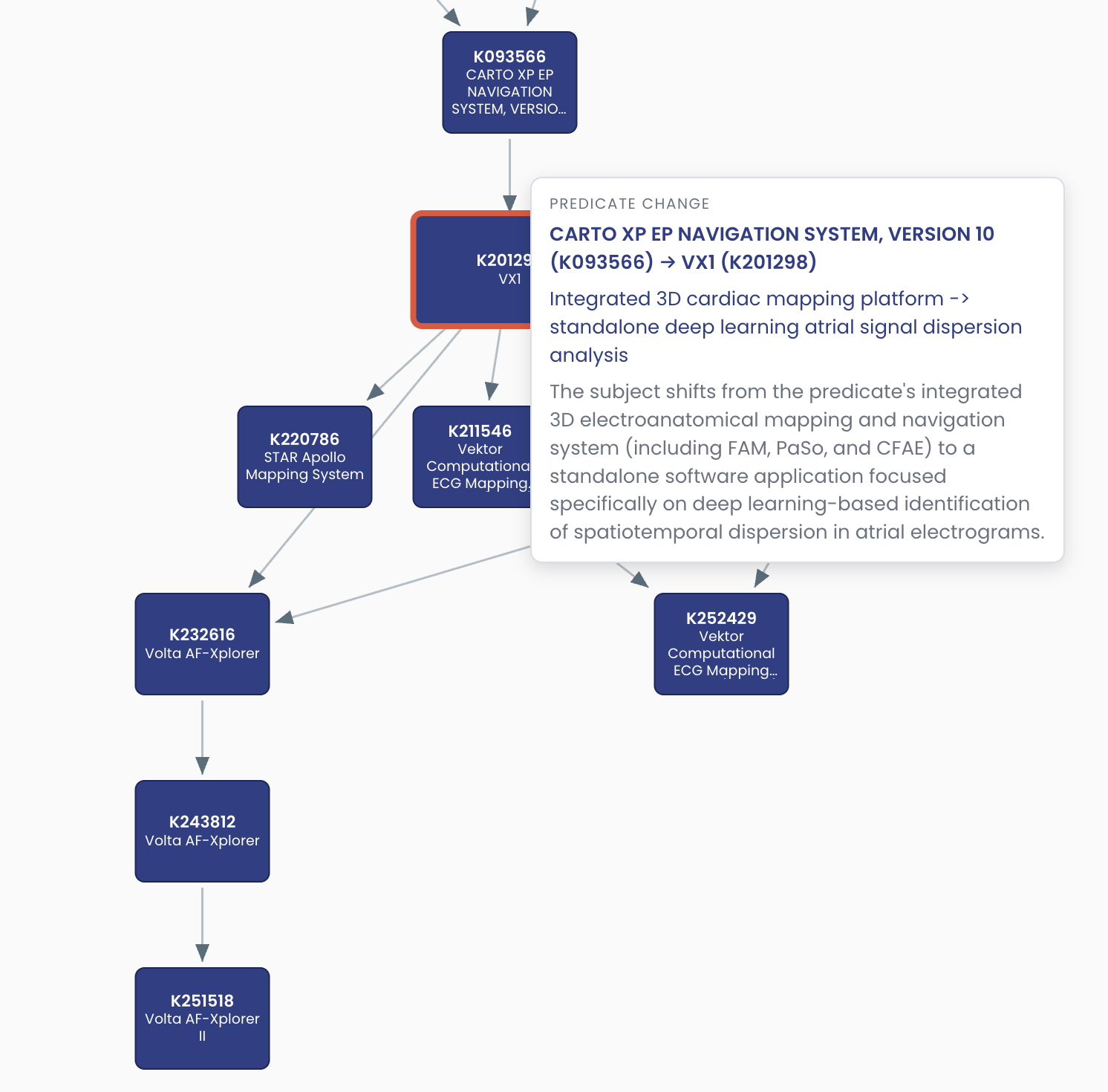
Eleven clearances read data from a scanner, mapping system, or monitor that another company sells, and cleared without shipping any of it. Volta's VX1 (K201298) cited the CARTO XP mapping console and cleared as software that reads its electrograms live during ablation. Sonio Detect cited a GE Voluson scanner and cleared as a vendor-neutral SaaS (K230365). Epitel's REMI-AI cited Ceribell's headband and recorder (K240408); Epitel runs on its own sensors and never sold Ceribell's. The two oldest crossings in the set, in 1998 and 2004, are qEEG software citing EEG machines from Teca and others (K974748, K041263).
What FDA asked for: a compatibility matrix for the consoles you claim to read from, interface conformance, and performance across those sources. No permission from the console maker is required or expected. What leaves your submission: everything about the console itself.
Play 4: strike your own device on paper 🔗
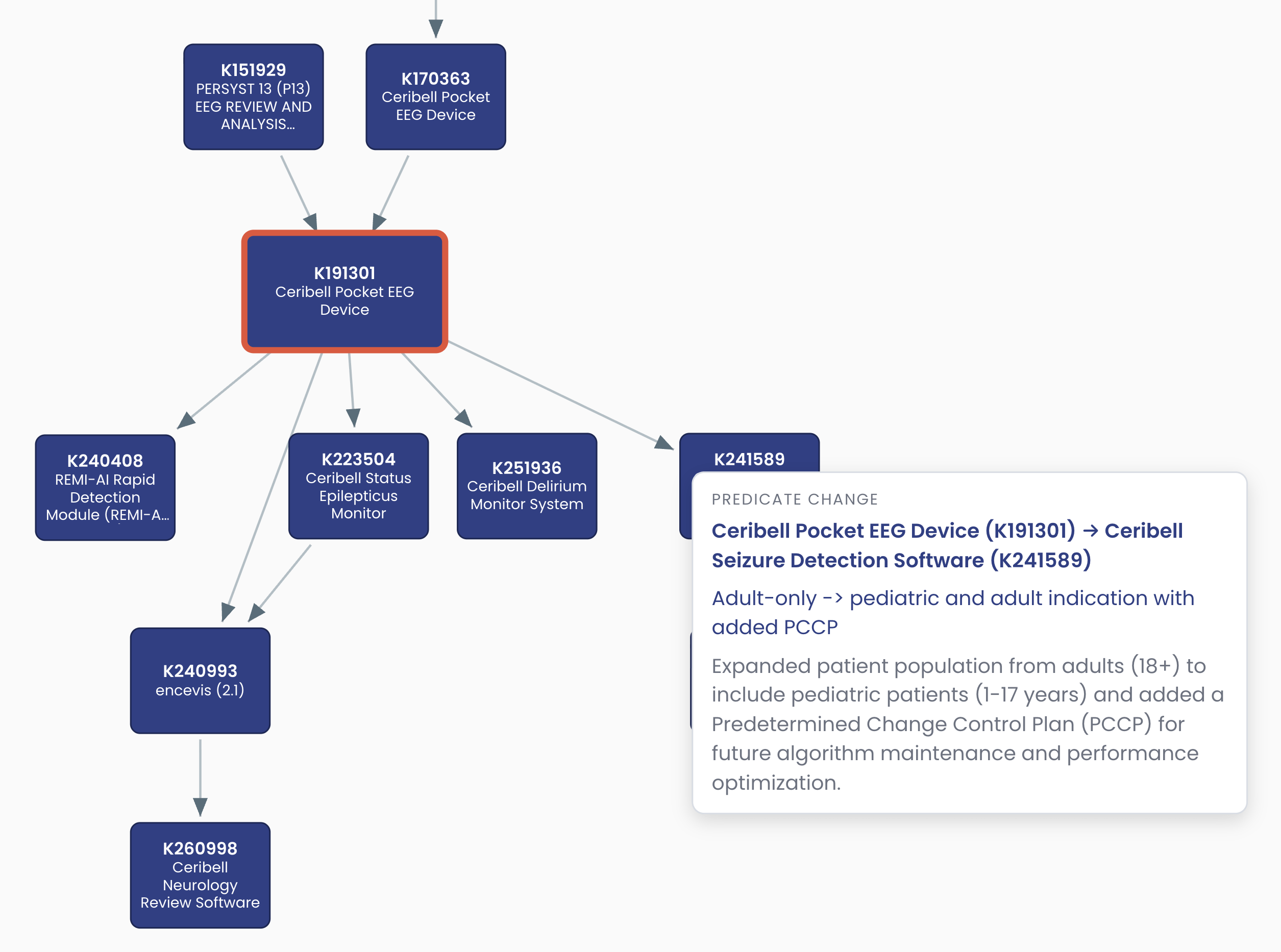
Thirteen clearances belong to sponsors who already had a cleared hardware device and filed the algorithm as its own 510(k), citing their own box. The hardware still ships; it just stops being inside the software's device boundary. Itamar (K254042), Nox (K241960), Ceribell (K241589), Leica (K253561), Butterfly (K252148), GE (K212067, K241350), and Edwards three times over (K230057, K233984, K242518). All thirteen cleared in 2018 or later; twelve since 2020.
What FDA asked for: performance carry-over and, increasingly, a PCCP. This is the lightest of the four. What it buys: updates on a software cadence and a separate sales motion. It also closes a door. Ceribell's headband (K191301) is the predicate for Ceribell's own software and for Epitel's competing module. Unbundle your algorithm before someone else predicates your box.
Seventeen of the 50 did not just drop the hardware. They widened the claim in the same submission. Ceribell added pediatric patients and a PCCP. Edwards' HPI added non-surgical patients (K230057). Fujifilm added Linked Color Imaging to white-light CADe (K230751). CADDIE added cecum landmark identification. Nox widened the age range from 22 to 18. Ten of the seventeen are own-box unbundles. If you are already rewriting the comparison table to remove a row of hardware, look at what else can go in the same 510(k).
Check your domain first 🔗
The 50 crossings are not spread evenly. Split the 985 AI SaMD records by clinical domain and two regimes appear.
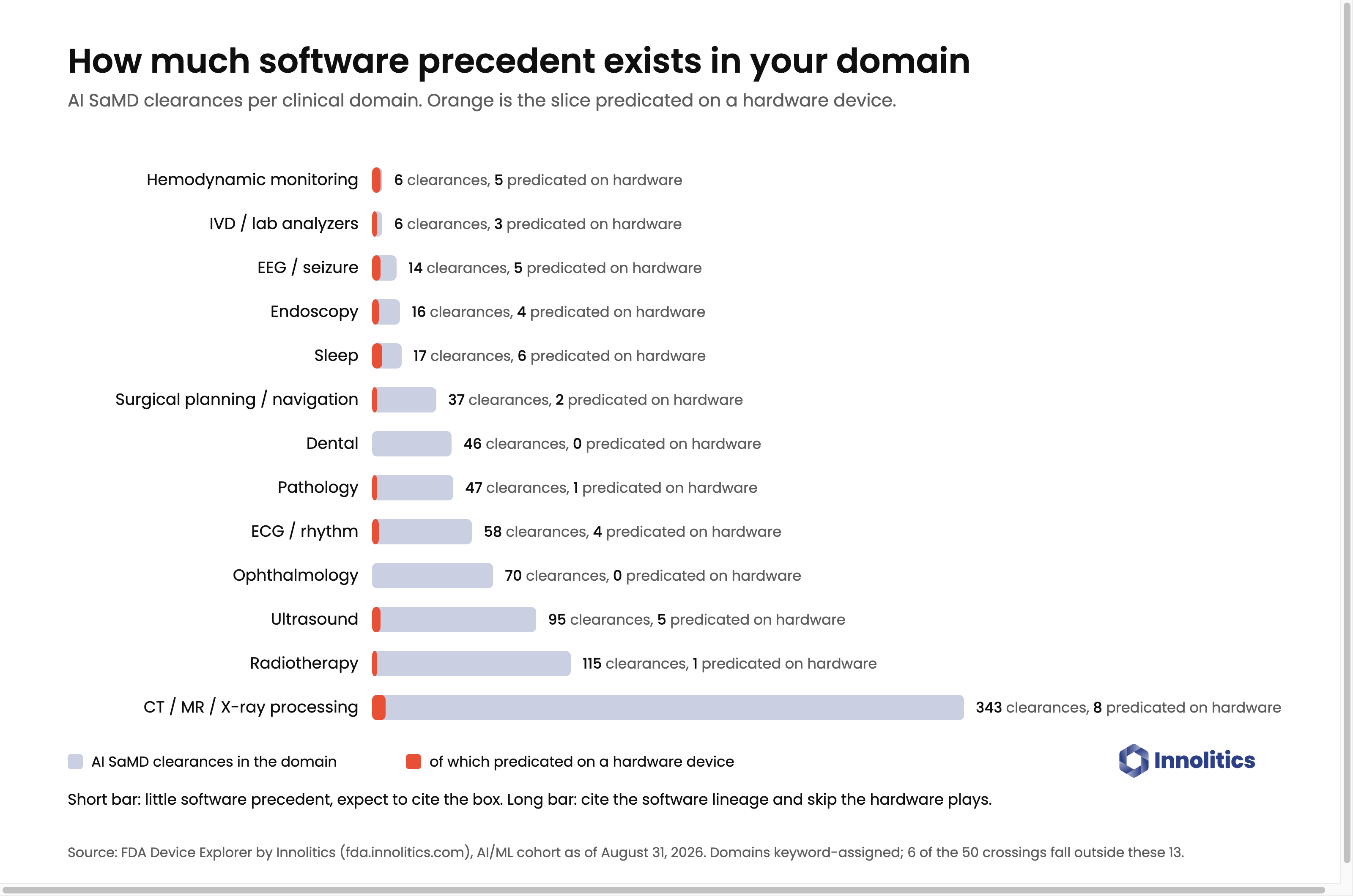
In hemodynamic monitoring, IVD, EEG, sleep, and endoscopy, fewer than 20 AI SaMD clearances exist, and between a quarter and most of them predicated on hardware. These are hardware-native domains: the cleared devices are monitors, headbands, wrist units, and video processors, so the software lineage is thin, and predicating the box is one way to go software-only in a hardware-filled world. The other way is probably a De Novo.
In ultrasound, CT and MR processing, radiotherapy, dental, and ophthalmology, there are dozens to hundreds of software clearances and only a handful predicated on hardware. Those domains already have deep software lineages, and sponsors there predicate software rather than scanners. If you have a choice, predicate your SaMD off of another SaMD.
Sometimes, the De Novo author must get cleared as a software-hardware combination until the hardware platform can be “abstracted away” while still mitigating risks. My hypothesis is that these devices start out as software-hardware combinations because standardization among hardware vendors has not yet reached a point where software-only devices can claim hardware agnosticism. GI Genius went De Novo as a box, and has spawned 19 software-only descendants devices. Of course, not all De Novos need to go hardware initially. Caption Guidance (DEN190040) went De Novo as software running on third-party probes, and its 8 descendants never touched a hardware predicate. Both lineages cover the same real-time, in-procedure claim class and inherited opposite form factors.
Ultrasound 🔗
Of 101 ultrasound AI SaMD records, 95 cite a predicate and 5 are verified hardware crossings; 62 citations are cross-company software predicates. In 12 clearances the citation ran the other way: probe and console makers predicated a startup's pure-software device. Clarius cited DiA (K222406) and Sonio (K233955), Exo cited DiA (K232501), GE's Automated Aortic Stenosis cited Ultromics (K254161). Real-time acquisition guidance runs from Caption's software De Novo through UltraSight (K223347), HeartFocus (K242807), and ThinkSono (K260338), all purebred SaMD.
Dental 🔗
All 46 dental AI SaMD records cite a predicate and none cite hardware. The root is a 1998 PMA for caries-detection software, Logicon (P980025), which Pearl (K210365), Videa (K213795), and Overjet (K212519) all cited in 2022. Four years later the imaging OEMs predicate the startups: Dentsply Sirona cites Videa (K253009), Nobel Biocare cites Pearl and Videa (K221921). Overjet reached outside the domain entirely, predicating an MRI denoiser for its dental image-enhancement tool (K241681).
Radiology reconstruction 🔗
Reconstruction and denoising split along the raw-data line. Algorithms that touch projection data stayed with the scanner maker and cleared by unbundling: GE's Deep Learning Image Reconstruction (K212067), United Imaging's HYPER DLR against its own PET/CT systems (K193210), GE's Clarify DL against the StarGuide SPECT gantry (K241350). My hypothesis is that non-scanner manufacturers cannot cross the SaMD divide because some collaboration is likely required between the hardware and SaMD devices to separate the APIs cleanly and establish an abstraction with appropriate risk controls.
Algorithms that work on the DICOM image went vendor-neutral and predicate software: SubtlePET (K182336) in 2018, Airs Medical's SwiftMR citing SubtleMR (K210999), Foqus citing SwiftMR (K241982). Across 46 reconstruction and denoising SaMD records, every hardware predicate belongs to an OEM. If your model consumes images rather than sinograms or k-space, you are in the software regime.
Pathology 🔗
Digital pathology followed the same pattern as ultrasound. Paige Prostate went De Novo as software (DEN200080), and Ibex's Galen Second Read predicated it (K241232). The lone hardware crossing is Leica unbundling a QC algorithm from its own Aperio scanner (K253561). Scanner vendors own the acquisition; the diagnostic software lineage is finally starting to become vendor-neutral. The age of VNAs for digital pathology is upon us, and with it, AI SaMD will go mainstream.
What FDA actually asked for 🔗
The 50 SiMD to SaMD substantial equivalence arguments share a similar structure: hold the intended use and claim type steady, and the missing hardware becomes one row of different technological characteristics. What fills the gap is standalone performance on the real input distribution, interface and compatibility documentation for the hardware you now depend on, latency and failure-mode analysis if the output is real-time, and cybersecurity. CADDIE’s (K240044) reviewers accepted a software-only cloud architecture for a live in-procedure claim.
Case study: how CADDIE kept a cloud device real-time 🔗
The obvious objection to CADDIE is latency. A sponsor does not control cloud compute or the hospital's network, and a colonoscopy CADe has to draw its box on a live video feed. The K240044 summary shows how Odin Vision answered the objection, and the answer is architectural rather than evidentiary: the latency-sensitive path never leaves the room, and performance degrades gracefully to standard of care anyway.
A small computer on the endoscopy stack sits between the video processor and the monitor. It passes the live feed through to the display with a fixed local pipeline delay, encodes a copy, streams that copy to the cloud for GPU inference, and composites whatever detections have come back onto whichever frame is currently on screen. The special controls in 21 CFR 876.1520 ask for exactly two latency measurements: real-time video delay due to the device, and video delay due to marker annotation. CADDIE reported 32.50 ms for the first on both the Olympus CV-1500 and CV-190, and 32.59 ms and 33.61 ms for the second.
That design converts cloud latency from a display-latency problem, which FDA would have to scrutinize, into a detection-timing problem, which the labeling already owns. If the inference round trip is delayed, the polyp detection box lands a few frames late on a polyp that is still on screen. If the connection drops, boxes stop appearing but, crucially, the video keeps running. The failure mode degrades toward unassisted colonoscopy, the baseline standard of care, and the indication makes the gastroenterologist responsible for confirming every finding anyway. This would have been a completely different story if they claimed to be fully autonomous. Inference latency distribution, network jitter, and offline behavior are not in the special controls, and the summary does not characterize them. Bounding the network became a site-installation (i.e., post-market quality system DHR) matter rather than a premarket regulatory matter.
In summary, relying on third-party implementations you do not fully control in a medical device adds risk—that much is undeniably true. However, FDA is not expecting devices with zero risk. They expect you to control risks to an acceptable level where the benefits outweigh the risks.
Frequently asked questions 🔗
Can my software cite a hardware device as its predicate? 🔗
Yes. At least 88 AI SaMD clearances cite a non-SaMD predicate, and 50 are strict hardware-to-software crossings we verified by hand. FDA evaluates intended use and technological characteristics, and a missing enclosure is a technological characteristic addressed in the comparison table.
Do I need permission from, or a partnership with, the hardware maker? 🔗
No. A predicate citation does not require the predicate holder's agreement.
I am in ultrasound or radiology. Does any of this apply to me? 🔗
Only the second half. Your domain already has a deep software lineage, so the efficient predicate is another software device, often from a company that is not your competitor. Use the hardware-predicate plays if a suitable software only predicate does not exist.
Method 🔗
Source: Innolitics FDA Device Explorer, AI/ML-flagged cohort, N = 1,483 records as of August 31, 2026. We flagged the 985 SaMD records; 951 cite at least one predicate, and the 34 that do not are accounted: 28 De Novos and 2 PMAs carry no predicate by definition, and 4 records had no machine-readable predicate in their summaries. Citations in nonstandard formats (lowercase K numbers, spaces inside DEN numbers) were recovered by AI; one recovered record, Sight Diagnostics' X100, was then excluded because the subject ships a benchtop analyzer. We resolved all 738 unique cited predicates against the corpus and kept subject-predicate pairs where the predicate is not SaMD (88 clearances, 120 citations). Each pair was reviewed against the intended use and predicate-change summaries; we excluded subjects that ship hardware, and predicates that are freestanding software, keeping hardware-integrated predicates whose function depends on dedicated acquisition hardware. That left 50 verified crossings. Domains were assigned by keyword matching on device name and intended use, so domain counts are approximate and a record belongs to one domain only. The screen is deliberately conservative and not intended to be an exhaustive list, but rather intended to add support to SIMD-to-SAMD prediction. Every K number, DEN number, and PMA number above links to the primary record in our FDA browser tool.
About the Author 🔗

Yujan Shrestha, MD
Partner
I have led or supported FDA strategy and submissions for 51+ medical devices, most AI-enabled, since co-founding Innolitics in 2012, across 510(k), De Novo, Breakthrough, Q-Sub, and deficiency responses. My work spans radiology AI (CADe, CADx, CADt, quantitative imaging), cardiac and neuro imaging software, dental AI, LLM and foundation model devices, and I have managed or contributed to 65 Innolitics projects. FDA's public clearance letters for AI Metrics (K202229, 2020) and Medweb's Lightning Viewer (K242362, 2024) name me as the sponsor's correspondent. I presented at FDA's first Digital Health Advisory Committee meeting on generative AI in November 2024, I have published 78 articles on innolitics.com, and I built fda.innolitics.com, our public FDA device search tool.