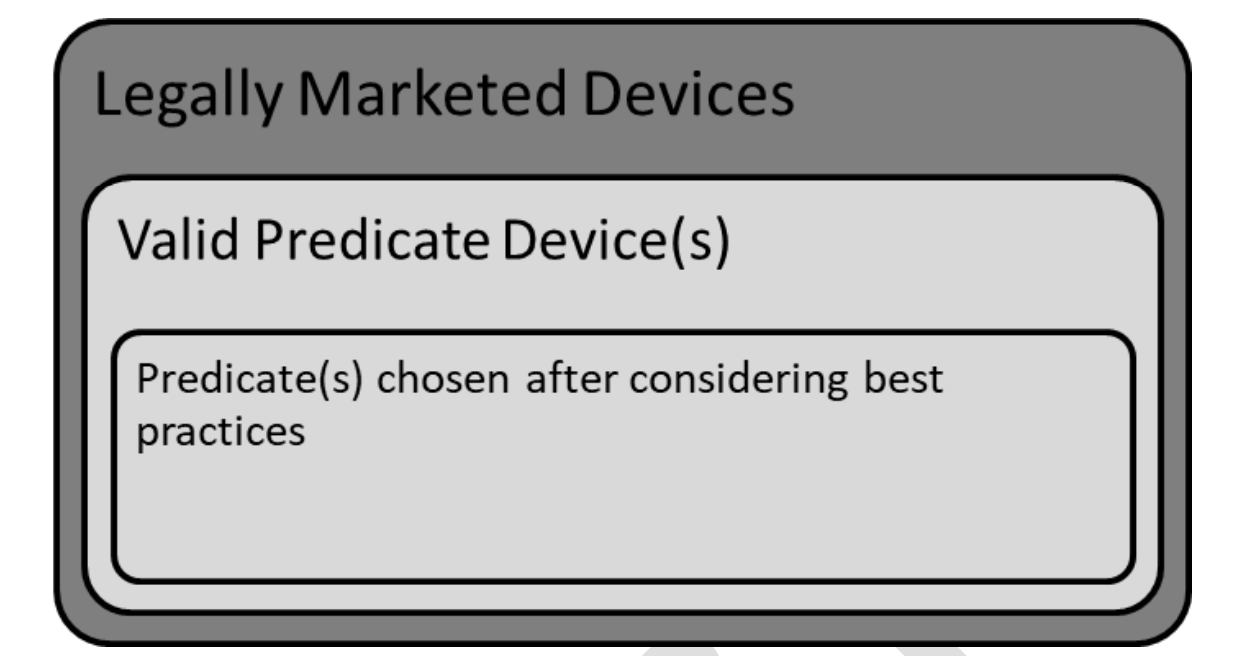

Ask most people what a valid predicate looks like and you get the same checklist: same body region, same modality, same product code. The clearance record says otherwise. At least one in five AI 510(k)s cites a predicate under a different product code. At least 85 cleared with a predicate targeting a different body region, at least 35 swapped imaging modality outright, and at least 122 predicate citations cross 21 CFR regulation numbers entirely. Brain triage software predicated abdominal triage. A desktop urinalysis analyzer was the predicate for an app that reads test strips with a phone camera.
We measured how far a 510(k) predicate can stretch, across every axis we could quantify, in 1,457 AI/ML-flagged records in the Innolitics FDA Device Explorer.
What we measured 🔗
Six axes of predicate distance: anatomical region, modality, use environment, intended use category, product code, and regulation number. The first four come from criterion-based screening of every predicate-change reason in the corpus. The last two are computed mechanically: we resolved the product code of all 1,181 cited predicate records and mapped each to its 21 CFR regulation. Every K-number, DEN number, product code, and regulation in this article links to the primary record.
Read every count in this article as a floor. The corpus keeps growing, so these numbers only rise from here. And the screening criteria were deliberately conservative: we counted only the certain and largest transitions, and left the ambiguous cases out.
Axis 1: Anatomical Region 🔗
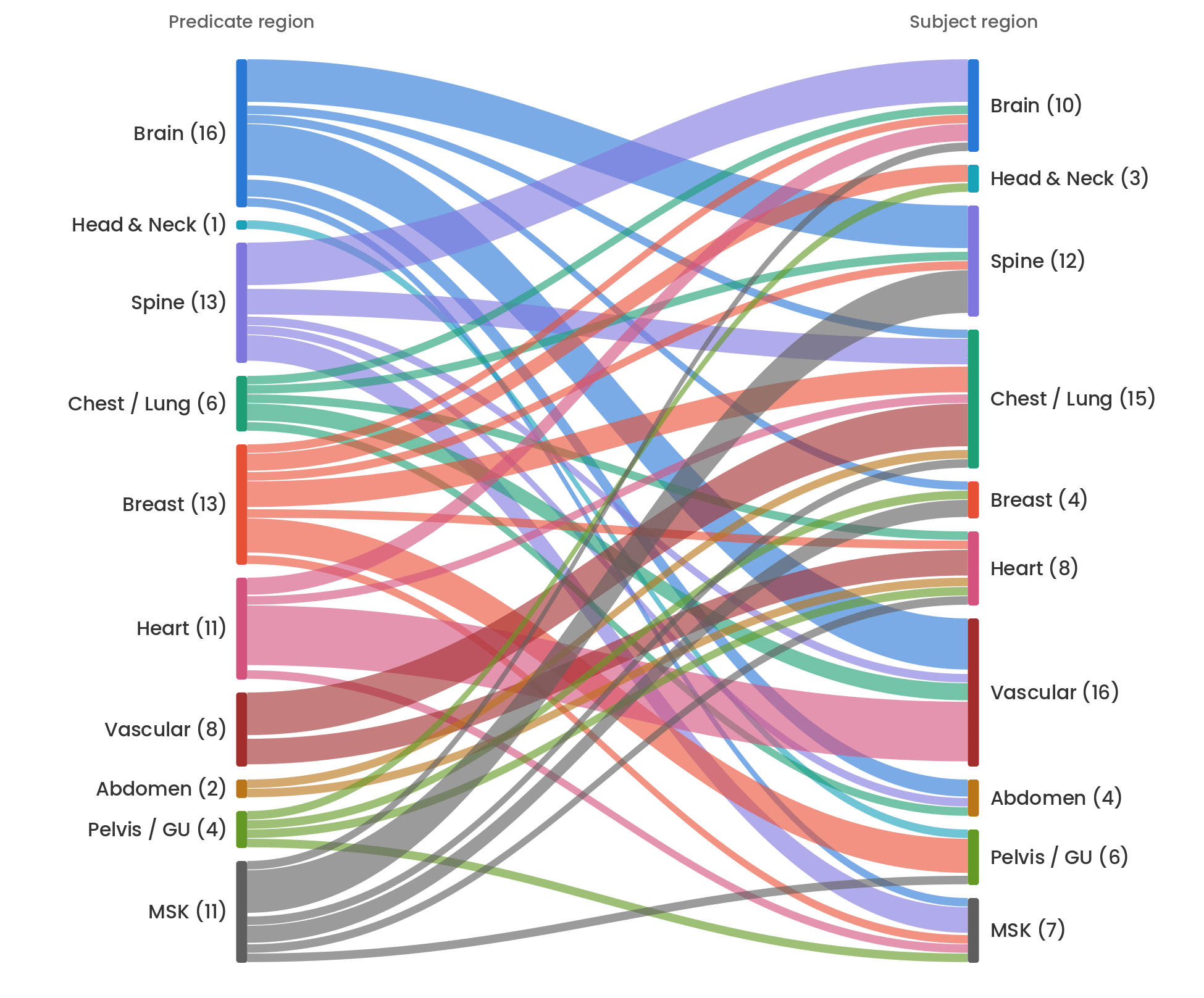
We measured this two ways. Systematically pairing every AI clearance against every cited predicate and comparing the anatomical targets in their intended-use statements finds at least 85 devices (about 1 in 15) whose predicate targeted a different specific body region, and at least 173 (about 1 in 7) counting multi-region expansions and narrowings. The 85 devices that crossed outright are charted below, one primary crossing per device, and brain seeds more of them than any other region: at least 18 departures. The Aidoc arc shows what that means commercially. One head CT triage clearance became the predicate for cervical spine fracture (K190896), abdominal free gas (K193298), and rib fracture triage (K202992), four markets on one algorithm family. The stranger pairs cleared too. Cycle Clarity predicated ovarian follicle measurement on cardiac chamber segmentation (K212012), and Smart Soft predicated lumbar spine measurement on a brain volumetry tool (K220497). Nobody was asked for outcome data. The ask, over and over, was standalone performance in the new anatomy.
One scoping note: anatomy here means body region, so the 85 counts only the major moves. Predicates that hop between organs inside the same region are far more numerous, and we did not capture them in this analysis. They are the subject of a separate article. This one tracks the documented big jumps.
Axis 2: Modality 🔗
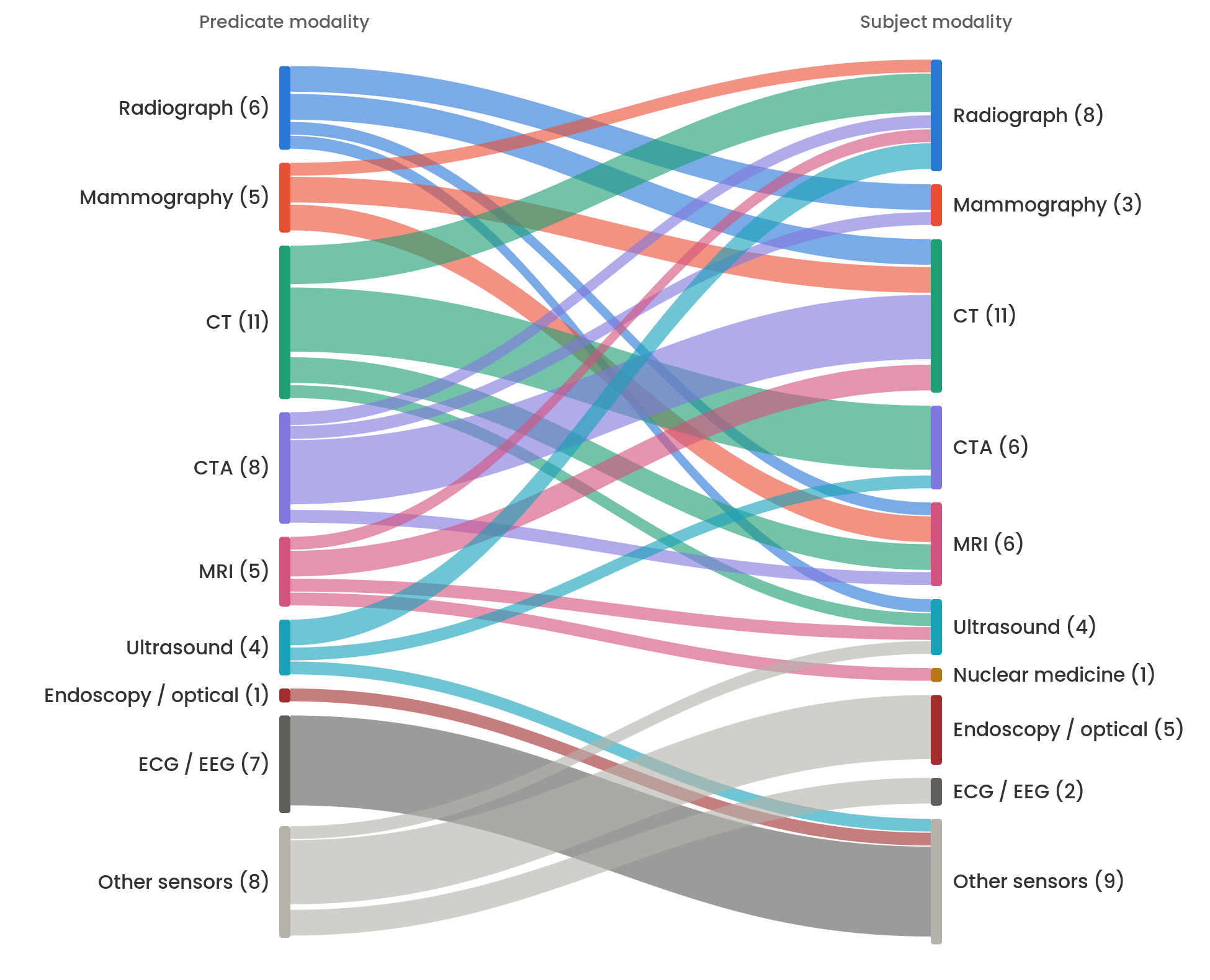
At least 95 modality-related crossings: 35 outright swaps, 27 additions where a second modality was bolted onto a cleared device, 16 where the sponsor crossed modality while citing a De Novo as the predicate (BriefCase rode the ContaCT De Novo from CTA to non-contrast CT, K180647), and 17 signal-source shifts among monitors and wearables. The swaps are the ones that surprise people. Mammography CADx predicated lung CT (K251474) in 2025, and a CT-based planning tool predicated TEE ultrasound video (K260300) the following year, so this is not some loophole FDA quietly closed. Contrast versus non-contrast CT behaves like a free move, with nine crossings running in both directions. And the cheapest expansion in the whole dataset is the modality addition, led by CT plus MR at 14 instances, because FDA treats the added modality as a validation domain rather than a new device.
Axis 3: Use Environment 🔗
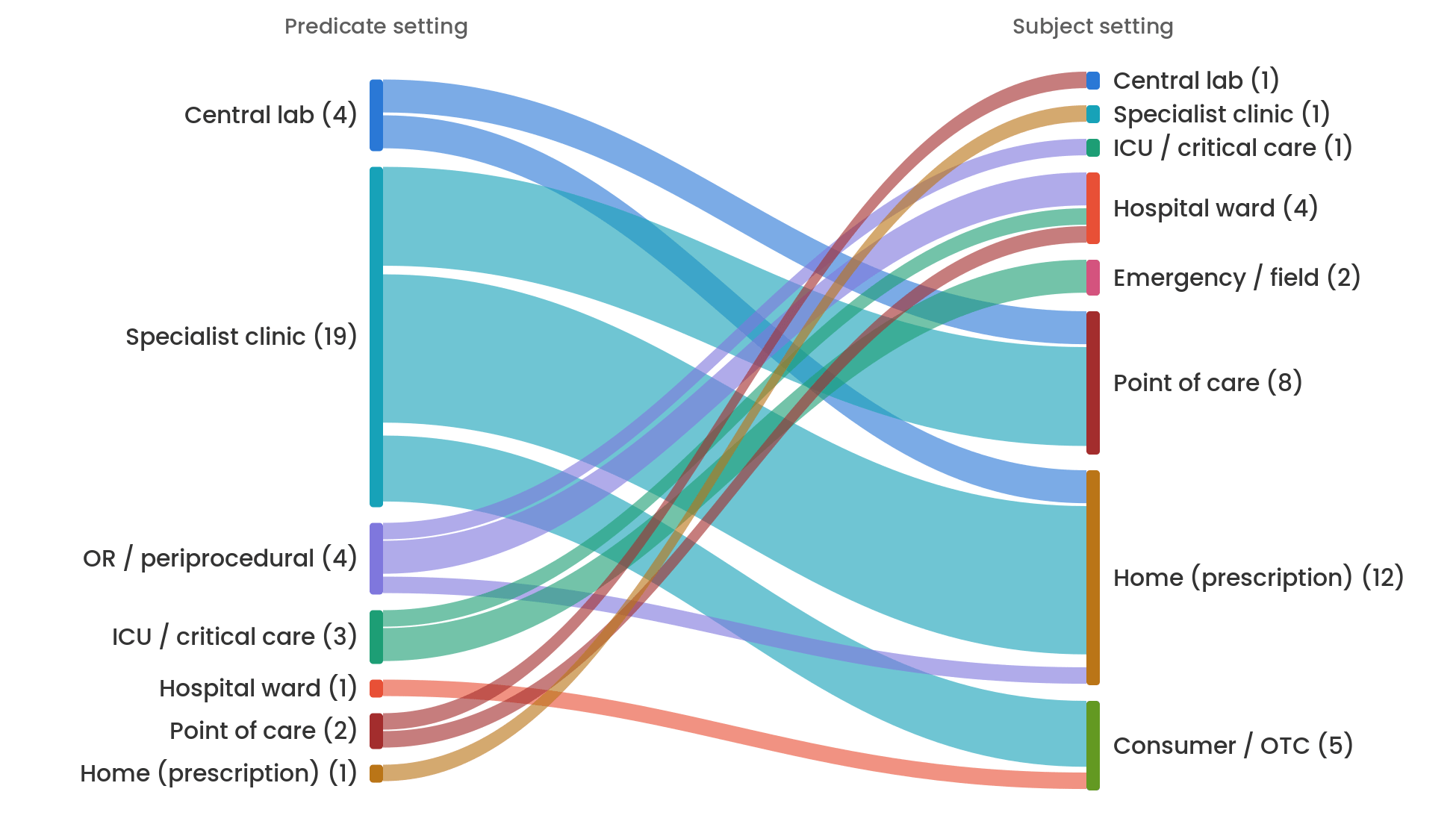
At least 34 use-environment crossings, and the direction is nearly one-way: specialist settings seeded 19, home and consumer absorbed 17. Clinician-overread ECG became independent consumer use (K191406). A desktop lab urinalysis analyzer became a patient's phone camera (K210069), which still strikes us as the most audacious predicate argument in the cohort, and it worked. Traffic occasionally runs backward too; TRIOS Dx brought a remote monitoring predicate into the dental clinic (K260082). One caveat: the first consumer device in each category went De Novo (Apple ECG, DEN180044), and everyone after rode it.
Axis 4: Intended Use Category 🔗
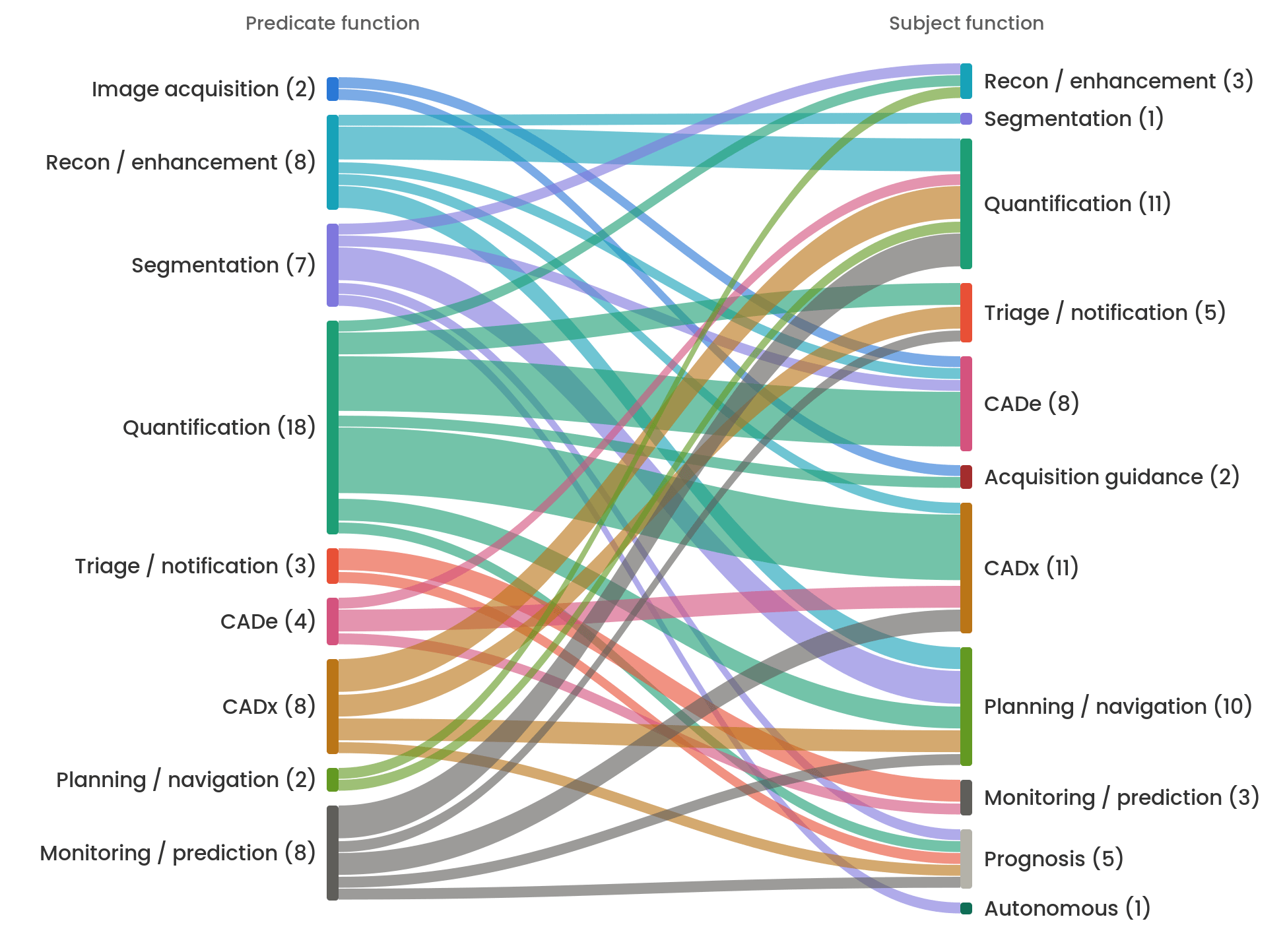
At least 60 clearances crossed intended use categories, and quantification is the hub with at least 17 departures. One-rung hops are routine: quantification to CADx, segmentation to planning. Deliberate down-classing works and is underused: IQ-UIP repositioned a diagnostic classification predicate as passive notification (K242467). But multi-rung jumps into prognosis or autonomy are where De Novo risk concentrates, and that is the gate: every category-creating De Novo in the cohort (ContaCT, QuantX, Caption Guidance, IDx-DR, ArteraAI Prostate) introduced a claim type with no precedent anywhere. None was forced by anatomy, modality, code, or setting.
Axes 5 and 6: Product Code and Regulation Number 🔗
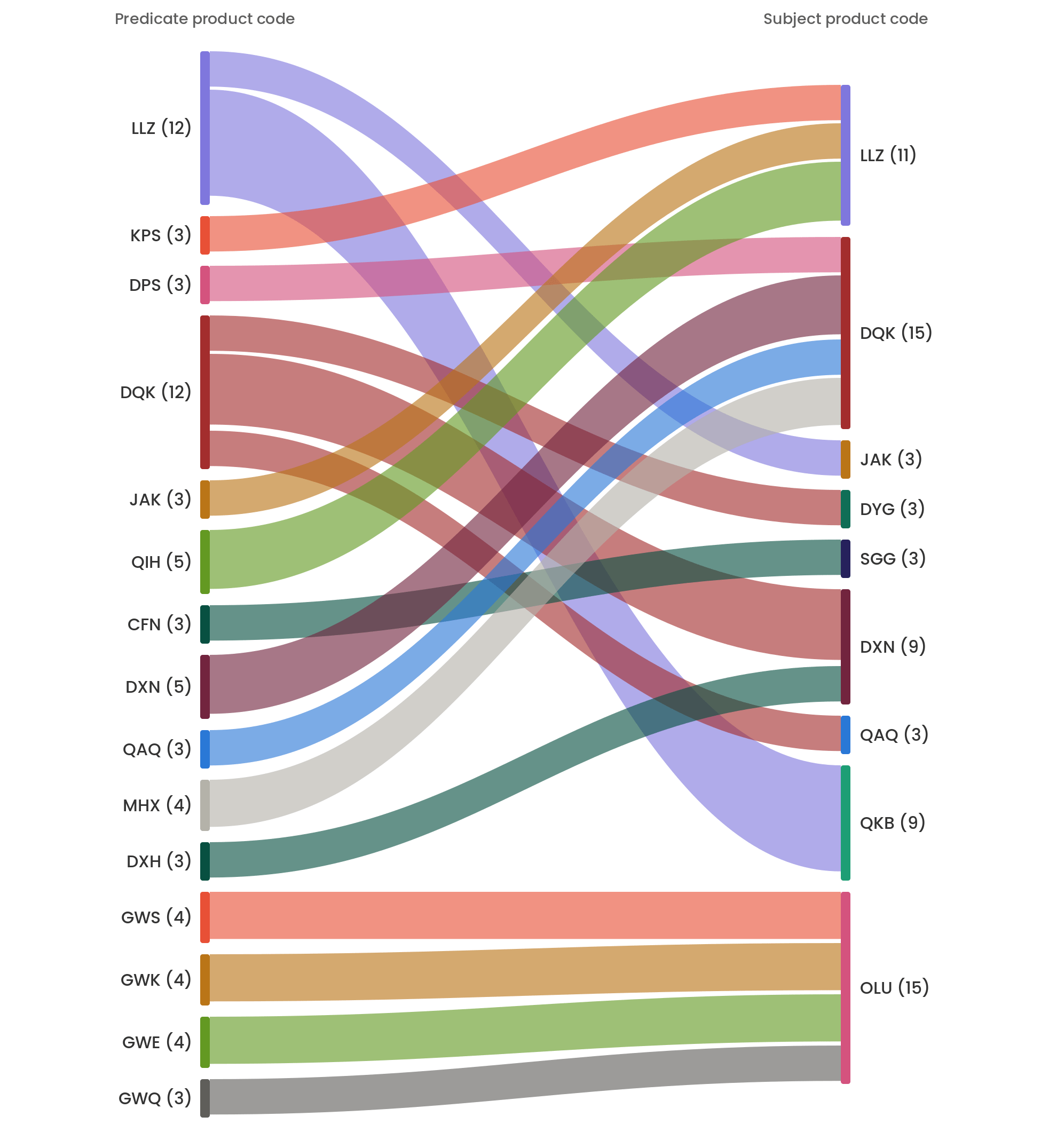
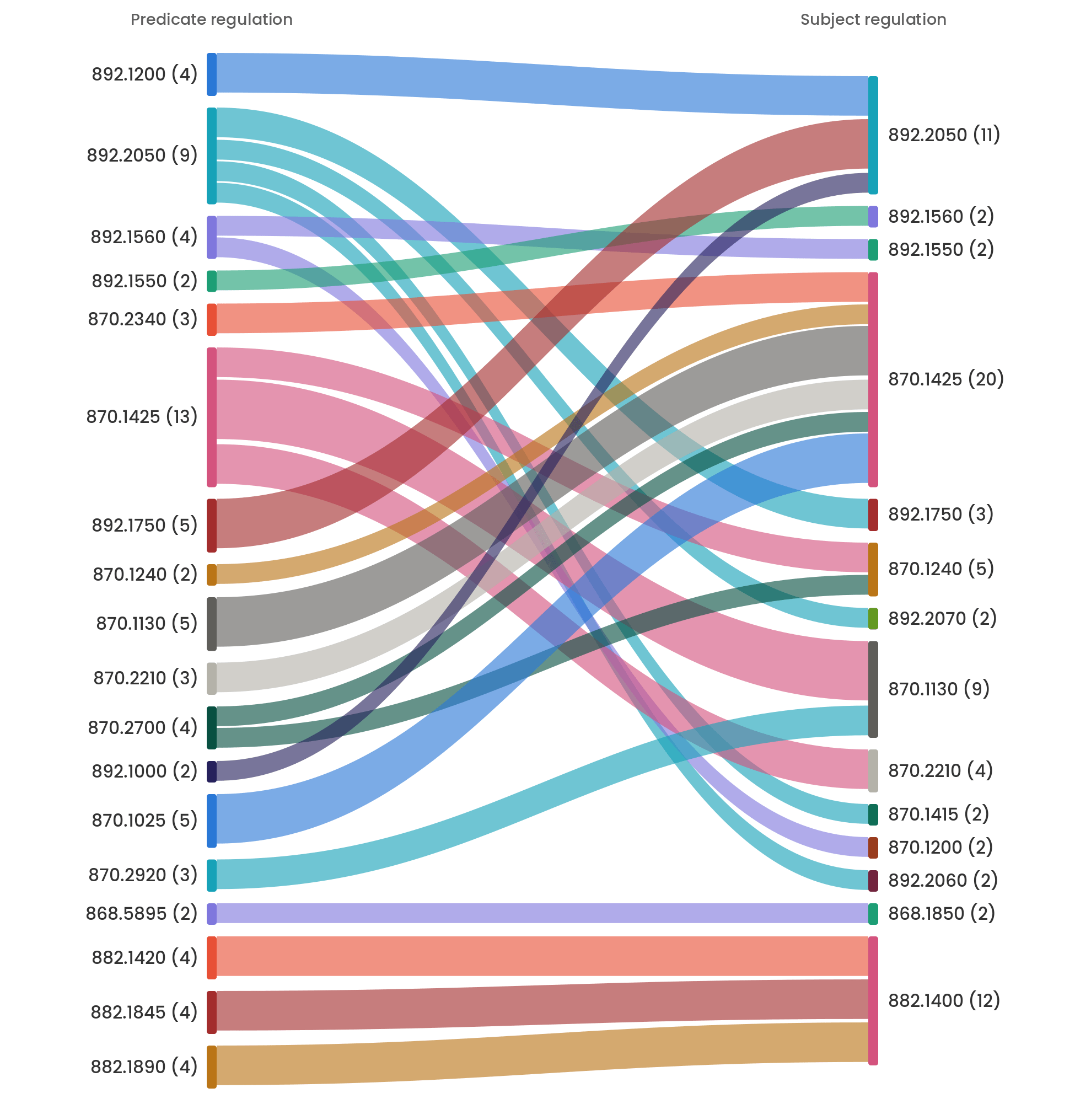
At least 349 predicate citations cross product codes. The dominant flow is FDA recoding its own ecosystem: 150 citations migrate the legacy LLZ image-processing code into QIH. Strip that wave out and at least 199 genuine crossings remain. Deeper still, at least 122 citations cross regulation numbers, densest inside cardiology's 870.x cluster, where ECG analysis, hemodynamic prediction, and cardiovascular quantification software have been borrowing each other's predicates for years. Pick your code by where the special controls and predicate pool are most favorable. The crossing will not be challenged; the comparison table will.
The six analyses at a glance 🔗
| Axis | Cleared crossings | Headline finding |
|---|---|---|
| Anatomical region | At least 85 outright (173 with multi-region shifts) | Measured across every predicate pair; brain is the dominant seed and anatomy is the cheapest-looking big move |
| Modality | At least 95 | Swaps cleared in every era; CT plus MR addition is the cheapest expansion; contrast versus non-contrast is near-free |
| Use environment | At least 34 | Traffic runs outward toward home and consumer; category firsts were De Novos |
| Intended use category | At least 60 | Quantification is the hub; one-rung hops are routine; multi-rung jumps ride De Novos |
| Product code | At least 349 citations | At least one in five clearances cites a cross-code predicate |
| Regulation number | At least 122 citations | Even 21 CFR boundaries are porous, densest in cardiology |
The scoring framework 🔗
Score a proposed device against its best candidate predicate in two steps. First the gate: does the device make a claim type with no cleared precedent in any anatomy or modality? If yes, plan for De Novo and decide whether to author the special controls deliberately. If the gate passes, score distance out of 100:
| Axis | Weight | What the data shows |
|---|---|---|
| Output type and autonomy | 25 | Autonomy escalations forced De Novos; notification-only framing repeatedly bought cheaper clearances |
| Decision consequence | 20 | Prognosis and risk-prediction claims all went De Novo first |
| Modality | 15 | At least 55 cleared crossings; 5 points for a within-family variant, 15 for a full swap |
| Use environment | 15 | Consumer-context firsts went De Novo; later entrants rode them |
| Anatomical region | 10 | At least 85 measured crossings including brain to abdomen |
| Population shift | 10 | Population-only expansions cleared routinely |
| Technology character | 5 | Rule-based to CNN swaps cleared silently; locked to adaptive cleared with a PCCP |
Under 40, lead with a lean 510(k). Between 40 and 65, file with the highest-scoring axis neutralized in the substantial equivalence table. Over 65, accept De Novo or decompose the journey into two clearances: Clarius chained bladder (K232257) to prostate (K243853) to median nerve (K250226), and each hop read as a modest delta.
Top transitions across all six axes 🔗
| Axis | Transition | n | Example records |
|---|---|---|---|
| Anatomical region | Heart → Vascular | 7 | K212383 K230534 K243859 K250337 K251027 K253735 +1 more |
| Anatomical region | Brain → Vascular | 6 | K201020 K210237 K220499 K223443 K251987 K260729 |
| Anatomical region | Brain → Spine | 5 | K190896 K203508 K220497 K241211 K241329 |
| Anatomical region | MSK → Spine | 5 | K183204 K193267 K221632 K241593 K253192 |
| Anatomical region | Spine → Brain | 5 | K213721 K220709 K221240 K221314 K252842 |
| Modality | ECG / EEG → Other sensors | 7 | K080337 K172935 K231355 K232686 K233249 K250507 +1 more |
| Modality | CT → CTA | 5 | K192383 K213319 K243145 K260166 K260167 |
| Modality | CTA → CT | 5 | K180647 K182177 K231094 K240786 K243378 |
| Modality | Other sensors → Endoscopy / optical | 5 | K182384 K210069 K221892 K241633 K251506 |
| Modality | CT → Radiograph | 3 | K221330 K240736 K244002 |
| Use environment | Specialist clinic → Home (prescription) | 9 | K042745 K173974 K180343 K210025 K213357 K220820 +3 more |
| Use environment | Specialist clinic → Point of care | 6 | K183182 K223347 K234141 K242807 K250484 K254086 |
| Use environment | Specialist clinic → Consumer / OTC | 4 | K191406 K213519 K221772 K250507 |
| Use environment | Central lab → Home (prescription) | 2 | K182384 K210069 |
| Intended use category | Quantification → CADx | 6 | K162484 K200356 K203502 K213857 K234141 K260680 |
| Intended use category | Quantification → CADe | 5 | K080337 K192109 K222054 K252235 K261210 |
| Intended use category | CADx → Quantification | 3 | K200760 K234042 K260303 |
| Intended use category | Monitoring / prediction → Quantification | 3 | K250233 K251218 K252204 |
| Intended use category | Recon / enhancement → Quantification | 3 | K202404 K212690 K260077 |
| Product code | LLZ → QIH | 150 | K253690 K260300 K253786 |
| Product code | LLZ → QKB | 9 | K203235 K220408 K241837 |
| Product code | DQK → DXN | 6 | K221833 K243781 |
| Product code | QIH → LLZ | 5 | K220624 K242062 K251532 |
| Product code | DXN → DQK | 5 | K201446 K243781 |
| Regulation | 870.1025 → 870.1425 | 4 | K180881 K181502 K212662 K221704 |
| Regulation | 870.1425 → 870.2210 | 4 | K203224 K230057 K231038 K242518 |
| Regulation | 892.1200 → 892.2050 | 4 | K212230 K241350 K253835 K254013 |
| Regulation | 892.1750 → 892.2050 | 4 | K162484 K223106 K243651 K253735 |
| Regulation | 870.1130 → 870.1425 | 3 | K180881 K201446 K243781 |
Three plays worth stealing 🔗
Artera ran the first-mover play with a straight face. They took prostate prognosis through De Novo in July 2025 (DEN240068), which cost them the long road: outcome-linked validation, novel special controls, the full category-creation tax. Ten months later, ArteraAI Breast cleared as a 510(k) predicated on their own De Novo (K254115). They paid the toll once and then owned the bridge. Every follower in digital pathology prognosis now has to meet special controls Artera wrote.
Clarius had a different problem: the distance from their starting point to their ambition was too far for one filing. So they walked. Bladder volume (K232257) predicated prostate volume (K243853), while a tendon tool predicated median nerve segmentation (K250226). Three clearances in roughly three years, each a modest delta a reviewer could nod through, and each a sellable product while the next one was in flight. When a client's end-to-end plan scores as a stretch, this is usually our answer.
Aidoc built a franchise on a single predicate root. One head CT triage clearance became the citation for cervical spine, abdominal free gas, and rib fracture, and later a quantification line, while competitors cited the same family to enter adjacent anatomies. The lesson cuts both ways. Your clearance is an asset you can compound, and it is also a doorway you may be opening for whoever files next.
Frequently asked questions 🔗
Can my predicate target a different organ or body region? 🔗
Yes, and not as an exotic exception: at least 85 cleared devices crossed body regions entirely, and moves between organs inside the same region are more numerous still. Hold modality, claim type, and output constant and the anatomy move is the cheapest big jump available. What FDA asked for, in clearance after clearance, was standalone performance in the new anatomy.
Can my predicate work on a different imaging modality? 🔗
Yes: at least 35 outright swaps cleared, from wrist radiographs predicating screening mammography (K181704) to mammography CADx predicating lung CT. Full-distance swaps cleared most easily when the output type and claim stayed boring. Keep every other row of the comparison table identical.
Can the predicate sit in a different product code or regulation number? 🔗
Routinely. At least one in five clearances cites a cross-code predicate, and at least 122 citations cross regulation numbers entirely. Pick your code by where the evidence burden is lightest, not by where the name fits.
Does the predicate have to be a 510(k), or can I cite a De Novo? 🔗
A granted De Novo is a fully valid predicate; at least 73 clearances cite one. ArteraAI Breast predicated the ArteraAI Prostate De Novo within ten months of its grant (K254115 on DEN240068).
When am I actually forced into De Novo? 🔗
When your claim type has no cleared precedent anywhere: a new intended use category, a new autonomy level, or a new consumer context. If a device with your claim type exists in any organ or modality, you have a 510(k) argument.
My predicate is rule-based and my device is deep learning. Problem? 🔗
No. Rule-based to CNN swaps cleared without ceremony (K212516, K212261), and locked to adaptive cleared with a PCCP (K243558). Algorithm internals are the cheapest axis in the framework.
Can I move my device from the hospital to the home or a wearable? 🔗
At least 34 precedents say yes, and the traffic overwhelmingly runs toward the patient. If a consumer precedent exists in your category, ride it. If not, you are the De Novo.
Can I claim a different intended use category than my predicate? 🔗
One-rung hops are routine: at least 60 cleared crossings. Deliberate down-classing also works: diagnosis repositioned as notification bought a faster review. Multi-rung jumps into prognosis or autonomy are where De Novo risk lives.
What evidence will FDA expect for a retarget? 🔗
Standalone performance in the new domain against a defensible reference standard, plus the usual software documentation. Distance on these axes changes what you validate, rarely how much clinic you must run.
What is the two-hop strategy? 🔗
When the end-to-end distance scores too high, clear an intermediate device and predicate yourself. Clarius went bladder to prostate to median nerve in three years. Bunkerhill went coronary calcium (K230223) to aortic valve (K243229) to mitral annulus (K250662). The intermediate clearance is often marketable on its own.
Is being forced into De Novo bad? 🔗
It is a position to exploit. The De Novo author writes the special controls every follower must meet, then converts each new organ into a cheap 510(k) against its own device. Our data shows at least 25 same-target follow-ons drafting behind pioneers, so author special controls with followers in mind.
How current is this data? 🔗
Curated figures reflect the corpus as of August 8, 2026 (1,457 AI records); the systematic anatomy measurement reflects August 15 (1,483). The full study, six companion reports, and every dataset behind these tables are available from Innolitics; every citation above links to the free FDA Device Explorer, where the underlying 510(k) summaries are searchable in full text.
Method 🔗
Source: Innolitics FDA Device Explorer, AI/ML-flagged cohort, N = 1,457 records as of August 8, 2026 (1,483 by August 15, when the anatomy measurement ran), with Innolitics-extracted predicate-change reasons. Anatomical region, modality, use environment, and intended use category datasets were curated by criterion-based screening; product-code and regulation crossings were computed against the full 179,331-record corpus and the openFDA classification database. The anatomy-crossing rate was additionally measured systematically: the primary anatomical target was extracted from the intended-use statement of every AI clearance and every cited predicate (2,061 records classified into eleven regions), and each subject-predicate pair was compared, yielding 85 strict region crossings and 173 including multi-region shifts among 1,267 clearances with a comparable anatomical predicate. We may have missed devices whose predicate reasons understate the change, and the screening criteria were deliberately conservative, built to capture only the certain and largest transitions, so every count reported here is a floor. The companion reports carry full tables, clickable transition matrices, and per-record links for each axis.