







FDA cybersecurity, done properly, without holding up your submission.
Your software is nearly done. The cybersecurity documents, testing, and risk controls are not. We write every document FDA asks for, run the testing, and stay until the deficiencies are closed.
- submissions supported to clearance
- 200+ submissions supported to clearance
- we fix any FDA cybersecurity deficiencies
- Guarantee we fix any FDA cybersecurity deficiencies
- deliverables, ready to upload
- eSTAR deliverables, ready to upload
OXOS Cybersecurity Remediation
- Performed a comprehensive cybersecurity gap assessment and identified required security controls.
- Drafted new cybersecurity documentation and updated company procedures to meet FDA cybersecurity guidelines.
- Developed software requirement specifications and provided support during FDA additional information requests and interactive reviews.
We Turned a Cybersecurity Hold Letter into an FDA Clearance in 3 Months
Client received hold letter with major cybersecurity findings. Engaged Innolitics. Cleared in 3 months.

We Submitted a 510(k) in 7 Weeks and Cleared it in 4 Months
Completed DHF and 510(k) documentation in 7 weeks. FDA cleared 4 months after submission."

Recent cybersecurity engagements
Our Clients Include
FDA Clearances Include
-
AI
-
AI

GuideAI VAOT
-
AI

Salix Coronary Plaque
-
Lightning Viewer
-
AI
GyriCalc
-
AI

Galileo CDS GBrain MRI
-
AI

Neosoma Brain Mets
-
AI

BioticsAI
-

Zeto New Wave System
-

RadUnity
-
AI

Galileo CDS
-
AI

Prenuvo
-
AI

TOMI Scope
-

Rology Teleradiology
-
AI

DiA Imaging LVivo Software Application PLAX module
-
AI

Echo IQ
-
AI
Salix Central
-
AI

Automatic Anatomy Recognition Software
-
AI

Limbus Contour
-

MD.ai
-
Mobius3D
-
AI

Corticometrics
-
FlexView
-
AI

Specific Dx
-
AI
Envisionit Deep AI
-
AI
Cube Click
-
AI

AI Metrics
-
AI

CT Cardiomegaly
-
AI

SimBioSys
Is this for you?
You are close to submitting, and cybersecurity is what is in the way.
Software is nearly done
Everything is ready except the cybersecurity package.
The algorithm works, the firmware is frozen, the UI is done. What is missing is about sixteen documents, a threat model, and a pen test. That is the whole job.
FDA already pushed back
You have a hold letter or an AINN with cybersecurity deficiencies.
You are on a 180-day clock with a list of things FDA wants. We read the letter, scope what closes it, and write the response. This is how most clients find us.
Your consultant is not an FDA cyber specialist
Your security consultant speaks DoD, not FDA.
Good IT security people often write in the wrong vocabulary, which invites FDA questions you did not need. Taking over mid-stream is usually clean.
Proof, not promises
Cybersecurity packages that survived FDA review.
Every job below ended in a cleared device, including one that started from an FDA hold letter.
Send us your architecture and we will tell you what is missing.
A device description, an architecture diagram, and whatever cybersecurity work you already have. We will tell you what FDA will ask for.
The core differentiation
We write for FDA reviewers, and we are not trying to sell you more cybersecurity.
Our cybersecurity team has helped more than 200 submissions reach clearance. We know which documents FDA expects, what a threat model looks like when it satisfies them, and where reviewers push back.
Cybersecurity is one of the things we do, not the only thing we sell. Most of our work is regulatory strategy, submissions, QMS, and software development, and we are an end-to-end shop rather than a security boutique. Our ethos is to get you to market quickly, which usually means arguing the scope down rather than up.
We really enjoyed working with Innolitics in reviewing our cybersecurity related documentation and compiling a response to the FDA. We were particularly impressed with their knowledge and expertise in the field, and quick turn-around times to our queries.
What you get
Every cybersecurity attachment the eSTAR template asks for.
Organized to upload straight into the current eSTAR template, and aligned to FDA’s 2026 premarket and 2016 postmarket cybersecurity guidance.
Security Architecture Views
Global system view, use case views, updateability view, and a multi-patient harm view where it applies. Components, data flows, connections, and trust boundaries.
Threat Model and Security Risk Assessment
STRIDE analysis of threat actors, assets, and attack paths, traced to controls and residual risk. Written without likelihoods, the way FDA asks for.
Cybersecurity Controls
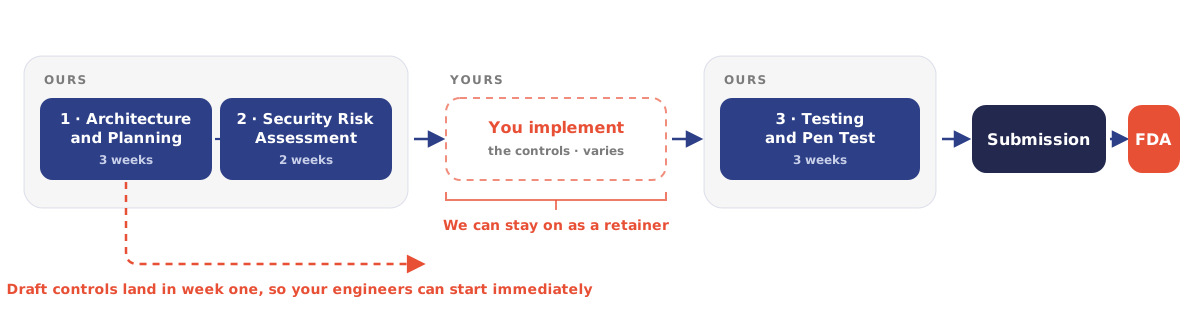
Controls covering all of FDA’s risk control categories, or a reason why one does not apply. A draft lands in week one so your engineers can start.
Management Plan, Measures and Metrics
How risk is managed across the lifecycle: secure development, vulnerability handling, monitoring, and the measures that show the controls work.
SBOM and Software Support Lifecycle
A readable SBOM covering the whole deployed artifact, not just your code, plus level of support and end of support for each part. We can wire your CI/CD to rebuild it.
Vulnerability Assessment and Unresolved Anomalies
The SBOM scan, a safety and security read on what it finds, and an honest list of open issues with impact and mitigation plans.
Penetration Testing Report
Scoped to the surfaces FDA expects, not just the easy ones, and written up the way reviewers want it. Retesting after you fix things is included.
Cybersecurity Labeling and Risk Management Report
User-facing security duties, diagrams, update and anomaly reporting, plus the final report that pulls every security activity into one submission-ready summary.
How the engagement runs
Three phases, and a gap in the middle that belongs to you.
We front-load the controls so your engineers can build while we keep writing. The one part of the schedule we do not control is how fast those code changes land.
Which situation looks like yours?
Six cybersecurity problems we are asked to solve.
Most engagements are one of these. If yours is not on the list, it is still worth a call.
Hold letter
FDA stopped our submission on cybersecurity
You have a clock and a list. We read the letter, work out the smallest change that closes each item, and write the response. Often the answer is a document, not a code change, and knowing which is which saves real time.
No cyber team
Our software engineers do not know cybersecurity
Good engineers who have never built a threat model or defended a control set to a regulator are the norm. We name the controls, write the documents, and run the testing, so your team builds against a list instead of guessing. If you would rather own this in-house, we can teach as we go.
Architecture
We want to reduce how much of this applies to us
Architecture is the biggest lever on a cybersecurity bill. Putting the algorithm in a container, leaving image retrieval to hospital IT, and treating inputs as files rather than network calls can take whole categories of testing off the table. Decided late, none of it is open to you.
Device or not
We are not sure we are even a cyber device
FDA reads the definition broadly, so the answer is usually yes. The useful question is what that obliges you to do. We settle it fast and move on to scope.
Pen test scope
We do not know what the penetration test has to cover
Firmware, the mobile app, the cloud and its APIs, third-party endpoints, and more and more a simulated clinical setup with a PACS and a server rather than the device alone. We scope it, run it, and retest after you fix what we find.
Legacy
Our software or OS predates the current guidance
Documents written before the 2023 guidance are close to unusable, and parts can reach end of support while you are still in review. We will tell you what can be saved, and when the problem is bigger than cybersecurity, we will say so.
Fixed fee. Every document. Penetration test included.
A cybersecurity package FDA will accept.
Three phases, ending in a submission-ready set of eSTAR attachments. Part of the fee is not due until FDA comes back without major cybersecurity deficiencies.
Before you book the call
The questions we actually get asked, in order.
What is in scope, and what is not?
In scope: every cybersecurity document the eSTAR template asks for, from the architecture views and threat model through to the SBOM, the vulnerability assessment, the pen test, the labeling, and the final security risk management report. Plus answering FDA if they come back with cybersecurity questions.
Not in scope: writing the code. We name the controls, draft them early so your engineers can start, and verify them after, but your team builds them. We also do not cover the rest of your submission, though we can.
Is penetration testing included?
Yes. It is part of the job, not a second project you have to scope, buy, and manage.
The threat model drives what gets tested, so it targets what actually worries FDA rather than running a generic checklist, and the findings come back ready for the submission. Retesting after you fix something is covered.
We are partway through the documentation already. Can we reuse it, or get a discount?
Almost never. We quote the full job whether or not you have a head start.
Everyone asks, and we get why. Your team put real money and months into this. But we tried picking up part-done work for a while, and every time it was slower and more expensive than starting clean.
The effort nearly always went into the software design spec, because that is the document engineers find easiest to write, and FDA barely reads it. The SOPs usually come from a generic template that was never meant for software as a medical device, so we have to fix those first. And we have to work out why your team did what they did, then change it without insulting anyone, which is slow.
It costs more than starting fresh. So we say no to the discount. It is not what anyone wants to hear, but the discount would have cost you more.
Can architecture changes reduce how much of this applies to us?
Often, yes. A SaMD can usually be shaped so that much less of it falls inside the pen test.
The biggest lever is defining your external connections by an interface contract rather than by one deployment. If the device reads DICOM files from a bind mount and writes a report back out, the PACS, the cloud gateway, and the routing service become external systems rather than parts of the device. Narrowing the device boundary helps too, since software that does not perform a medical device function can often sit outside it.
Most teams do not know how their software will be deployed when they submit. On premise, in the cloud, through an AI marketplace: the market usually settles that later. Threat modeling one setup you are going to change anyway is wasted work, and much of what would have been security controls in that surrounding infrastructure turns into labeling and interface tests.
The catch is that these are design decisions. Raised during architecture they are nearly free. Raised after the software is frozen they are usually gone. Our article Everything Outside the Binary Is a Guess goes deeper.
How do I know you will not inflate the scope?
Because inflating scope is how a cybersecurity specialist grows an account, and we are not one.
Cybersecurity is one of several things we do here. Most of our work is regulatory strategy, submissions, QMS, and software development, often with the same clients over years. Talking you into more security work than your device needs would cost us the next job.
In practice that means we argue for less: a narrower device boundary, fewer controls where the risk does not justify them, documentation scaled to what the device actually is. FDA does not reward a thicker package, and neither do we.
Is my device even a cyber device? Can we qualify out?
If your device has software, chances are it is a cyber device. FDA reads the term very broadly, and most teams hoping to fall outside it do not.
The main exception we see in practice is firmware on custom hardware with no exposed ports. Almost everything else lands inside, including instruments on a local network with no route to the internet and systems that are air-gapped at launch.
Settle it early rather than assuming either way, but plan on being a cyber device unless you have a specific reason to think otherwise.
Can you work with our regulatory consultant?
Yes, and it is common. We are often brought in as the cybersecurity specialist on a submission somebody else is leading, including by regulatory consultants who send us their own clients for this part.
We work inside your quality system, and the documents drop into the rest of the submission without reformatting. Your consultant keeps the FDA relationship and the plan.
How much of our engineering team's time does this take?
Plan on up to three one-hour meetings a week with engineers who can explain the architecture and the existing controls, plus a guided walkthrough of the code on a screen share.
The bigger commitment is building. We draft the controls early so your team can start while we keep writing, but someone has to write that code, run the manual test protocols, and fix what the pen test finds. That window is the main variable in your real calendar.
Do your deliverables map onto the eSTAR template?
Yes, on purpose. Clients have matched our proposal line by line against the eSTAR attachment list, which is fair enough, and we welcome it.
Each document is named and organized to upload straight into the current template. Where eSTAR splits something we deliver as one artifact, we break it out so the mapping is one to one.
Do you need our source code?
It helps, but it is not required.
With access we move faster and ask fewer questions. Without it we need more engineer time in design talks to reach the same understanding, which usually costs more of your team’s hours than it saves in access reviews. A guided screen share is often enough.
What happens if FDA still finds cybersecurity deficiencies?
We fix them at no extra cost. That is the guarantee, and it is in writing.
On top of that, part of the fee is not due until FDA responds without major cybersecurity deficiencies. If major ones do come back, that payment waits until the submission goes through, or until it fails for reasons unrelated to cybersecurity. We are paid in full when the work has done its job.
Do we need cybersecurity finished before our IDE?
Not the whole package. FDA spells out a subset of the cybersecurity documentation that an IDE requires, which is meaningfully less than what a marketing submission needs. We scope to that subset when the IDE is what you are working toward.
What tools do you use for the SBOM, and do we have to buy anything?
Nothing to buy. The right tool depends on your stack, and we have built SBOMs by hand where no good automated option existed.
For ongoing work we usually suggest off-the-shelf vulnerability monitoring such as Dependabot or Snyk, both with usable free tiers, and we can set up your CI/CD to emit an FDA-compatible SBOM on every build so it never goes stale.
One scoping note: your SBOM should cover the whole deployed artifact, including system libraries in the container, not just your own dependencies. Narrow SBOMs are a steady source of FDA questions.
Do you work inside our QMS, and do you have your own cybersecurity SOPs?
We almost always work inside your quality system, and we bring our own cybersecurity SOP.
If you do not have one of your own, which is common, we can hand ours over for you to adopt, or build it into your QMS as separate work. We can also supply resumes for everyone on the project, since most supplier controls procedures ask for them.
Do we have to retest every year?
Expect to. FDA usually recommends an annual pen test retest, and we have sometimes negotiated every two years depending on the device and how fast it changes.
This is an ongoing cost whoever you work with, so it belongs in your operating budget, not your submission budget. We automate the test where we can, which makes each later round faster and cheaper than the first.
What are the other ways we can work with you on cybersecurity?
Remediation is the biggest of four. The others:
Scoping. Where the device boundary is genuinely unsettled, we do a short paid review of your architecture and existing documents first, so the scope is built on something real rather than a guess.
Support. For teams still building. We work with your engineers during design so the controls are built in rather than retrofitted, and the documents pile up as you go. Cheaper over the life of the program, and only open to you if you start early enough.
AINN and hold letter response. You submitted, FDA came back with cybersecurity deficiencies, and you have a clock. We scope what closes the letter and write the response.
All four are sold on their own. You do not need to buy a regulatory strategy engagement to get cybersecurity work from us, and we will not try to turn a small one into a large one. We also do the rest: regulatory strategy, submissions, QMS, and software development. Plenty of clients start here and bring us the next thing, which is a better outcome for us than padding this one.
Why pay for this when an LLM can tell us what FDA requires?
A fair question, and we use these tools ourselves.
Models are good at telling you what the guidance says. What they cannot tell you is how a review division has behaved lately: which architecture choices shrink the scope, what reviewers ask for beyond the written requirement, where the unwritten expectations sit. None of that is published.
The other half is doing it. Knowing the document list does not produce a defensible threat model, a pen test FDA will accept, or a traceable risk assessment. That is the part FDA reviews.
When is Innolitics the wrong firm?
When the device is hardware-first and the software is incidental. We do not take on implantables, catheters, surgical instruments, orthopedic hardware, or the electrical and mechanical work on capital equipment. We work on combination products where the software is the substance of the device, and we partner for the hardware.
When the problem is an end-of-life operating system on complex electromechanical equipment. We have handled that as a letter-to-file question, not as the center of a first submission, and we will say so and point you to someone better placed rather than learn on your schedule.
When you need CE Mark or other non-US submissions as the main goal. We are a US FDA firm.
When you want a light review or hourly consulting. We add the most value when we are playing a major role, so if you want a second set of eyes, we are not the right fit.
30 minutes. No deck.
Book the fit call. Leave knowing what you actually need.
We will tell you whether you are a cyber device, what the pen test has to cover, and whether you need us at all. If you do not, you will hear that.
What people read before booking
We publish our thinking.
The same reasoning that goes into a cybersecurity package, written up in public.
Start here
Medical Device Cybersecurity: Best Practices, FAQs, and Examples
This article provides an in-depth exploration of medical device cybersecurity requirements, including best practices and FAQs. It also includes examples and resources for those ...
 J. David Giese
How should we handle our SBOM?
Medical Device SBOMs: Best Practices, FAQs, and Examples
Practical suggestions and tips for authoring SBOMs for medical devices and for using them to monitor for cybersecurity vulnerabilities.
J. David Giese

What does the 2026 guidance actually change?
2026 FDA Guidance - Cybersecurity in Medical Devices: Quality Management System Considerations and Content of Premarket Submissions
The 2026 FDA guidance on medical device cybersecurity, updated to align cybersecurity expectations with the Quality Management System Regulation (QMSR) and ISO 13485.
Feb 3, 2026
What does FDA push back on most?
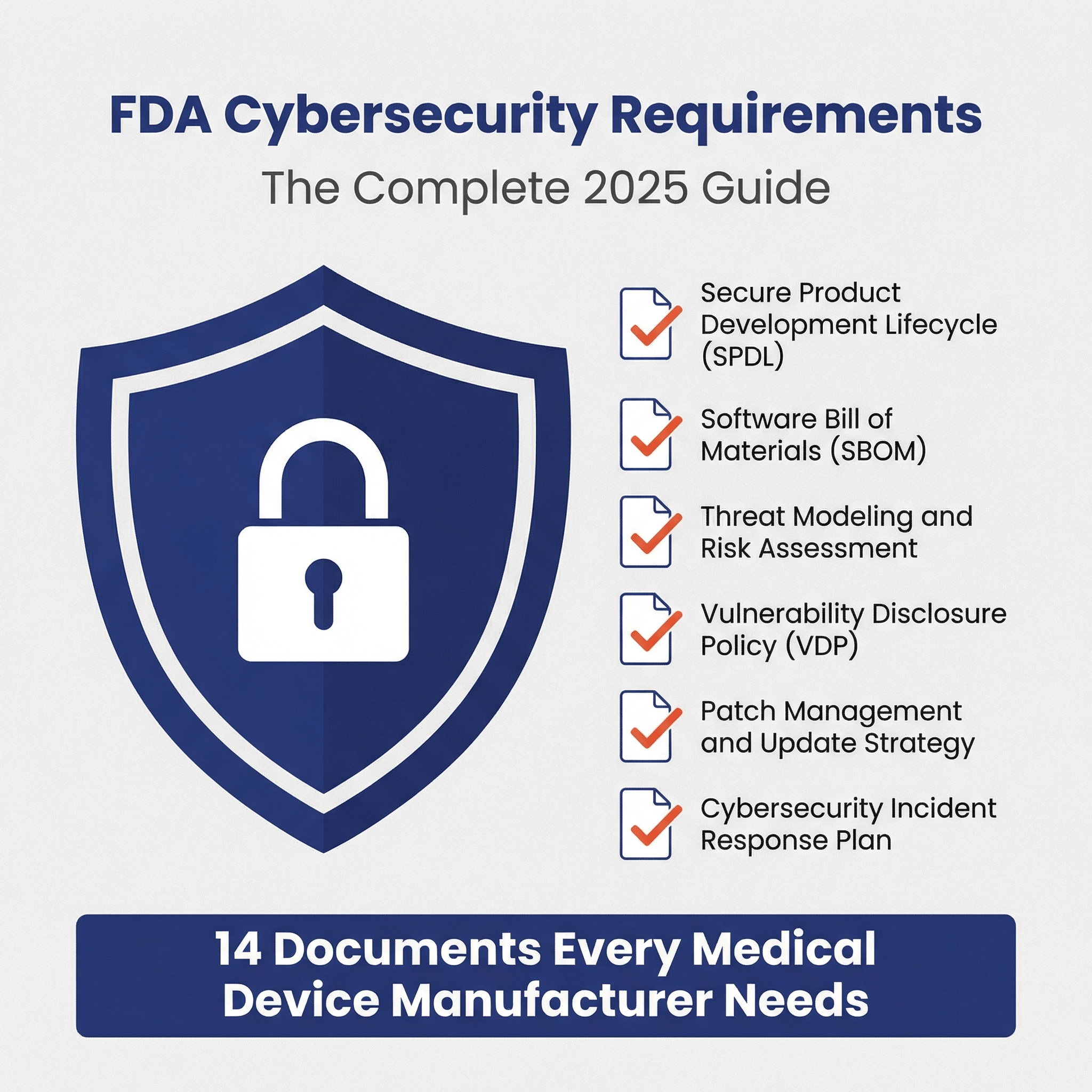
How to Avoid 14 Common FDA Cybersecurity Deficiencies
How do you avoid slowing down your FDA marketing submission (510(k), De Novo, or PMA) with cybersecurity problems? This article reviews 14 common FDA cybersecurity deficiencies ...
 Yujan Shrestha & George Hattub

Do we have to share our SBOM?
On Sharing SBOMs
In this article, we share a nuanced approach to avoiding sharing sensitive information in an SBOM.
J. David Giese

Need more than cybersecurity?
See our other services.
Regulatory strategy and FDA Pre-Sub, concept to cleared device, AI/ML 510(k) submissions, and QMS, each sold on its own.
Let's Talk
Every great partnership starts with a conversation. Fill out the form below for a discovery call, and an Innolitics team member will contact you soon.
I learned more from an hour-long Innolitics sales call than an entire paid engagement from other consultants.

Richard Clark
Executive in Residence at Washington University