Summary 🔗
I'm Yujan Shrestha, a co-founder of Innolitics. If you plan to file with FDA in 2027, allow for the time your team will spend answering FDA's questions, and make the submission easy for a newer reviewer to follow. The user-fee changes FDA has proposed could start no earlier than fiscal year 2028, which begins October 1, 2027.
That was the practical message of our November 5, 2026 Coffee and Q&A. James Swink, who spent 22 years at FDA, hosted my co-founder J. David Giese and me to discuss what FDA's device center, the Center for Devices and Radiological Health (CDRH), said at its Town Hall, which closed The MedTech Conference in Boston on October 21. Quotations come from the replay, with filler words removed.
Key points
- Reviewers. David's recent reviews have been less predictable, though not necessarily tougher. I find a clear, visual submission helps.
- Calendar time. FDA's 90-day goal for a 510(k), the most common device clearance route, does not count time the sponsor spends answering FDA. Our planning allowances from submission to decision run from about 4 to about 8 months.
- User fees. The draft of the next user-fee agreement keeps the 90-day goal and proposes a $2,000 fee for certain initial pre-submission (pre-sub) meetings. Congress has not acted on it.
- Change control plans. Keep predetermined change control plans (PCCPs) narrow. David recommends a first submission without one, or with a simple one.
- Cybersecurity. David does not expect FDA to increase its focus soon. Security at the company and in the device both need continuing funding.
Replay of the November 5, 2026 Coffee and Q&A (58 minutes, edited).
Will newer reviewers make a 510(k) less predictable? 🔗
CDRH Director Dr. Michelle Tarver said the center had lost about 22% of its staff over the year and a half before October 2026, along with 30% of its reviewers and a significant number of digital health and AI specialists. She said CDRH hired 65 people at White Oak in fiscal 2026. The reported hiring total does not identify how many hires were reviewers. She also said that as of September 30, 2026 the center was on track to meet nearly all its review goals. These are Tarver's figures as the Regulatory Affairs Professionals Society (RAPS) reported them. With that turnover, James's advice was to plan for a new reviewer.
"My experience on my last few submissions is primarily a less predictable review, unfortunately." (J. David Giese)
David said some recent reviewers seemed new and unclear about standards FDA had enforced before, and in some cases about FDA's own guidance. He expects less predictable reviews, though not necessarily tougher ones.
In my experience, FDA becomes less predictable when a package lacks detail or is hard to follow. When the submission leaves uncertainty, I find reviewers tend to take the more conservative position. My advice is to "make their job as easy as possible, use as many visuals as you can."
What is the real 510(k) timeline? 🔗
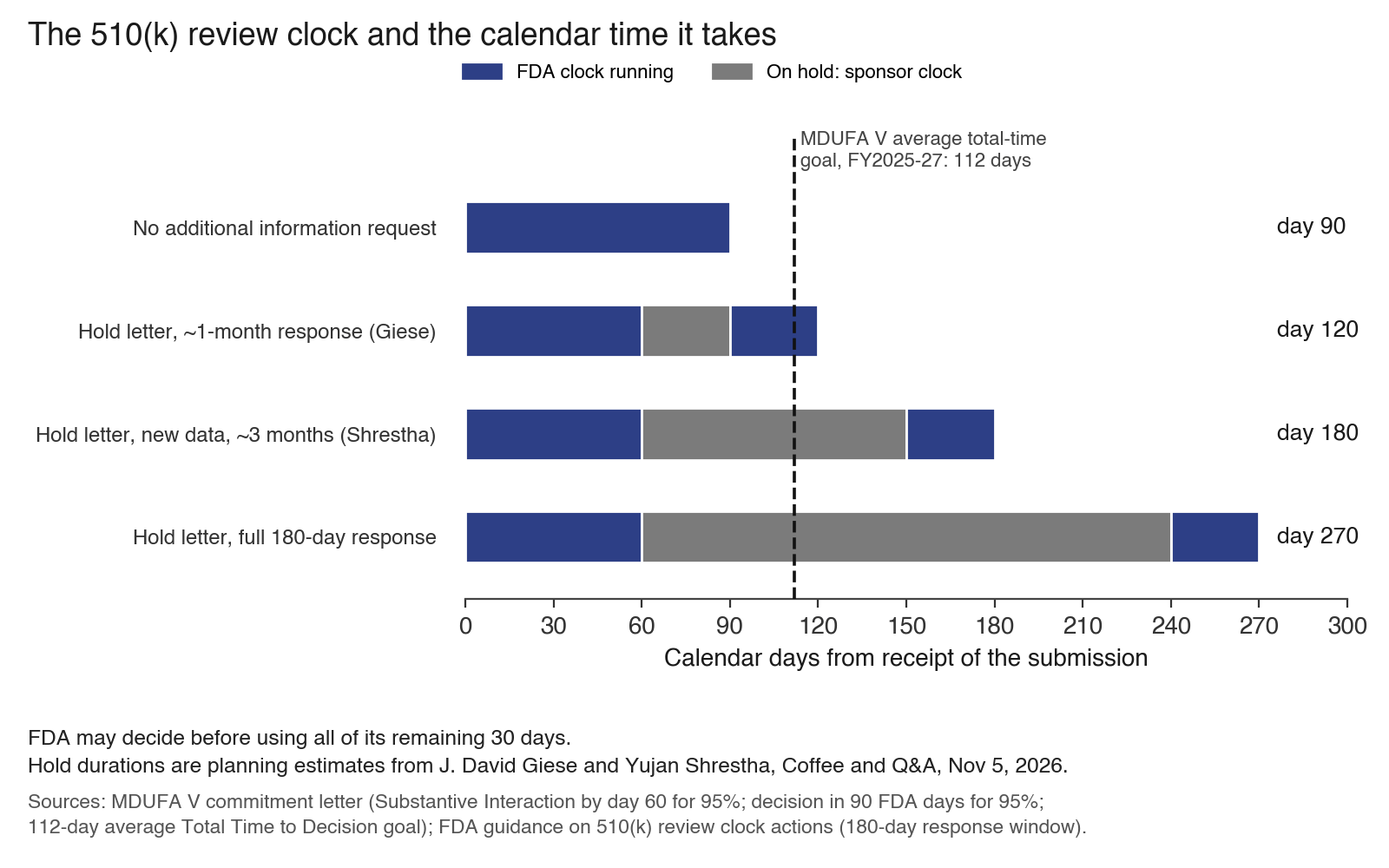
FDA measures its 510(k) goal in FDA days, which exclude any time the submission is on hold while the sponsor responds. Calendar time includes those days. "Plan on calendar days, not FDA days," James said.
"It's kind of like a chess clock. The sponsor gets 180 days, FDA gets 90." (Yujan Shrestha)
FDA's goals, which describe performance across all submissions, are first substantive feedback within 60 calendar days and a decision within 90 FDA days, each for 95% of 510(k)s. FDA's additional-information request usually arrives around day 60. FDA then stops its clock, and you have up to 180 calendar days to respond.
For a single submission, these are our planning allowances from submission to decision, based on our own experience:
- About 4 months (David). The 90 FDA days plus about a month on hold. A month is realistic if you need no new studies.
- About 6 months (me). "4 months is realistic. I think 6 months is even more realistic, especially if you have a lot of AI stuff."
- About 8 months (me). If the first submission lacks a study or validation data FDA is likely to ask for, I would budget 2 more months on hold to collect it.
New data takes as long as it takes to collect it and to have experts determine the correct answers the device is scored against. A good consultant can tell you what FDA is likely to ask. Start likely additional studies before FDA sends the letter.
Where does the time go before you submit? 🔗
FDA's records do not show how long a company took to go from zero documentation to its first submission. I think that is where the vast majority of the time goes, much of it spent hiring a team, qualifying vendors and running pre-subs that may not have been needed.
My analysis of AI device fundraising found a median of 25.7 months from the first disclosed funding round to the first 510(k), across 37 companies. Work done before that round is not counted. This is an observation from those companies. It does not measure the time needed to prepare a submission or set a minimum schedule for another company.
What is proposed for MDUFA VI? 🔗
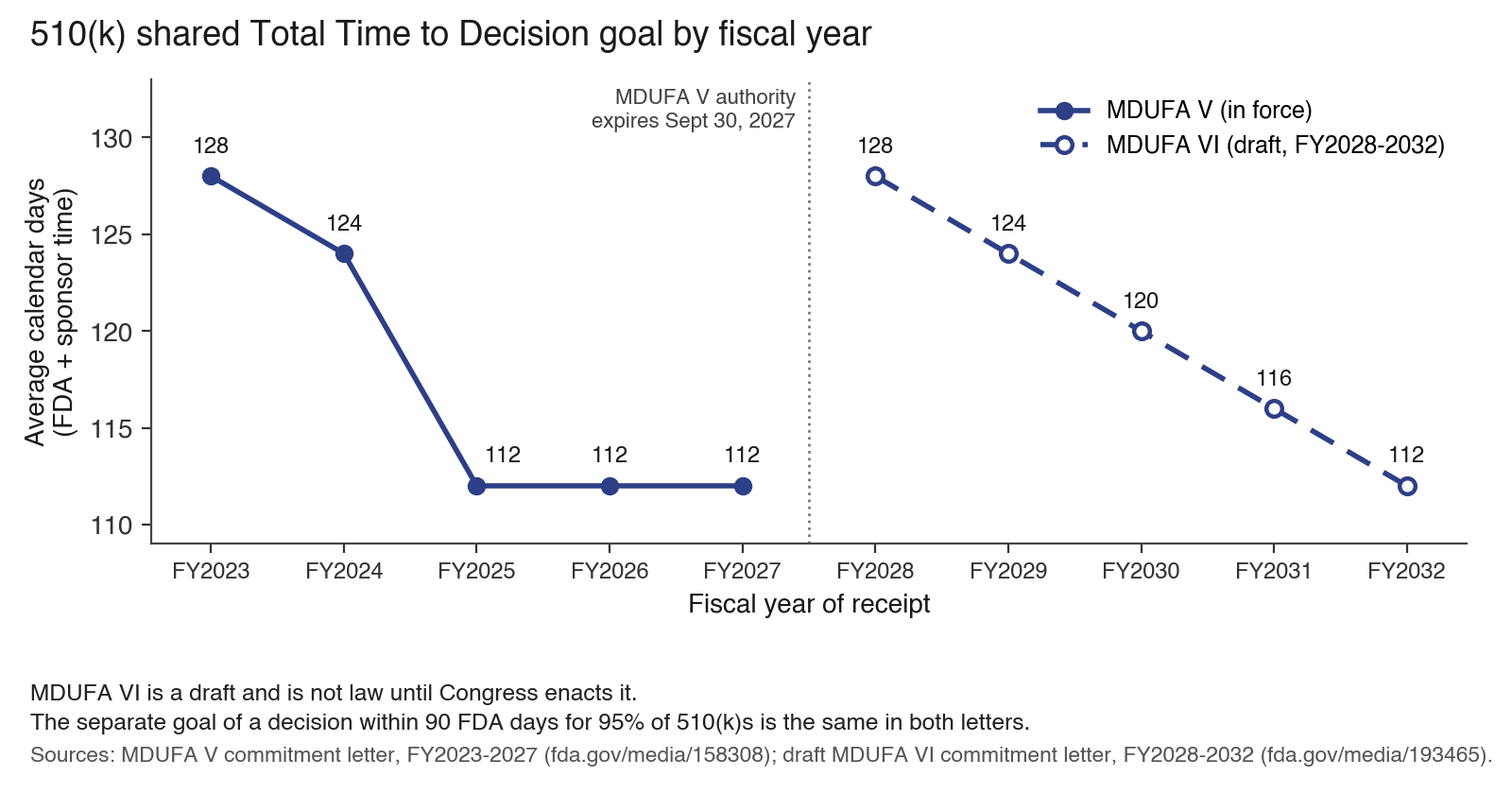
MDUFA VI, the next Medical Device User Fee Amendments agreement, would cover fiscal years 2028 through 2032. FDA's fiscal year starts October 1. The statutory deadline to send it to Congress is January 15, 2027, and the current agreement, MDUFA V, expires September 30, 2027. Everything below is a proposal until Congress acts.
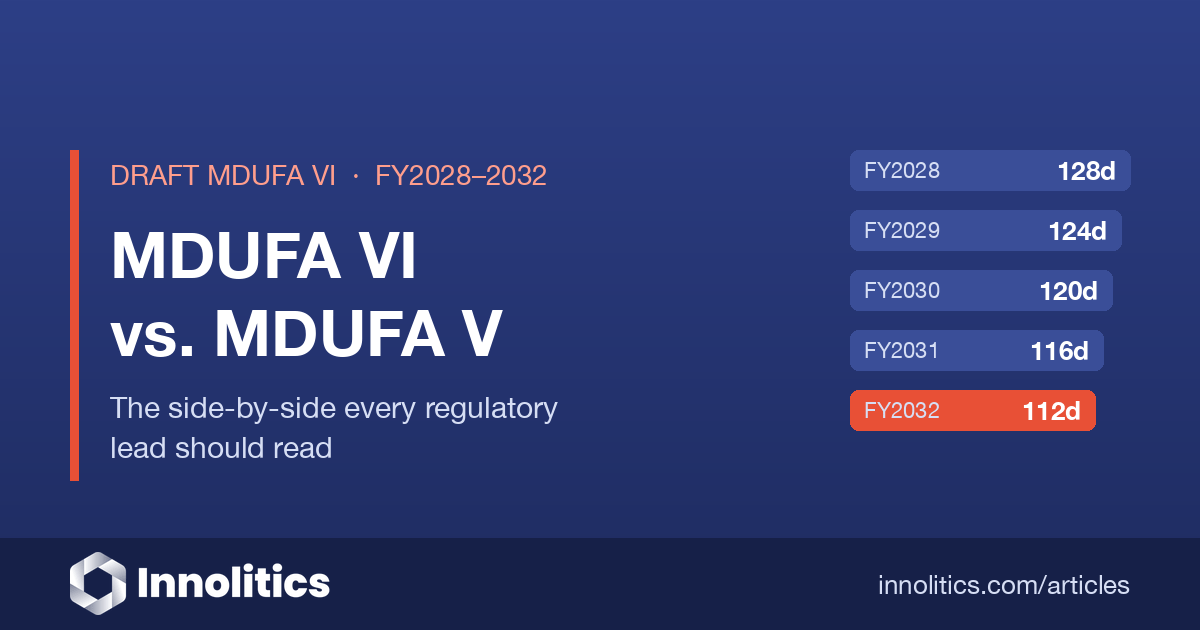
- 510(k). The 90-FDA-day goal is unchanged. The Total Time to Decision goal, an average across submissions that counts FDA and sponsor days together, is already 112 calendar days under the MDUFA V letter. The draft MDUFA VI letter would restart it at 128 days in fiscal 2028 and step it down to 112 in fiscal 2032.
- Pre-subs. FDA proposes a focused follow-up option and a "$2k fee for certain initial Pre-Submissions", credited toward a future marketing submission fee. There is no pre-sub fee in the fiscal 2027 fee schedule.
Should a pre-sub cost $2,000? 🔗
I support the proposed fee if it improves the feedback sponsors get.
Pre-sub feedback varies a lot. Sometimes FDA's team comes well prepared, and other times it is clear they did not have time to review everything we sent. A fee should limit pre-subs that never needed to go to FDA. I would also ask for a tiered system with a much faster turnaround for a higher fee.
David agreed and said $2,000 is too low, since the cost of a team waiting around 2 months and then getting poor feedback can far exceed the fee.
How do you run a pre-sub with a reviewer you don't know? 🔗
Begin with a brief walkthrough. Our team spends the first 5 to 10 minutes walking the reviewer through the device, then moves to our questions. Without that, you can loop on questions and discover at the end that the reviewer did not understand your device. James's advice was to explain the device from front to back.
David has seen a clinical reviewer who had not read everything raise questions that then went into the meeting minutes.
"That can almost hurt you more than if you just hadn't even had the pre-sub in the first place." (J. David Giese)
A vague pre-sub can leave you facing more demanding expectations than the ones you started with.
Why we recommend keeping PCCPs narrow 🔗
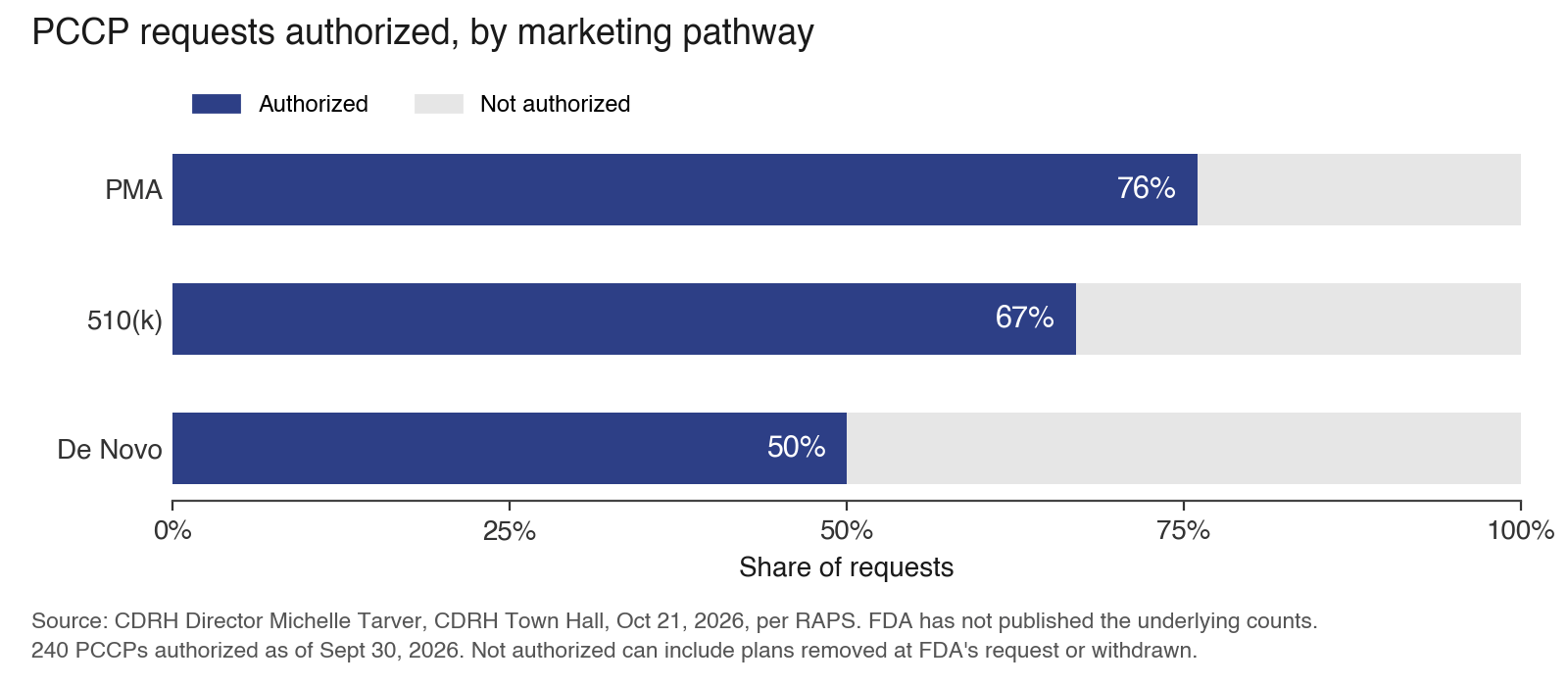
A PCCP, authorized under section 515C of the Federal Food, Drug, and Cosmetic Act, lets a manufacturer make pre-specified changes without a new submission. Tarver said CDRH has authorized 240 PCCPs, with authorization rates of 76% for premarket approval applications, 50% for De Novos and 67% for 510(k)s, as RAPS reported. "Not authorized" can include plans removed at FDA's request or withdrawn. Those rates do not say why requests failed. The reasons below come from our own experience.
FDA has to assess the proposed changes in advance, so a plan needs limits and enough description. The plans I have seen fail had too little description, were too broad, or allowed changes that could alter the intended use or indications for use.
David said companies often add the plan at the end of a 510(k) to skip the next one, and it usually does not work. Reviewers must project forward through every possible change on roughly the same review budget.
"I'm becoming a bigger and bigger proponent of you do your first submission without a PCCP, or maybe one that's just on AI retraining or something simple and straightforward." (J. David Giese)
Then make a follow-on submission that adds the PCCP, so FDA has time to review it carefully.
Are AI tools making FDA's reviews more detailed? 🔗
David said an FDA official told him at the conference that Elsa, FDA's internal generative AI tool, is fully rolled out and widely used. FDA launched Elsa agency-wide in June 2025 in a GovCloud environment and said the model was not trained on data submitted by industry. David has seen deficiencies that a few years ago would probably not have been raised, and I see more nuanced, detailed comments. We observed this on our own submissions and did not establish that Elsa caused it.
Is the doctor the safety net? 🔗
In its comments to FDA on generative AI, the American Medical Association wrote: "Physician expertise should inform the standards, not serve as the safety net." I read that as saying the doctor should not be the only safety net, and read that way I support it. Clinician involvement does not remove the need to test the device's effect on clinical decisions.
David said too many new generative AI devices lean on the doctor, and he sees it in almost every submission.
"Any time you have a shared responsibility, you always... there ends up being a little bit of a blame game." (J. David Giese)
For a sponsor whose study is marginal, the decision depends on risk. Look at how the device performs, what its errors cost the clinician, and how much it biases the clinician in the intended workflow. FDA may still push back on any of those points.
Rick Abramson, Director of FDA's Digital Health Center of Excellence, said at an AI policy panel on October 20 to expect draft generative AI guidance in a matter of months, without a firm timeline, as MedTech Dive reported. The only generative AI draft on CDRH's priority A-list for fiscal 2027 covers conversational devices for mental disorders.
Cybersecurity: protecting the company and the device 🔗
"It's an economic game." (J. David Giese)
David said defenders need to spend enough that an attack is not worth the attacker's time. AI makes attacks cheaper, so more organizations become targets, and it also makes defense easier.
The business. Security measures have to go in at the company as well as in the device. The larger the company, the larger the target.
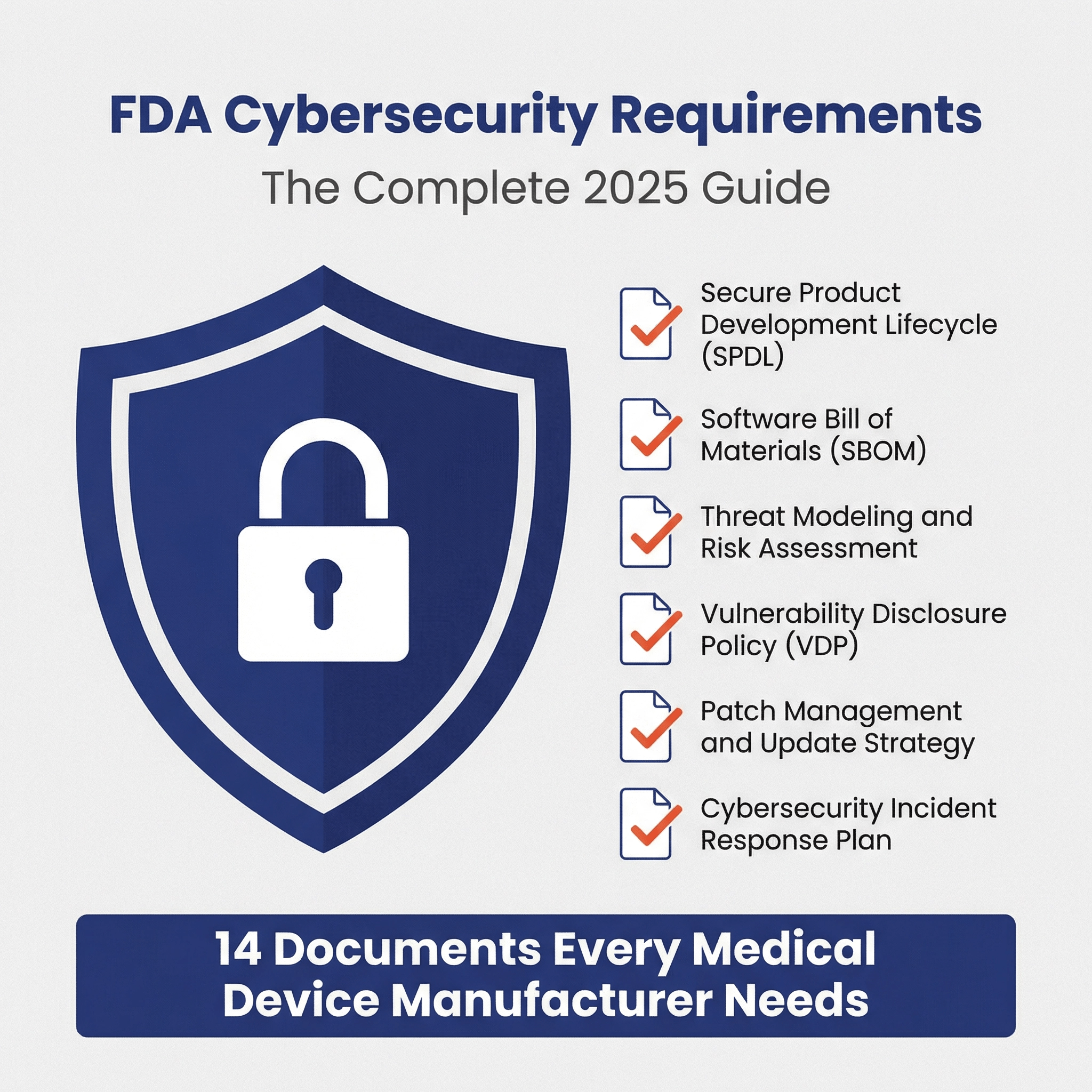
The submission. David's starting point is to have an AI coding tool such as Claude Code review your code for vulnerabilities and run mock penetration tests, then add more sophisticated tools. The penetration test report in the submission is a separate item. In David's experience, reviewers object when that report is more than about 6 months old. That window is reviewer practice. FDA's cybersecurity guidance, issued February 3, 2026, asks for penetration test reports. David doubts FDA will increase its focus soon, given how stretched it is.
After clearance. FDA recommends postmarket testing "at regular intervals commensurate with the risk (e.g., annually)." David said companies should test more often. I would fund cybersecurity and postmarket surveillance as ongoing activities. James's closing advice was to use FDA's guidance, and the work continues after the submission at a level set by the device's risk.
Which FDA and CMS programs should you watch? 🔗
These programs matter most if you are deciding how an AI device will get paid for. CMS is the Centers for Medicare & Medicaid Services.
- TAP, for sponsors who want early FDA engagement. Tarver said the Total Product Lifecycle Advisory Program is estimated to save companies 6 to 12 months of development time and about $100,000. RAPS did not report the basis for that estimate.
- RAPID, for makers of certain novel devices who need Medicare coverage. Tarver described this proposed CMS and FDA pathway as aiming for coverage within one to two months instead of a year or more, with CMS issuing a proposed coverage decision at the same time as FDA authorization. Only Class II De Novo devices in TAP and Class III Breakthrough devices are eligible, and in vitro diagnostics are excluded. CMS published a proposed notice on August 11, 2026.
- TEMPO, an FDA pilot for digital health makers generating real-world evidence. It had four participants as of November 2026.
- ACCESS, a CMS model for chronic care that pays for outcomes and is tied to TEMPO. CMS's payment table sets annual allowed amounts of $90 to $420 per beneficiary depending on track and period, or about $7.50 to $35 a month.
I have used TAP on client projects and find it a strong benefit, because these programs push a client to think early about how the device will be reimbursed.
"It's very rare that you have a list of needs that your customers give you." (Yujan Shrestha)
Even if you never join ACCESS or TEMPO, I would use them as a signal of what CMS is willing to pay for when you plan reimbursement and choose which device claims to pursue. Any claim still has to be proven, and some will need a hefty study.
Limitations 🔗
This article reports a conversation and is not a study. It corrects several statements made on air, so where the replay differs, use the figures here.
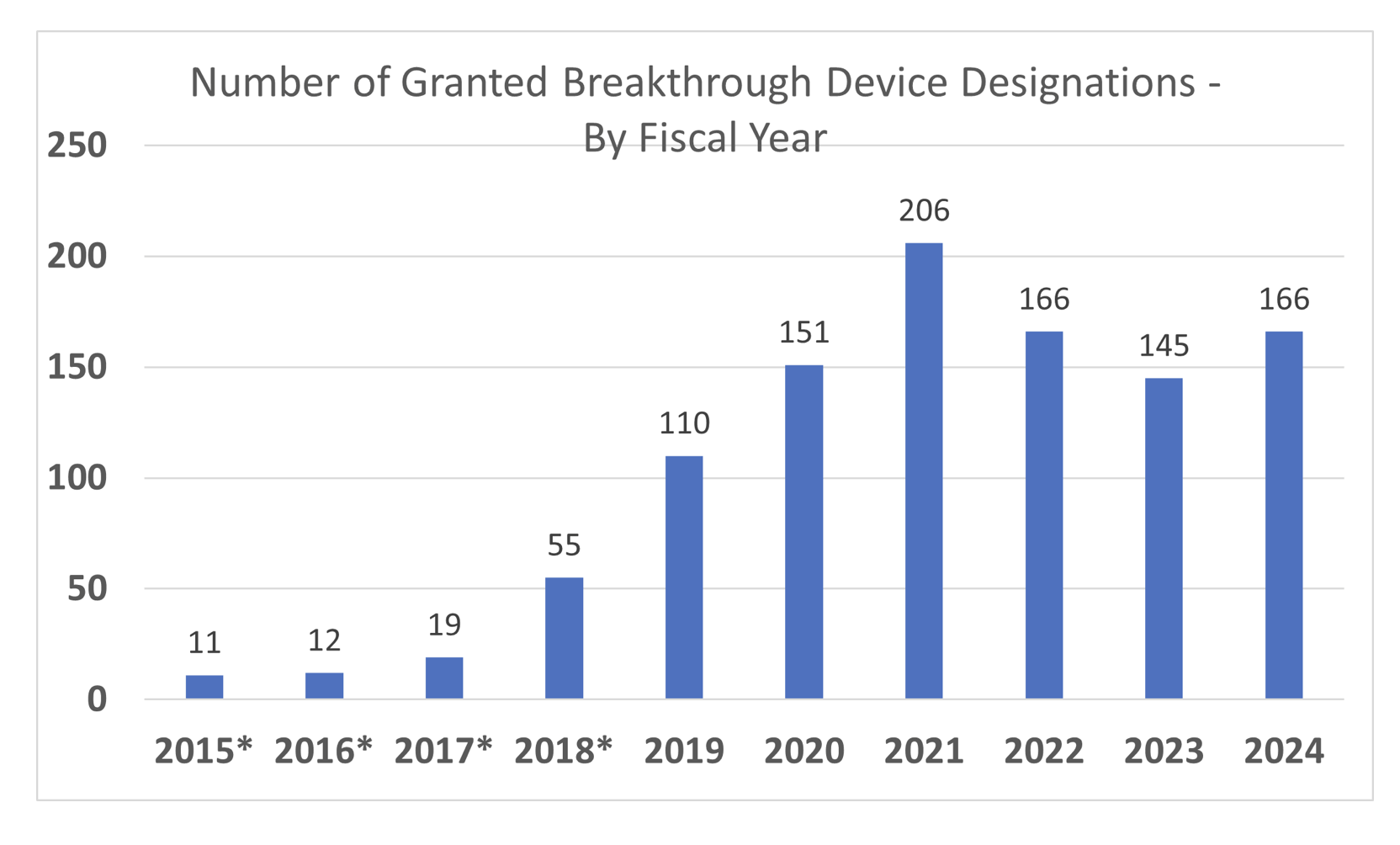
- Novel devices and hiring. The 151 novel devices James cited is Tarver's fiscal 2026 figure. The hiring goal she cited was 63 people, said on air as "63%."
- 510(k) total time. It was said on air that the goal "drops from 128 days to 112 days." It is already 112 days, and the draft would restart it at 128.
- Pre-sub fee. It was said on air that the fee is "already implemented." It is a proposal.
- PCCPs. The closing summary said about 25% were not cleared. For 510(k)s, about a third were not authorized. 24% is the premarket approval figure.
- Names and sources. "Mick Farrow" is Mick Farrell, who said smaller firms "may also be vulnerable." The AI speakers James quoted are Zahra Timsah of i-GENTIC AI and Erez Kaminski of Ketryx. Abramson's "matter of months" came the day before the Town Hall and is MedTech Dive's paraphrase.
- RAPID and TEMPO. RAPID is a CMS pathway outside MDUFA, with the eligibility stated above. TEMPO has four participants in total.
- ACCESS payments. David hedged a figure of $12 per patient per month. $12 a month matches the Medicare 80% share of a $180 track in CMS's table.
- Elsa. FDA describes Elsa as hosted in a GovCloud environment. I used that description.
- My own figures. I replaced the fundraising figures I gave from memory with the published ones, and left out a chest x-ray reading time I could not source.
- Start of FDA's clock. I described FDA's clock as starting after the administrative review. Under the MDUFA V letter, a 510(k) filed through FDA's electronic template that passes technical screening is accepted as of the date FDA received it.
Further reading 🔗
ArticleAI/ML
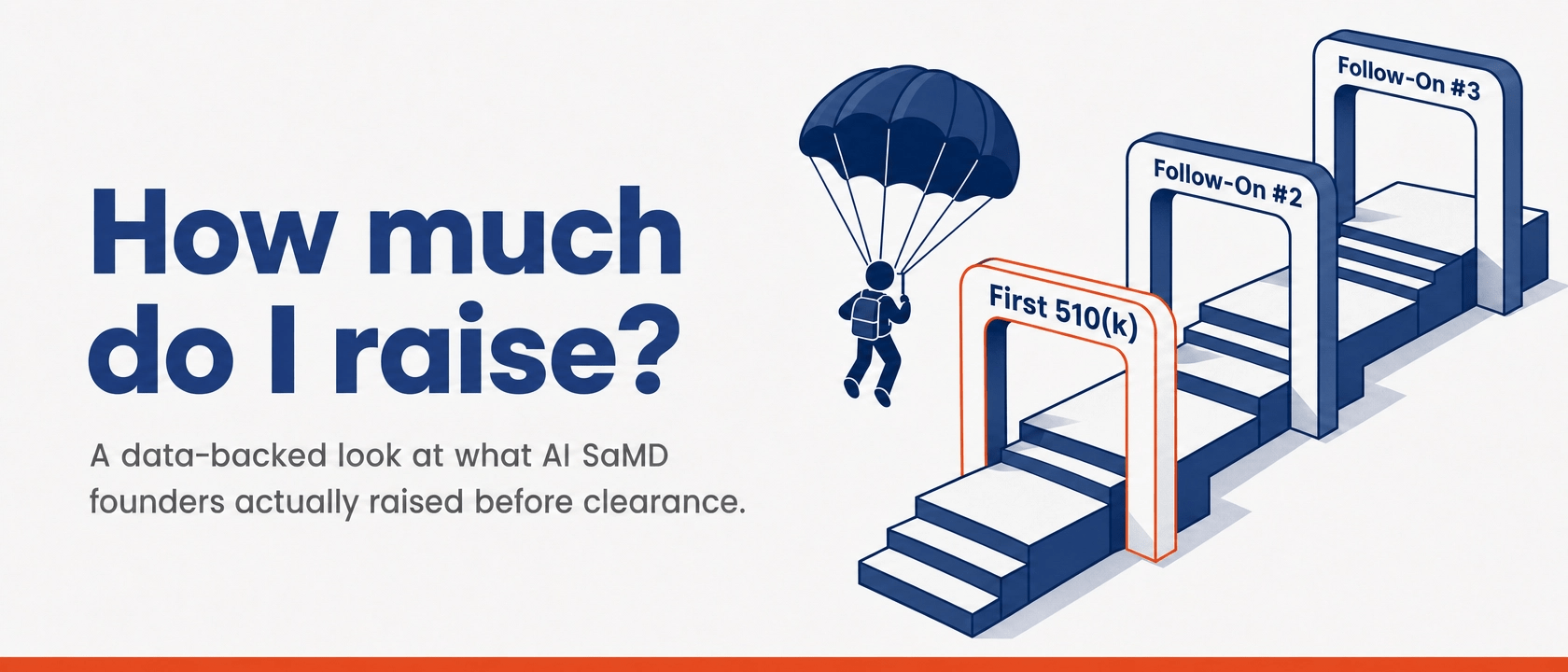
How much money should an AI SaMD company raise?
For AI SaMD founders deciding how much to raise and how long the first FDA 510(k) will take. A 37-company benchmark: $16.0M market-comparable median, $11.0M capital-efficient, 2...
 Yujan Shrestha
ArticleAI/ML
MDUFA VI vs. MDUFA V: The Side-by-Side Every Regulatory Lead Should Read
FDA’s draft MDUFA VI commitment letter (FY2028–2032) restructures how sponsors interact with the agency. Seven changes that will reshape submission planning for software and AI ...
Yujan Shrestha
ArticleRegulatory
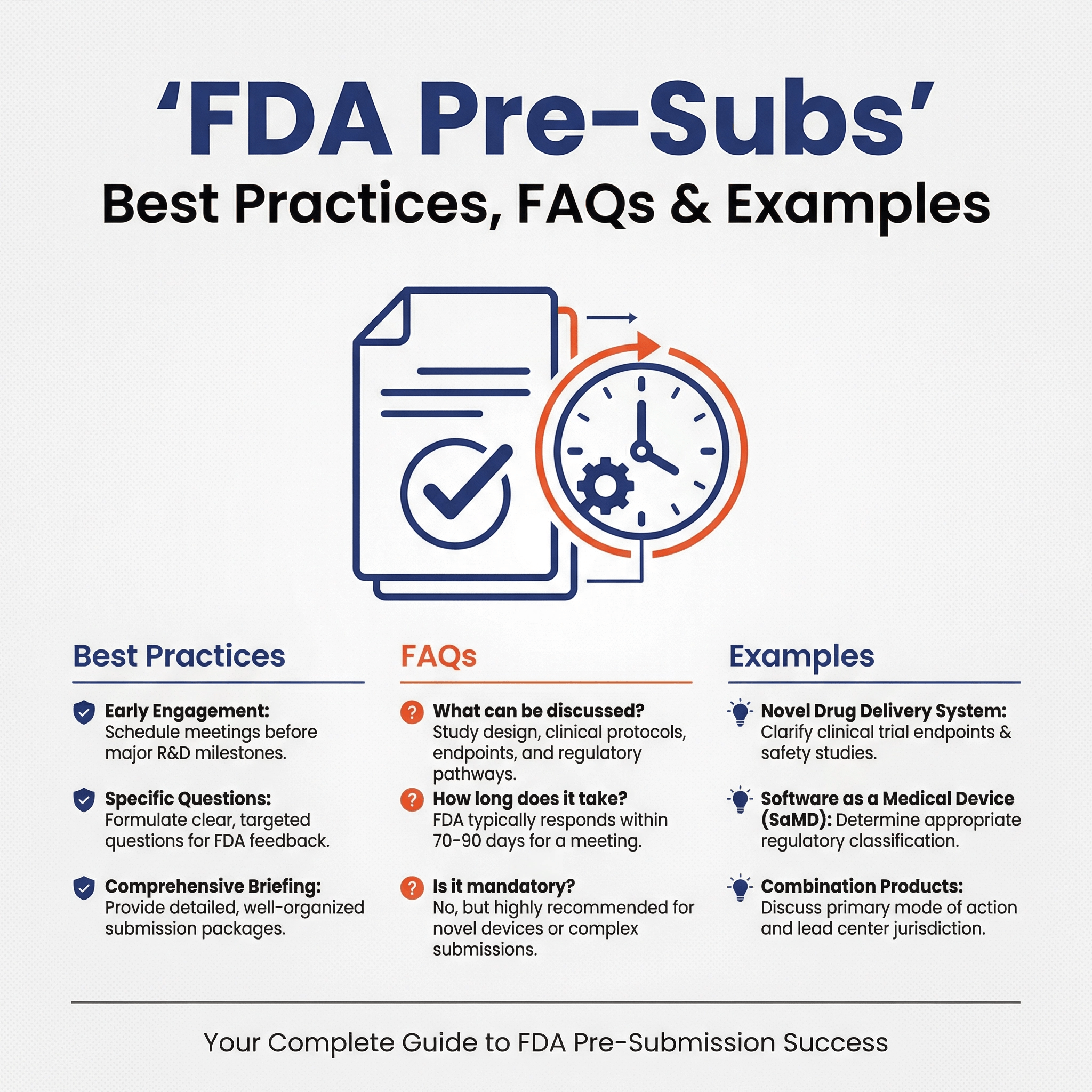
FDA Pre-Subs: Best Practices, FAQs, and Examples
A Pre-Sub is a mechanism for requesting formal written feedback from the FDA, and (optionally) a one-hour meeting. Pre-subs are a useful means to mitigate regulatory risk. This ...
 J. David Giese
ArticleAI/ML
PCCPs: Best Practices, FAQs, and Examples
With predetermined change control plans (PCCPs), FDA has given manufacturers a great new regulatory tool. In this article, we discuss PCCP best practices and questions based on ...
J. David Giese
ArticleAI/ML
FDA Releases Generative AI Medical Device Discussion Paper: What's Inside
FDA’s Aug 18, 2026 discussion paper proposes grading generative AI medical devices like physicians: benchmarks, then clinical confirmation, then live monitoring. What it says, w...
Yujan Shrestha
Public Comment on FDA's Generative AI Device Questions
ArticleRegulatory
FDA’s Breakthrough Device and STeP Programs: FAQs
Wondering whether FDA’s Breakthrough Device Designation or STeP program is worth the effort? This pocket guide unpacks the program in plain English—what it is, who qualifies, an...
J. David Giese
About the authors 🔗
James Swink
Principal Regulatory Specialist
I spent 22 years at FDA's CDRH working 510(k), PMA, De Novo, and IDE pathways, directed more than 150 Advisory Committee meetings, and oversaw all six CDRH advisory committees. I oversaw all six CDRH advisory committees, trained the center's Designated Federal Officers, prepared both FDA review teams and sponsors for panel, and served as Designated Federal Officer for FDA's first Digital Health Advisory Committee meeting on generative AI in 2024. At Innolitics I bring that reviewer-side view to regulatory strategy, Q-Subs, 510(k) and De Novo submissions, and hold responses for software and AI/ML devices.

Yujan Shrestha, MD
Partner
I have led or supported FDA strategy and submissions for 51+ medical devices, most AI-enabled, since co-founding Innolitics in 2012, across 510(k), De Novo, Breakthrough, Q-Sub, and deficiency responses. My work spans radiology AI (CADe, CADx, CADt, quantitative imaging), cardiac and neuro imaging software, dental AI, LLM and foundation model devices, and I have managed or contributed to 65 Innolitics projects. FDA's public clearance letters for AI Metrics (K202229, 2020) and Medweb's Lightning Viewer (K242362, 2024) name me as the sponsor's correspondent. I presented at FDA's first Digital Health Advisory Committee meeting on generative AI in November 2024, I have published 78 articles on innolitics.com, and I built fda.innolitics.com, our public FDA device search tool.

J. David Giese
Partner
I have led or supported FDA submissions for 40+ diagnostic devices since 2012, across 510(k), De Novo, Q-Sub, and PCCP, including cleared 510(k)s for Echo IQ and Prenuvo. I co-founded Innolitics in 2012 and was the named FDA contact on Echo IQ's EchoSolv AS (K241245, 2024) and Prenuvo Body Composition (K242825, 2025); in 2026 I helped GuideAI Health clear a vascular occlusion triage CADt 510(k) without a pre-submission. My work spans radiology AI (CADt, CADe, CADx, quantitative imaging), ECG and signal analysis software, and SaMD cybersecurity across 65 Innolitics projects, and I write our long-form guides on FDA software regulation, cybersecurity, SBOMs, pre-subs, PCCPs, and De Novo requests. I hold biomedical engineering degrees from Boston University (M.S.) and UT Austin (B.S.) and run Innolitics with Yujan, my old friend and business partner.