Download the 1-Page Regulatory Landscape Brief: Get the printable, self-updating Enhanced vs. Basic Documentation Level in AI/ML SaMD PDF with clickable highlight links to every cited FDA summary and guidance passage.
Abstract 🔗
Many AI medical device teams assume that using machine learning, filing a Predetermined Change Control Plan (PCCP), or pursuing a De Novo classification automatically pushes their submission into FDA’s Enhanced Documentation Level. This article tests that assumption against every AI/ML software as a medical device (SaMD) 510(k) and De Novo authorization decided after FDA issued its June 14, 2023 final guidance, Content of Premarket Submissions for Device Software Functions.
Using the FDA Device Explorer (data as of November 17, 2026; latest decision date November 15, 2026), we audited all 687 post-guidance AI/ML SaMD authorizations. Because FDA does not require sponsors to state software documentation level in a public 510(k) Summary, 107 authorizations (15.6%) explicitly name Basic or Enhanced Documentation Level under the 2023 framework (while 75 still cite the legacy 2005 Level of Concern terminology).
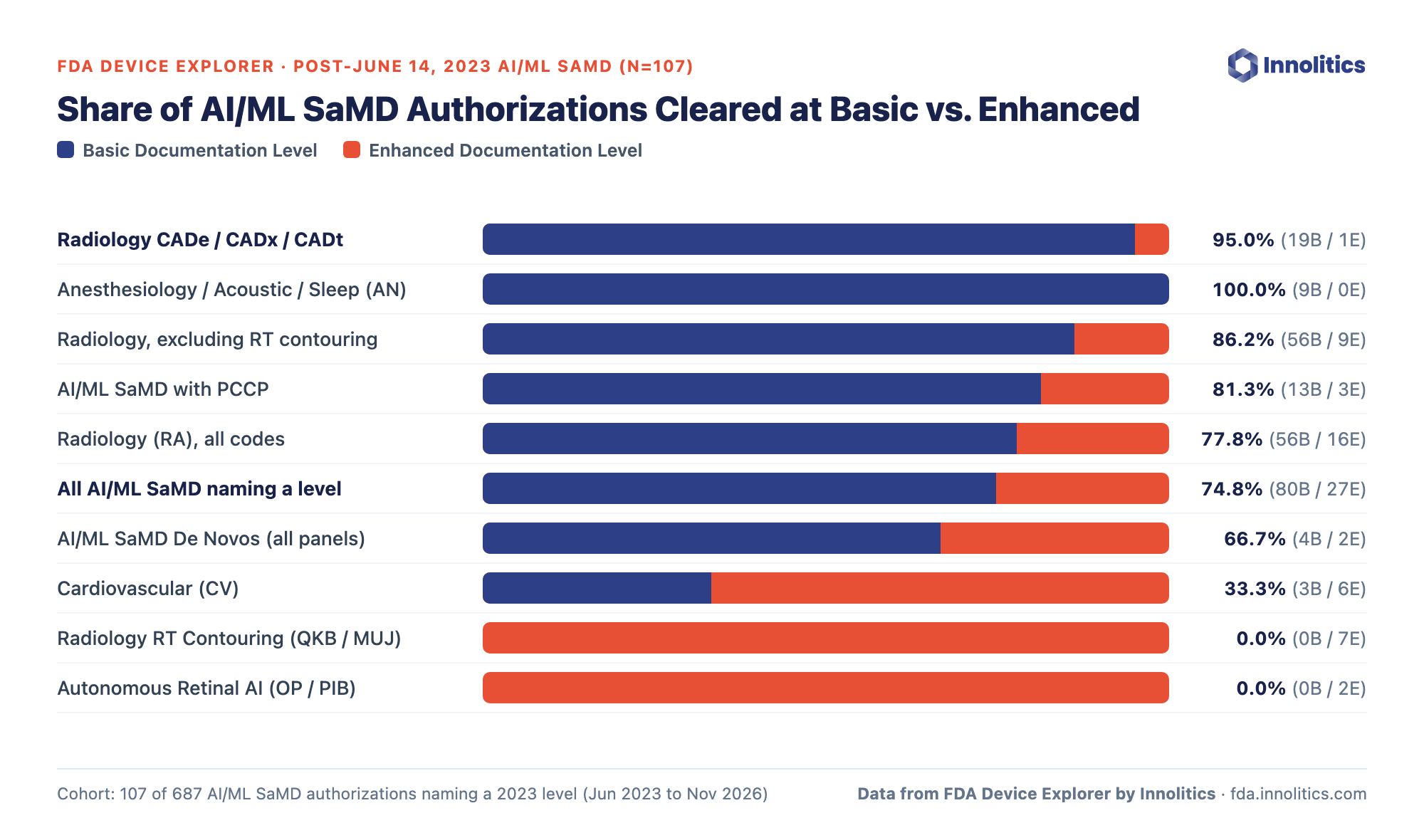
Among those 107 authorizations, 80 (74.8%) cleared at Basic Documentation Level and 27 (25.2%) cleared at Enhanced Documentation Level. In Radiology excluding radiation-therapy contouring, 56 of 65 (86.2%) cleared at Basic. Across Radiology CADe, CADx, and CADt clearances (QAS, QFM, QDQ, QBS, MYN, POK), 19 of 20 (95.0%) cleared at Basic. Among AI/ML SaMD authorizations with a PCCP, 13 of 16 (81.3%) cleared at Basic. Among AI/ML SaMD De Novos naming a level, 4 of 6 (66.7%) cleared at Basic, including 2 of 2 (100%) in Radiology. Every one of the 27 Enhanced authorizations maps cleanly to five concrete categories: radiation therapy contouring (7), Siemens Healthineers non-RT boilerplate templates (7), high-acuity cardiovascular and critical-care sepsis tools (7), autonomous diabetic retinopathy diagnostics (2), and intraoperative orthopedic guidance, digital contraception, or an enterprise imaging suite (4).
Background: What the June 2023 Guidance Actually Says 🔗
On June 14, 2023, FDA replaced its 2005 three-tier Level of Concern model (Minor, Moderate, Major) with a two-tier Documentation Level framework in Content of Premarket Submissions for Device Software Functions. The guidance draws a single bright line based on risk evaluated prior to implementing risk controls:
- Enhanced Documentation applies when a failure or flaw of any device software function “could present a hazardous situation with a probable risk of death or serious injury” to a patient, user, or others.
- Basic Documentation applies to every submission with device software functions where Enhanced Documentation does not apply.
- FDA explicitly clarifies that the word “probable” excludes purely hypothetical risks.
Enhanced Documentation adds meaningful software engineering overhead compared to Basic, including a Software Design Specification (SDS), more detailed risk management and verification traceability, and deeper architecture documentation. Over-classifying a Basic device as Enhanced can add months of unnecessary documentation work before filing.
Crucially, the guidance does not treat AI/ML algorithms, PCCPs, or De Novo submissions as automatic triggers for Enhanced Documentation. Instead, Appendix examples illustrate the boundary:
- A radiological display device falls at Basic because inadequate image quality alone does not present a probable risk of death or serious injury prior to risk controls.
- A critical-care sepsis alarm, an autonomous AI/ML retinal diagnostic device, and a radiation therapy treatment system (where software errors can cause target under- or overdose) fall at Enhanced.
Methods 🔗
Cohort 🔗
We pulled the complete cohort of FDA medical device authorizations in the FDA Device Explorer matching contains_ai_ml = true, is_samd = true, and decision_date >= 2023-06-14 through November 15, 2026 (data as of November 17, 2026, queried November 22, 2026). That yields 687 authorizations (539 in Radiology, 148 across 12 other review panels, and 16 De Novos), all with public PDFs.
Exhaustive Recall Sweep and Verbatim Verification 🔗
A naive exact search for "Basic Documentation" and "Enhanced Documentation" misses real clearances that write "Basic" Level of Concern, 'Enhanced' software documentation, Documentation Level: Basic, Level of documentation: Enhanced, or place the level in a comparison table cell. It can also double-count summaries that mention both terms in a footnote explaining the 2023 transition (such as K252204, which is Basic).
To avoid both failure modes, we fetched full OCR text for 357 of the 687 records: every post-June 14, 2023 AI/ML SaMD authorization containing the word "Basic", "Enhanced", "Documentation Level", or the 2023 guidance title, plus all 16 De Novos (reading FDA Decision Summaries where 510(k) summaries are not published, such as digital pathology 510(k) K254115). Every candidate passage was verified verbatim against the source PDF and linked via FDA Device Explorer native highlight links.
Results 🔗
Overall Distribution Across Segments 🔗
Of 687 post-June 14, 2023 AI/ML SaMD authorizations, 107 explicitly name Basic or Enhanced Documentation Level. Another 75 summaries still reference the legacy 2005 Level of Concern wording (for example, Moderate Level of Concern), and the remaining summaries omit documentation level altogether.
| Cohort / Segment (Jun 14, 2023 to Nov 15, 2026) | Naming a Level | Basic | Enhanced | % Basic |
|---|---|---|---|---|
| All AI/ML SaMD naming a 2023 level | 107 | 80 | 27 | 74.8% |
Radiology (RA), all product codes |
72 | 56 | 16 | 77.8% |
Radiology (RA), excluding RT contouring (QKB, MUJ) |
65 | 56 | 9 | 86.2% |
Radiology CADe / CADx / CADt (QAS, QFM, QDQ, QBS, MYN, POK) |
20 | 19 | 1 | 95.0% |
| AI/ML SaMD with a PCCP | 16 | 13 | 3 | 81.3% |
| AI/ML SaMD De Novos (all review panels) | 6 | 4 | 2 | 66.7% |
| Radiology AI/ML SaMD De Novos | 2 | 2 | 0 | 100.0% |
Anesthesiology / Acoustic / Sleep (AN) |
9 | 9 | 0 | 100.0% |
Cardiovascular (CV) |
9 | 3 | 6 | 33.3% |
Radiology RT Contouring (QKB, MUJ) |
7 | 0 | 7 | 0.0% |
Ophthalmology Autonomous Retinal AI (OP / PIB) |
2 | 0 | 2 | 0.0% |
Radiology CADe, CADx, and CADt: 19 of 20 Cleared at Basic (95%) 🔗
In clinician-in-the-loop radiology detection, diagnosis, and triage, Basic Documentation Level is the overwhelming norm. Nineteen of 20 clearances across QAS, QFM, QDQ, QBS, MYN, and POK cleared at Basic, including high-profile triage and cancer screening products:
-
Chest X-ray CADe with PCCP: Gleamer ChestView US 1.1 (K252486, Sep 2026,
MYN) -
Multi-finding chest X-ray CADx: AZmed Rayvolve AZchest (K261378, Aug 2026,
QBS) -
Chest X-ray & mammography triage (CADt): Neurocareai CXRDetectAI (K253751, Jul 2026,
QFM), Envisionit Radify Triage (K231871, Jan 2024,QFM), and United Imaging uAI Easy Triage ICH (K242292, Sep 2024,QAS) -
Lung & breast cancer screening CADe/CADx: Median eyonis LCS (K251474, Feb 2026,
QDQ), ScreenPoint Transpara (K260898, Aug 2026,QDQ), and Hologic Genius AI Detection 2.0 (K243341, Jul 2025,QDQ) -
Ultrasound CADx: Deep Breathe BlineSlide (K261679, Oct 2026,
POK)
The single Enhanced Radiology CADt in the entire cohort is Siemens Healthineers’s syngo.CT LVO Detection (K243145, Apr 2025, QAS), which uses the same Enhanced boilerplate language Siemens applied across six other non-RT syngo and nuclear-medicine filings.
De Novos and PCCPs Do Not Automatically Trigger Enhanced 🔗
Sixteen AI/ML SaMD De Novos were granted after June 14, 2023. Four recent grants (late 2025 through 2026) do not yet have published FDA decision summaries, three earlier grants still cited legacy 2005 Moderate Level of Concern, and three decision summaries omitted documentation level. Among the six AI/ML SaMD De Novos that name a 2023 documentation level, four (66.7%) cleared at Basic:
-
Clairity Allix5 (DEN240047, May 2025,
RA/SEZ): 5-year breast cancer risk prediction from screening mammograms (Basic) -
16 Bit Rho (DEN230023, Apr 2024,
RA/SAO): opportunistic low bone mineral density screening on radiographs (Basic) -
ArteraAI Prostate (DEN240068, Jul 2025,
PA/SFH, with PCCP): digital pathology prognostic test (Basic) -
Tyto Insights for Eardrum Bulging Detection (DEN250014, Mar 2026,
EN/SHL): pediatric otoscopy detection aid (Basic)
Only two AI/ML SaMD De Novos cleared at Enhanced, and both sit squarely in acute, life-threatening clinical decision-making: Prenosis Sepsis ImmunoScore (DEN230036, Apr 2024, GU/SAK), whose FDA decision summary explicitly cites FDA’s June 2023 sepsis alarm example, and Powerful Medical Queen of Hearts (DEN250044, Sep 2026, CV/SHS, with PCCP), an acute coronary syndrome (OMI) ECG model.
The same pattern holds for Predetermined Change Control Plans (PCCPs). Across all 16 post-guidance AI/ML SaMD clearances with a PCCP that name a documentation level, 13 (81.3%) cleared at Basic, including ChestView US (K252486), ArteraAI Prostate (DEN240068), ArteraAI Breast (K254115, May 2026), Apple’s Hypertension Notification Feature (K250507, Sep 2025) and Sleep Apnea Notification Feature (K240929, Sep 2024).
Where Enhanced Actually Triggers: All 27 Authorizations Mapped 🔗
Rather than appearing randomly across AI products, every single one of the 27 Enhanced AI/ML SaMD authorizations falls into one of five concrete patterns.
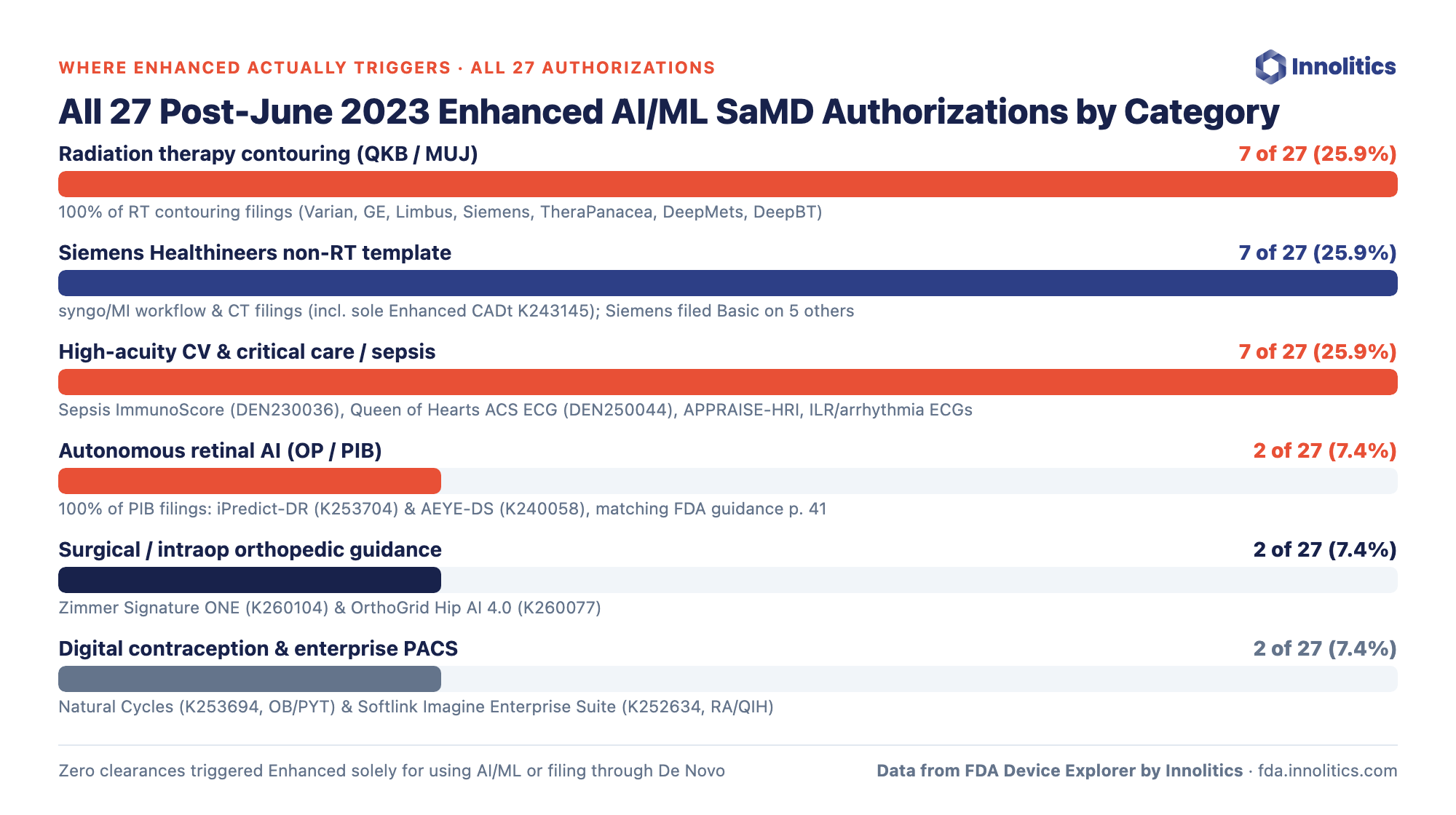
The alignment between FDA’s worked guidance examples and actual clearance outcomes is striking:
-
Radiation therapy contouring (
QKB/MUJ) is 7 of 7 Enhanced (100%). Automated organ-at-risk and tumor contours feed directly into radiation treatment planning, mirroring FDA’s p. 42 guidance example. -
Autonomous retinal diagnostics (
PIB) is 2 of 2 Enhanced (100%). Because primary-care providers act on an autonomous positive/negative diagnostic output without an ophthalmologist’s over-read, these directly match FDA’s p. 41 retinal AI example. - High-acuity cardiovascular and critical-care sepsis account for 6 of 9 Cardiovascular clearances and 1 of 3 GI/Urology clearances, matching FDA’s p. 40 sepsis alarm example. By contrast, ambulatory consumer cardiovascular alerts such as Fitbit’s Loss of Pulse Detection (K242967, Feb 2025) and Apple’s HTNF (K250507, Sep 2025) cleared at Basic.
-
Large-OEM template choices distort naive Radiology counts. Seven of the nine non-RT Radiology Enhanced clearances come from Siemens Healthineers
syngoand MI product lines, while Siemens itself cleared five other post-2023 AI SaMD products at Basic, including Prostate MR AI (K241770, Mar 2025). That reflects internal QMS template policy rather than an FDA mandate that non-RT radiology AI be Enhanced.
Practical Decision Framework 🔗
Before defaulting your software engineering team into Enhanced Documentation overhead, run a disciplined pre-mitigation hazard check against FDA’s June 2023 test:
- Check whether a clinician independently reviews the underlying clinical data. Adjunctive CADe, CADx, CADt, quantitative post-processing, and risk-stratification tools where a qualified clinician reviews the original images or records overwhelmingly qualify for Basic Documentation, even when filing a De Novo or bundling a PCCP.
- Watch the true Enhanced triggers. Plan for Enhanced Documentation upfront if your software directly informs radiation dose delivery, produces an autonomous diagnosis without specialist review, drives real-time life-threatening critical-care or cardiac alarms, guides intraoperative surgery, or serves as primary contraception.
- Document the rationale crisply in your Pre-Sub. A clear 1-page Documentation Level Evaluation grounded in your specific hazardous situations and peer precedents locks in FDA alignment before you write an unnecessary Software Design Specification.
Limitations 🔗
This audit relies on public FDA 510(k) Summaries and De Novo Decision Summaries indexed in the FDA Device Explorer. Because FDA does not require a 510(k) Summary to disclose software documentation level, only 107 of 687 post-June 14, 2023 AI/ML SaMD authorizations explicitly name Basic or Enhanced (with another 75 citing legacy 2005 Level of Concern terminology and four recent AI SaMD De Novos awaiting publication of their FDA decision summaries). Reporting bias is possible if sponsors who clear at Basic or Enhanced disclose documentation level at different rates. In addition, documentation level is determined by each device’s specific pre-mitigation hazards and intended use, not by product code alone.
Conclusion 🔗
Using AI/ML, adding a PCCP, or pursuing a De Novo classification does not automatically require Enhanced Software Documentation. Across all 107 post-June 14, 2023 AI/ML SaMD authorizations that name a documentation level, nearly three in four (74.8%) cleared at Basic, rising to 86.2% in non-RT Radiology and 95.0% in Radiology CADe/CADx/CADt. Enhanced Documentation clusters sharply where software failure creates a direct, probable hazard of death or serious injury: radiation therapy contouring, acute cardiovascular and sepsis monitoring, autonomous diagnostics, intraoperative surgical guidance, and contraception.
Data 🔗
Source: FDA Device Explorer by Innolitics, cohort of 687 AI/ML SaMD authorizations decided from June 14, 2023 through November 15, 2026 (data as of November 17, 2026; retrieved November 22, 2026). Download the companion 1-page printable summary: Enhanced vs. Basic Documentation Level in AI/ML SaMD (PDF).