Abstract 🔗
A Special 510(k) is a manufacturer's change to its own cleared device, with a 30-day review target. FDA's 2019 guidance states that certain changes to the indications for use may go through this pathway. This article measures how far the indications for use moved in every Special 510(k) for software as a medical device (SaMD) in the FDA Device Explorer. The cohort holds 486 clearances from 1998 to 2026. For 428 of them, the cited predicates have comparable indications text. A panel of AI models scored each change from 0 to 10 against the indications of the cited predicates. Of the 428 clearances, 250 (58%) make no change and 118 (28%) make a trivial one. Twenty-four (5.6%) score 5 or higher, which means a material expansion on at least one dimension. No clearance scores above 7. In three of the four largest changes, the manufacturer already held the added indications under another of its own clearances. Annalise Enterprise combined the findings of three earlier Annalise clearances in one device. Stethophone Pro added over-the-counter use by lay users, which an earlier Stethophone clearance already included. The share scoring 5 or higher is 3.4% before the 2019 guidance and 8.4% after it (Fisher's exact test, p = 0.03). The other material changes add anatomy, an imaging input or a function to a device whose claim type stays the same.
Background 🔗
FDA created the Special 510(k) Program in 1998 for changes a manufacturer makes to its own legally marketed device. The program relies on the manufacturer's design controls. The submission presents verification and validation results in a summary or risk analysis format. FDA intends to process a Special 510(k) within 30 days of receipt. The statute gives FDA 90 days for a 510(k).
The original program covered changes that left the intended use and the fundamental scientific technology unchanged. Under that policy, Special 510(k)s with modified indications for use were routinely converted to Traditional 510(k)s. The September 13, 2019 guidance replaced that test. FDA now asks whether well-established methods are available to evaluate the change and whether the results can be reviewed in a summary or risk analysis format. The guidance states that certain changes to the indications for use may be made under this approach. It also names changes to the indications for use that are supported by clinical, animal, or cadaver data as a scenario where a Special 510(k) is not appropriate.
The guidance includes a software example. A chest X-ray image processing program adds a feature that highlights lung nodules and changes its indications to describe nodule quantification. FDA's decision for that example is that the change cannot be reviewed in a Special 510(k), because no well-established method exists to evaluate it.
My earlier article, How Far Can a 510(k) Predicate Stretch?, measured predicate distance across all AI/ML 510(k)s. This article narrows the question to Special 510(k)s for software and to one axis, the indications for use.
Methods 🔗
Cohort 🔗
The cohort is every record in the FDA Device Explorer with submission type Special and the software-as-a-medical-device flag, as of October 27, 2026. That gives 486 clearances decided between October 1998 and September 2026. The analysis resolves the predicate numbers cited in each 510(k) summary and keeps the predicates whose indications for use are in the database. That leaves 434 clearances with at least one comparable predicate. In 99 of them, the indications text matches a cited predicate's text. Eighty-nine are identical apart from the device name, and ten differ by a few words.
Scoring scale 🔗
Each change is scored from 0 to 10 against the union of the cited predicates' indications. A feature counts as new only if no cited predicate already covers it.
| Score | Meaning |
|---|---|
| 0 | Same indications, or wording-only edits such as trade names and model numbers |
| 1 to 2 | Clarification or trivial addition, such as an accessory or a compatible component |
| 3 to 4 | Minor expansion inside the same claim, such as a closely related sub-population or configuration |
| 5 to 6 | Material expansion on one dimension, such as new anatomy, patient population, use environment, user, or input modality |
| 7 to 8 | New clinical finding or condition, a new claim type, or material expansion on several dimensions |
| 9 to 10 | A different clinical purpose from every predicate |
Scoring panel 🔗
Twelve AI models scored the 335 clearances whose indications text differs from every predicate. Five are general-purpose language models: Gemini 3.8 Flash, Claude Opus 5.5, GPT-6.1 Sol, Gemini 4 Argon and Kimi K3.1 Pro. Seven are decision models, which pick a level on the scoring scale and return a probability for each level: Liquid d1-ultra, Liquid d1.1, TypeSafe Jev 1.14, Perplexity Decider v1.2, Baseten Mammoth-1, Nace Drex Max and Morph Reflex. Each model scored every clearance independently. Each language model's ranking agreed with the other four at a rank correlation of 0.91 to 0.96, and each decision model agreed with the language models at 0.83 to 0.88.
Some predicate clearances bundle several indications under one 510(k) number, and the extracted indications field shows only one of them. The panel therefore re-scored the 98 clearances with a possible material change against the full text of each predicate's 510(k) summary. The five language models and four of the decision models took part in this round. The reported score is the median of the five language models.
Checks on the largest changes 🔗
The panel scored 25 clearances at 5 or higher. Each of the 25 then received three checks against the 510(k) summaries. The first check compared every added phrase with the full text of the cited predicate's summary. The second check compared the predicate list in the Device Explorer with the predicates the summary names. The third check searched earlier clearances held by the same manufacturer for the added wording.
The checks removed one clearance and corrected one predicate. syngo.via RT Image Suite left the list, because the full indications of its predicate already name every tool in the new indications. Visage PACS/CS 5.0 was re-scored against its own earlier version, which the summary names as a predicate, and it stayed in the list. The third check found three clearances whose added wording the manufacturer already held under another clearance. Those three stay in the list with a note. Twenty-four clearances remain. Every before and after excerpt in the table of the 24 matches the source indications text word for word.
Exclusions 🔗
Six clearances are excluded because the predicate comparison is unsound. In four, the summary cites a K number that belongs to an unrelated device. For example, ACON On Call Diabetes Management Software cites K113566, which is a T-cell culture medium. In one, ARIA Radiation Oncology cites a spinal kit number in place of its Vision predicate. In one, the bundled predicate of BriefCase K221314 includes the large vessel occlusion indication on pages that the text extraction cuts off. The final analysis covers 428 clearances.
Results 🔗
Distribution of change scores 🔗
| Change band | Clearances | Share |
|---|---|---|
| No change (0) | 250 | 58.4% |
| Trivial (1 to 2) | 118 | 27.6% |
| Minor (3 to 4) | 36 | 8.4% |
| Material (5 to 6) | 22 | 5.1% |
| New finding or several dimensions (7 to 8) | 2 | 0.5% |
| Different clinical purpose (9 to 10) | 0 | 0% |
Most SaMD Special 510(k)s keep the indications for use of the predicate. The 99 matching texts and the 151 wording-only edits make up 58% of the cohort. Twenty-four clearances score 5 or higher, and none scores above 7.
The 24 largest changes 🔗
The table lists the 24 largest changes, ranked from the largest. Each row shows the predicate's indications next to the Special 510(k)'s indications, as verbatim excerpts with omitted text marked by an ellipsis. Highlighted wording is what the Special 510(k) replaced or removed (blue) and what it added (orange). Each highlight links to its passage in the 510(k) summary. Three rows note that the same manufacturer already held the added wording under another clearance.
| # | Device | Before: predicate indications | After: Special 510(k) indications |
|---|---|---|---|
| 1 |
Annalise Enterprise K250831 (2025) Added wording already cleared to the same manufacturer under K213941 and K222268 |
K222179: chest X-ray cases with features suggestive of pleural effusion and pneumoperitoneum | features suggestive of the following findings: pleural effusion, pneumoperitoneum, pneumothorax, tension pneumothorax, vertebral compression fracture |
| 2 |
Stethophone Pro K252595 (2025) Added wording already cleared to the same manufacturer under K231551 |
K240901: is for use in environments where health care is provided by clinicians | can be used in clinical and nonclinical environments … also intended to be used by lay users |
| 3 |
AirStrip ONE Web Client with ACM K211949 (2021) |
K160862: To view the near real-time waveforms remotely … To provide a request for remote consultation | To view the near real-time and historic waveforms … To allow clinicians to manage secondary alarm transmission by suppressing non-critical alarms |
| 4 |
syngo.via MI Workflows VB40A, Scenium K191309 (2019) Added wording already cleared to the same manufacturer under K173597 |
K173897: provide analytical tools to help the user assess, and document changes in morphological or functional activity | … The Scenium display and analysis software has been developed to aid the Clinician in the assessment and quantification of pathologies taken from PET and SPECT scans |
| 5 |
ADAS 3D K210850 (2021) |
K191125: myocardial scar produced by ischemic heart disease … not intended to identify regions for catheter ablation | myocardial scar produced by ischemic or non-ischemic heart disease … intended to be used for pre-planning and during electrophysiology procedures |
| 6 |
Glytec G+ System K101344 (2010) |
K061110: calculate and recommend a dose of saline, glucose, and insulin … not intended for use with patients with known insulin allergies or patients under the age of 18 | regulate the infusion of I.V. fluids, through an I.V. infusion pump, and drive the blood glucose level towards a predetermined target range |
| 7 |
AI4CMR v2.0 K252084 (2026) |
K220624: report cardiac function measurements (ventricle volumes, ejection fraction, indices etc.) | report cardiac function measurements … AI4CMR also supports clinical diagnostics by calculating flow measurements of vascular structures in 2D phase-encoded cardiac MR images |
| 8 |
Imbio PHA K241847 (2024) |
K203256: maximal diameters of the right and left ventricles of the heart from a volumetric CTPA acquisition and report the ratio of those measurements | maximal diameters of the right and left ventricles of the heart, the main pulmonary artery, and the ascending aorta … report the RV/LV and Pa/Ao ratios |
| 9 |
Axial3D Cloud Segmentation Service K231607 (2024) |
K221511: diagnostic purposes in the field of orthopedic, maxillofacial and cardiovascular applications | cardiovascular applications in adults … may also be used for pediatrics between the ages of 12 and 21 years of age in cardiovascular applications |
| 10 |
VisAble.IO K240773 (2024) |
K223639: Computed Tomography (CT) image processing software package … imports images from CT scanners | Computed Tomography (CT) and Magnetic Resonance (MR) image processing software package … imports images from CT and MR scanners |
| 11 |
True 3D Viewer K170167 (2017) |
K142107: digital images acquired from CT or MR imaging devices | digital images acquired from CT, MRI and Ultrasound sources |
| 12 |
Exo AI Platform 2.2 K260217 (2026) |
K240953: trained and qualified to conduct echocardiography and lung ultrasound scans | trained and qualified to conduct echocardiography, abdominal, and lung ultrasound scans |
| 13 |
ImagenSPECT 3.0 K201933 (2020) |
K152503: analysis and display of cardiac SPECT images | analysis and display of cardiac SPECT and planar images … quantitation of multigated acquisition blood pool scans (MUGA) … early and late 99mTc pyrophosphate images |
| 14 |
densitas densityai K192973 (2020) |
K170540: compatible full field digital mammography systems | compatible full field digital mammography and digital breast tomosynthesis systems |
| 15 |
MI View&GO K201202 (2020) |
K191309: support the interpretation of examinations and follow up documentation of findings | The images and results produced by MI View&GO can also be used by the physician to aid in radiotherapy treatment planning |
| 16 |
EFAI RTSuite CT HCAP-Segmentation K231928 (2023) |
K220264: providing initial contours of organs at risk in the head and neck region on non-contrast CT images | providing initial contours of organs at risk on non-contrast CT images |
| 17 |
TomTec Image-Arena Applications K071232 (2007) |
K040546: intended as a general purpose digital medical image processing tool for cardiology, radiology, neurology | software packages for analysis of the left ventricle in heart failure patients, to analyze pathologies related to the Mitral Valve and for analysis of the right ventricle |
| 18 |
Cedara I-ReadMammo K040468 (2004) |
K022881: primary diagnostic review and planning through flexible and interactive manipulation of multi-modality softcopy images | primary diagnostic review and planning … including the use of prosthetic template overlays, and including mammography |
| 19 |
GE 12SL ECG Analysis Program K060833 (2006) |
K042177: under the direct supervision of a licensed medical professional in a hospital or medical professional's facility | intended for use in hospitals, outpatient clinics, emergency departments, and out-of-hospital sites such as ambulances and patient's homes |
| 20 |
Hi-D Imaging 4TAVR K261535 (2026) |
K241984: including aorta, left ventricle, left atrium, myocardium, right ventricle, and pulmonary artery | including the aortic valve and femoral arteries … Automatic detection of abdominal aorta, left and right common iliac |
| 21 |
ScanNav Anatomy Peripheral Nerve Block K232787 (2023) |
DEN220024: Supraclavicular level brachial plexus, Longitudinal suprainguinal fascia iliaca plane | Supraclavicular level brachial plexus, Longitudinal suprainguinal fascia iliaca plane, Femoral block |
| 22 |
Visage PACS/CS 5.0 K072205 (2007) |
K062490: Integration with other hospital information systems (HIS, RIS, CIS) is provided via special interfaces | Integration with other hospital information systems (HIS, RIS, CIS) is provided via special interfaces … Only DICOM for presentation images can be used on an FDA approved monitor for mammography for primary image diagnosis |
| 23 |
Scenium 1.1 K061545 (2006) |
K042863: pathologies taken from PET scans … derived from FDG-PET studies | pathologies taken from PET and SPECT scans … derived from FDG-PET and SPECT studies |
| 24 |
BriefCase-Triage K251406 (2025) |
K222329: analysis of CT exams with contrast (CTA and CT with contrast) that include the chest | analysis of CT chest, abdomen, or chest/abdomen exams with contrast (CTA and CT with contrast) |
Indications the manufacturer already held 🔗
In three of the four largest changes, the same manufacturer already held the added indications under another clearance.
Annalise Enterprise adds pneumothorax, tension pneumothorax and vertebral compression fracture to a predicate that triaged pleural effusion and pneumoperitoneum. Annalise already held clearances for those findings. K213941 covers pneumothorax and tension pneumothorax, and K222268 covers vertebral compression fracture. The K250831 summary states that the test dataset "was previously acquired (K213941, K222268 and K222179)".
The Stethophone Pro summary cites Stethophone K231551 as a reference device. K231551 is cleared for professional or lay users in a clinical or nonclinical environment. The Stethophone Pro summary states that the features "are now available for OTC use".
syngo.via MI Workflows VB40A names Scenium VE20A as a reference device and adds the Scenium indications to the workflow product.
Against the cited predicate, these three changes are among the four largest in the cohort. Against the manufacturer's existing clearances, they combine indications FDA had already cleared. The search of each manufacturer's earlier clearances found no such overlap in the other 21.
Dimensions of change 🔗
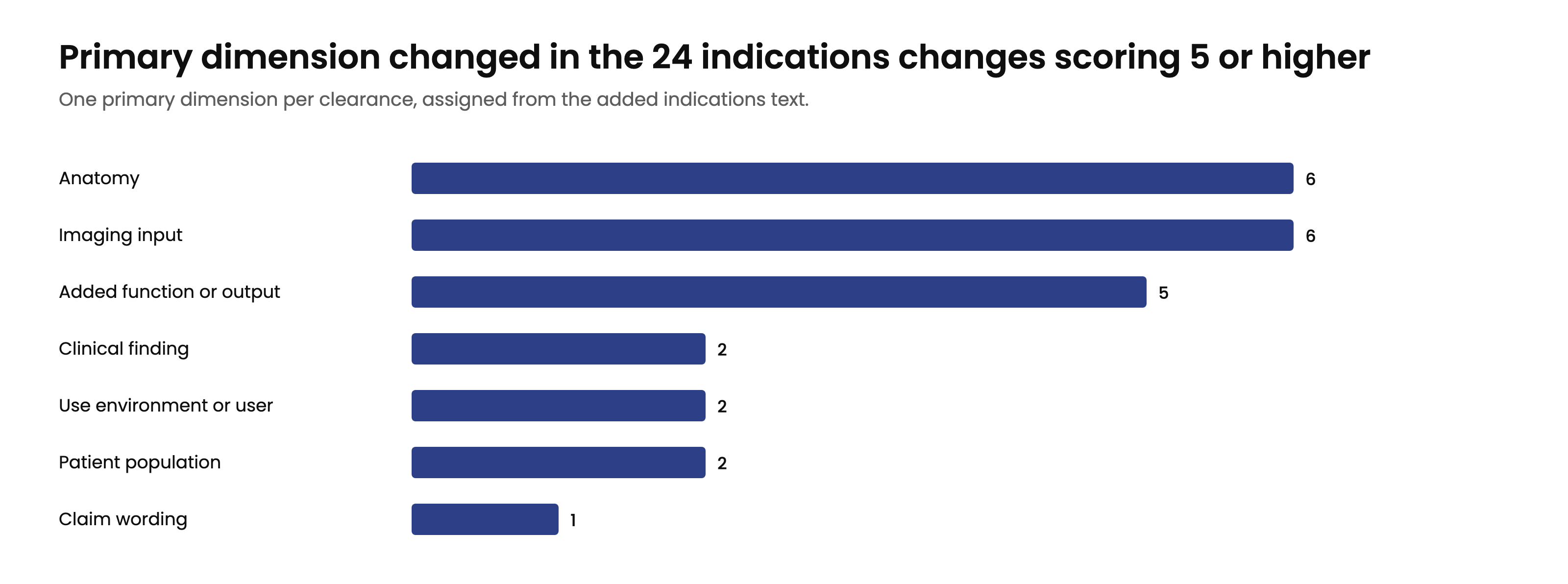
Seventeen of the 24 changes fall in three dimensions. Six extend the device to new anatomy, such as the femoral block region in ScanNav. Six add an imaging input, such as MR for VisAble.IO. Five add a function or output, such as flow measurement in AI4CMR. Two add clinical findings, two add a use environment or user, and two add a patient population. One changes the claim wording.
The claim type stays the same in 23 of the 24. A triage device remains a triage device, and a viewer remains a viewer. The remaining clearance is the Glytec G+ System, whose wording changes from recommending a dose to regulating an infusion. The case section below describes it.
Before and after the 2019 guidance 🔗
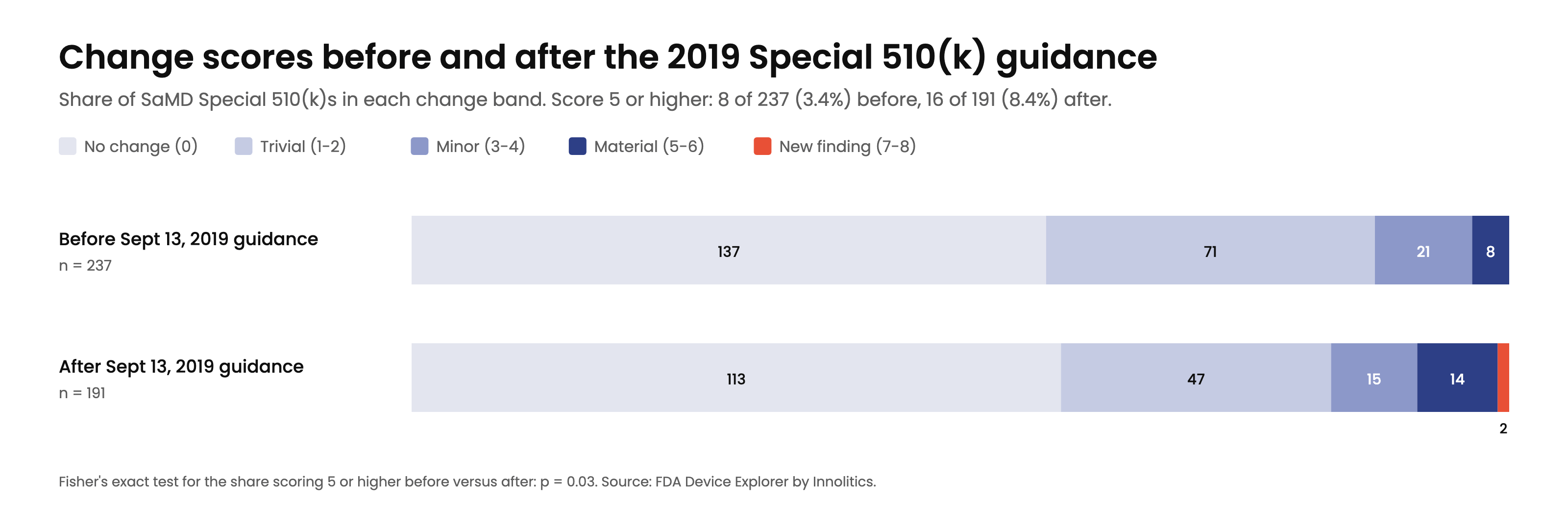
Before September 13, 2019, 8 of 237 clearances (3.4%) score 5 or higher. After that date, 16 of 191 (8.4%) do (Fisher's exact test, p = 0.03). Both clearances that score 7 are from 2025. The eight earlier clearances show that FDA cleared indications changes as Special 510(k)s under the earlier policy. GE's 12SL ECG Analysis Program extended use to ambulances and patients' homes in 2006, and Cedara added primary diagnosis of mammography in 2004.
AI-flagged devices are 117 of the 428 clearances, and FDA decided 112 of the 117 after the guidance. Eleven AI-flagged clearances (9.4%) score 5 or higher, against 13 of 311 (4.2%) for the other SaMD (p = 0.06). Among clearances decided after the guidance, the shares are 11 of 112 (9.8%) for AI-flagged devices and 5 of 79 (6.3%) for the others (p = 0.44). The data does not separate an AI effect from the change in era.
Evidence behind the material changes 🔗
Eleven of the 24 summaries report performance testing on patient images or recordings. Annalise Enterprise reports a standalone study of 3,252 cases from four US sites. ScanNav reports 183 ultrasound scans for the femoral block region, and Hi-D Imaging reports 289 CT scans for the aortic root and 85 for vascular access. The other 13 summaries report software verification and validation or bench testing only.
No summary describes its testing as a prospective clinical study. Three of the summaries that tested on patient images place that testing outside clinical testing. Imbio states that "No clinical testing was conducted". Hi-D Imaging states that "Clinical testing was not relied upon". VisAble.IO lists its segmentation results under "Performance testing (Bench)". One summary reports data collected during live use. Exo reports that "186 abdomen scans were acquired by 12 users" with the quality feedback running in real time.
Cases at the top of the ranking 🔗
Annalise Enterprise, K250831 🔗
The predicate, Annalise Enterprise CXR Triage Trauma (K222179), triaged adult chest X-rays for pleural effusion and pneumoperitoneum. The Special 510(k) lists five findings in one device. It sets the population at 22 years or older and names CR and DX as the modalities. The three added findings match two earlier Annalise clearances, K213941 and K222268. The claim type stays computer-aided triage under 21 CFR 892.2080. The summary reports a standalone study of 3,252 cases and states that the test dataset was previously acquired under the three earlier clearances.
FDA's guidance example treats a new nodule feature on chest X-ray software as unsuitable for a Special 510(k). The Annalise clearance differs from that example on the public record. FDA had already cleared each finding in the manufacturer's earlier submissions, and the test data came from those submissions.
Stethophone Pro, K252595 🔗
The predicate, Stethophone Pro K240901, offered murmur detection to clinicians and was for use in "environments where health care is provided by clinicians". The Special 510(k) adds nonclinical environments and over-the-counter use by lay users when the automatic analysis is not available. The summary reports bench testing only. The added uses match the reference device K231551.
AirStrip ONE Web Client with ACM, K211949 🔗
The predicate, AirStrip ONE Web Client (K160862), displayed near real-time waveforms and patient data remotely and allowed consultation requests. The Special 510(k) adds alarm communication management that suppresses non-critical secondary alarms. It also adds historic waveforms and additional data sources. The summary reports software validation, code analysis, vulnerability scans, network testing and interoperability verification.
ADAS 3D, K210850 🔗
The predicate, ADAS 3D K191125, covered visualization of scar from ischemic heart disease on MR and CT and excluded use to identify ablation regions. The Special 510(k) adds non-ischemic heart disease and use before and during electrophysiology procedures. It replaces the ablation exclusion with a statement that the clinical significance for arrhythmia treatment is not established. The summary states that the device "is identical to the ADAS 3D device cleared under (K191125)" and that only the indications and precautions changed. The summary reports no clinical data.
Glytec G+ System, K101344 🔗
The predicate, Glucommander Plus (K061110), states that the software will "calculate and recommend a dose of saline, glucose, and insulin". The 2010 Special 510(k) states that the system will "regulate the infusion of I.V. fluids, through an I.V. infusion pump". The new indications statement no longer lists the predicate's exclusions for insulin allergy and patients under 18. The summary does not describe a connection between the software and a pump. Both clearances use the drug dose calculator classification, and the new indications still describe the output as recommended guidance for trained personnel. The summary reports no performance data. The record shows a change in wording. The record does not establish that the software controls a pump.
Discussion 🔗
The highest score in this cohort is 7, and three of the four largest changes combine indications the manufacturer already held. In the changes that are new to the manufacturer, the device gains an anatomical region, an imaging input or an output, and the claim type stays the same. No SaMD Special 510(k) in the record changes the clinical purpose of the device.
The higher share after September 2019 is consistent with the change in FDA's stated test. Under the earlier policy, FDA routinely converted a Special 510(k) that changed the indications. Under the current guidance, FDA asks whether a well-established method exists to evaluate the change. The comparison is observational. Software devices and their indications statements also changed over the same period.
The evidence in the summaries is consistent with the guidance. The guidance names indications changes supported by clinical, animal or cadaver data as unsuitable for a Special 510(k). No summary describes a prospective clinical study. Eleven report testing on patient images or recordings, and three of those place that testing outside clinical testing.
The eight clearances before 2019 show that FDA cleared indications changes through this pathway before the policy changed, at a lower rate.
Limitations 🔗
The scores come from AI models that read the indications text and the predicate numbers in public 510(k) summaries. The three checks changed two of the 25 highest-scoring clearances, and the lower bands did not receive those checks. A change that appears in the labeling outside the indications statement is not measured. The SaMD flag defines the cohort, so software embedded in hardware is outside it. The search of a manufacturer's earlier clearances matches wording, so it can miss an earlier clearance that describes the same use in different words.
Conclusion 🔗
Most SaMD Special 510(k)s keep the predicate's indications for use or change the wording only. One in 18 makes a material change, and the share is higher since the 2019 guidance. Three of the four largest changes combine indications the manufacturer already held under its own clearances. The other material changes add anatomy, an imaging input, a function, a user or a population inside an unchanged claim type. The summaries support them with bench testing or testing on existing patient images. No SaMD Special 510(k) in the record changes the device's clinical purpose.
Data 🔗
Source: FDA Device Explorer by Innolitics, records as of October 27, 2026, with 510(k) summary text retrieved November 5 and November 10, 2026. The full scored dataset of 434 clearances, including the six exclusions, is available from Innolitics.