
Your chest CT model can measure nodules, find additional nodules, prioritize scans, estimate malignancy, and recommend follow up. All five look promising in a demo. You can afford to develop and validate one product first.
If you go with measurement, you would need to show that your measurements are reliable for the proposed use. If you chose detection, you would need to account for locating nodules, false detections, and the radiologist’s use of the output. These would result in different data, studies, and software required. Starting that work before choosing the claim can spend money you need to deliver the product.
Choose a first claim that a potential customer would pay for, that you can justify with evidence, and that has a defensible regulatory pathway. Include the cost of putting it into the customer’s workflow.
Let’s compare the five options for a hypothetical company. Its buyer is interested in both measurement and detection, and its existing annotations describe selected nodules. We would investigate measurement first, with detection as the alternative. Before funding validation, we still need to check that the complete workflow is worth buying, that we can obtain suitable independent data, and that the proposed regulatory pathway holds up.
Write down what the first product will do 🔗
“Our AI measures nodules” is too ambiguous. Does the radiologist select the nodule? Does the software report a diameter, estimate cancer risk, or recommend an action?
For each product, describe the patient group, the user, setting, input, output, and the clinical action it performs. For measurement, start with:
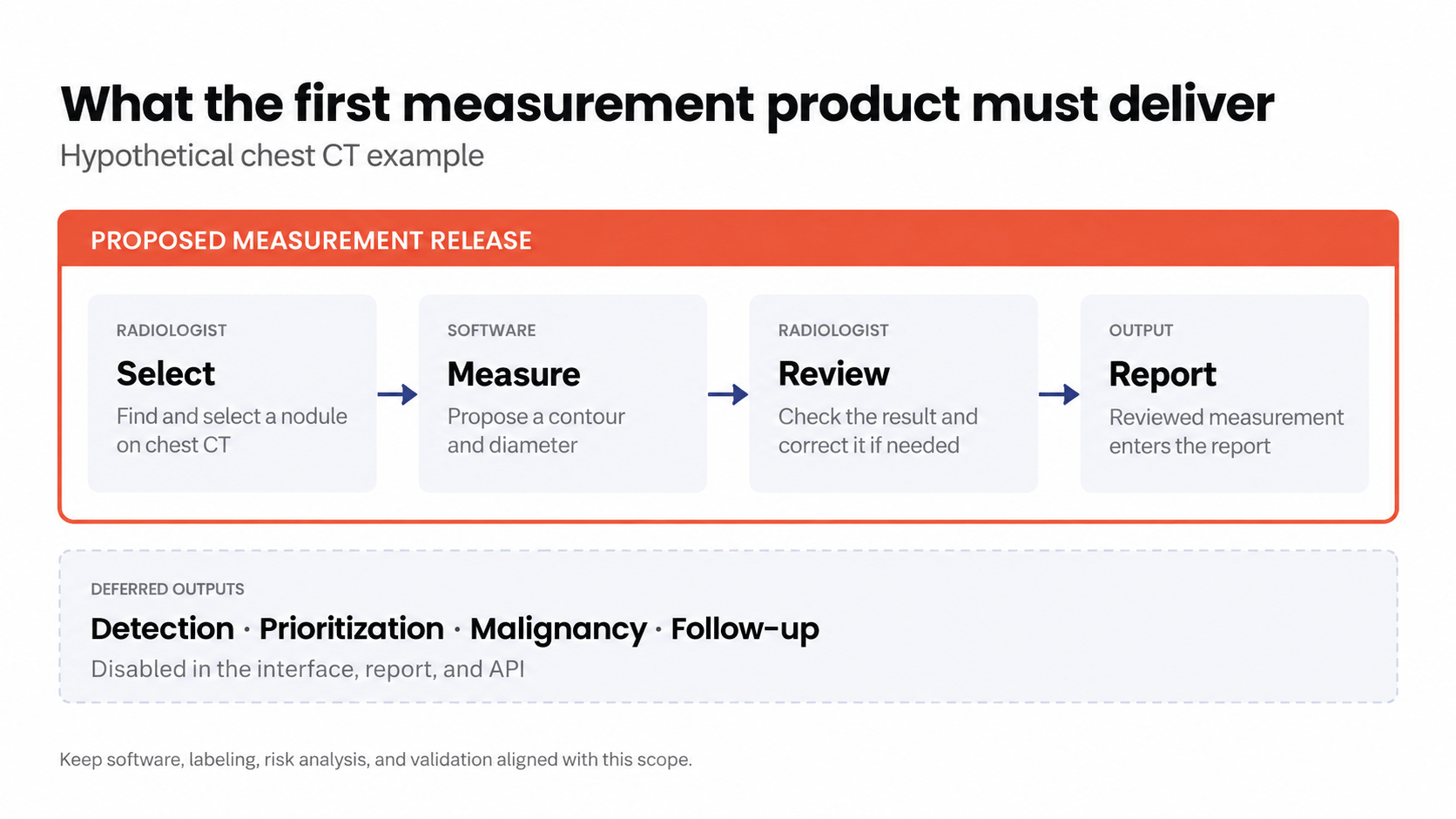
Software for radiologists performing non-contrast chest CT examinations on adult patients. After the radiologist selects a pulmonary nodule, the software proposes a contour and diameter measurement for review and correction, supporting the radiologist's measurement task.
The supported nodule types, sizes, acquisition conditions, and limitations still need to be defined before this becomes proposed labeling. But we now have a product to discuss. The radiologist finds the nodule. Our software helps measure it.
Write comparable descriptions for the other four candidates. “Prioritize scans,” for example, needs a specified finding and a reason that finding should affect the worklist.
Compare the products a customer could buy 🔗
For our example, the buyer is interested in both measurement and detection. Measurement could minimize repetitive work for nodules that the radiologist has already identified. Meanwhile, detection could help radiologist identify additional nodules. The buyer would pay for measurement alone if reviewing and transferring the result takes less effort than the current process.
That is an important consideration. Think about how the reading session would be like. The radiologist would select a nodule, check the contour, adjust it if needed, and insert the measurement in the report. Time those steps. See if the viewer can help in doing that. The work imposed on the clinician belongs in the product decision.
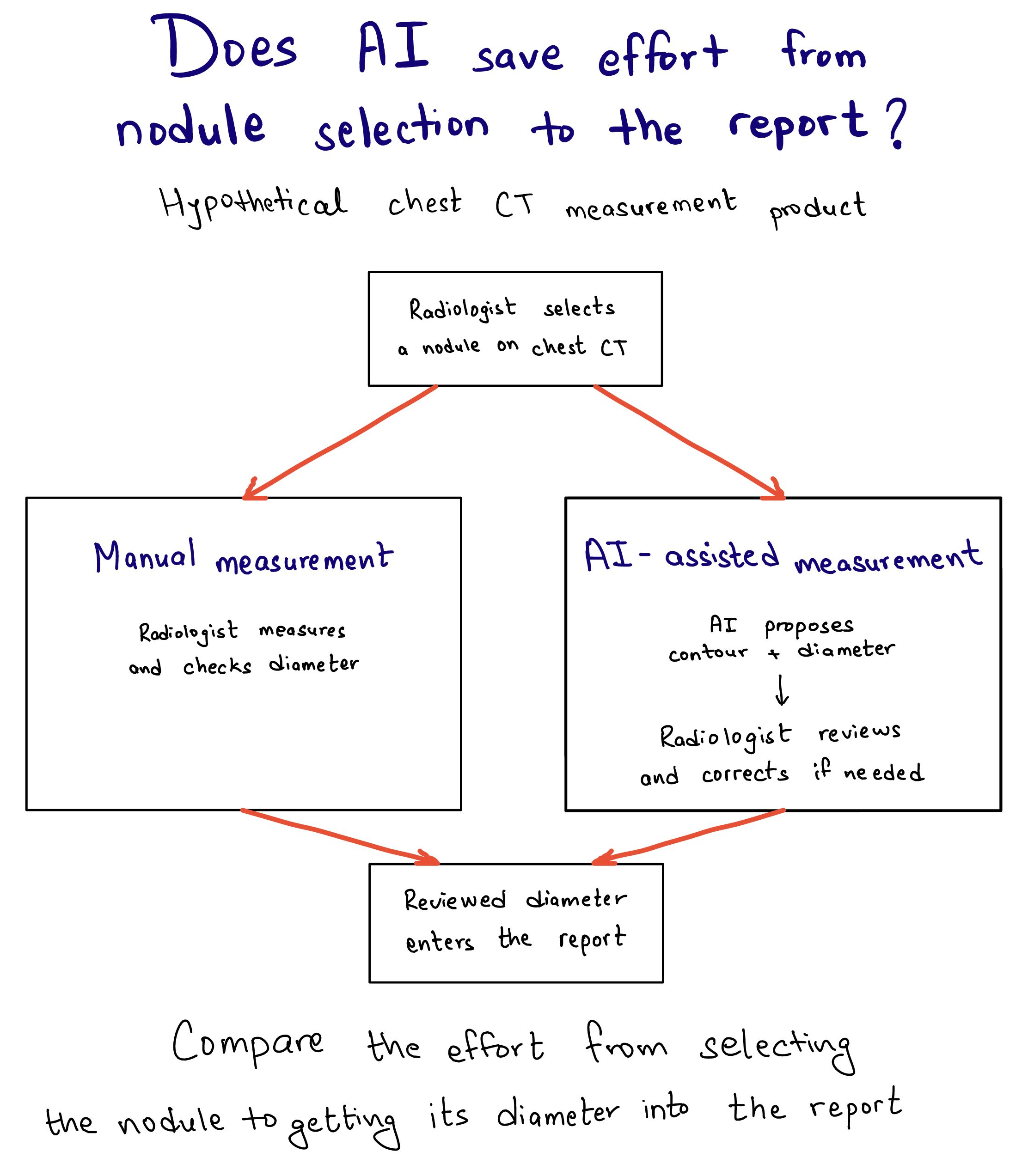
Here is how we would compare the five candidates for this company:
| Candidate claim | Why the buyer wants it | Work or uncertainty affecting the choice | Decision for this company |
|---|---|---|---|
| Measure a selected nodule | Less effort measuring and reporting a nodule already found | Confirm viewer integration, suitable reference measurements, and performance before and after correction | Plan the first release, subject to these checks and pathway review |
| Detect additional nodules | Help find nodules the reader might otherwise miss | Establish reference findings for the target nodules and plan appropriate standalone and reader evaluation | Keep as the alternative if measurement alone does not justify purchase |
| Prioritize scans for a specified finding | Bring relevant cases to the reader's attention sooner | Define the finding, worklist action, and consequences of missed and unnecessary flags | Defer until the prioritization workflow is agreed |
| Estimate nodule malignancy | Help assess the likelihood of cancer | Obtain suitable outcome labels and define the population and prediction target | Defer because dependable outcomes are unavailable |
| Recommend follow up | Help choose the next clinical action | Define patient inputs, reference recommendations, and consequences of wrong advice | Defer because inputs and recommendation scope remain unresolved |
Why we would investigate measurement first 🔗
The company's available annotations describe selected nodules. They help with measurement planning, but do not establish that every target nodule in each scan has been identified. For this example, assume a data partner may be able to supply independent scans and arrange suitable reference measurements. Before relying on that plan, the team still needs to check coverage, annotation quality, access rights, and independence from development data.
For detection, we would need a process for establishing the target reference findings throughout each scan. Otherwise, an unannotated nodule could be mistaken for a false detection. FDA's CADe standalone guidance discusses reference findings and scoring against them. Its clinical performance guidance addresses reader performance for covered radiology detection devices. The evidence plan may include a reader study, depending on the device and proposed use.
We think detection still has potential. If missed findings are the buyer's main concern, measurement may solve too small a problem. But this buyer also has a measurement task worth improving. We would choose measurement for the first release because there is a customer reason to build it and a more developed plan for obtaining reference data. We would fund the workflow, data, and pathway checks before committing the validation budget.
The sacrifice is explicit: the radiologist must still find and select the nodule. This first product will not help find additional nodules. That is acceptable only while measurement alone remains worth buying. If the buyer requires detection, or viewer integration makes measurement cumbersome, reopen the decision. An easier data plan cannot rescue a product the customer does not want.
Check the evidence before funding the study 🔗
Choosing measurement does not finish the evidence plan. A good contour-overlap score does not establish that diameter errors are acceptable for the clinical task. FDA's quantitative imaging guidance addresses accuracy, precision, and performance across intended operating conditions. Its semi-automated example discusses evaluating both automated output and the result after user correction.
We would evaluate the proposed contour and measurement, then the result after the intended review and correction steps. If radiologists frequently have to redraw the contour, that also challenges our reason for building the product. The buyer wanted less work.
Before paying for the study, confirm:
- Cases and references. Can the data partner supply the supported nodule types, size range, imaging conditions, and suitable reference measurements?
- Access and independence. Are the records usable for the planned evaluation, with development-data overlap addressed?
- Endpoints and targets. What performance would be acceptable for the clinical task, and how will the study estimate it?
Use development and pilot evidence to choose the claim. Keep final evaluation data independent of model and claim selection. The Good Machine Learning Practice principles call for representative data and appropriately independent training and test datasets.
Define clinically justified acceptance criteria and the statistical plan before final validation. Our AI/ML SaMD acceptance criteria guide covers that next step. For a measurement-agreement endpoint, the Bland Altman sample-size guide shows how to plan for a specified agreement criterion.
Check the pathway for that exact use 🔗
Give regulatory review the same product description used for the customer discussion and evidence plan. Identify the classification, whether premarket review is required, and the proposed pathway. Read relevant FDA decision records and labeling.
For a 510(k), the device must have the same intended use as a legally marketed predicate. Different technological characteristics can be acceptable if they do not raise different questions of safety and effectiveness and the evidence supports substantial equivalence. Indications need not be identical. FDA's 510(k) Program guidance explains these distinctions.
Compare the clinical role, users, population, inputs, outputs, and consequences of an incorrect result. A product that measures a selected nodule is not automatically a suitable predicate for software that estimates malignancy. A similar model architecture does not establish the pathway.
For our measurement candidate, the team has identified a possible predicate. Document the relevant differences and how they would be addressed. If that comparison fails, revisit the budget and product choice. Without an appropriate predicate, assess eligibility for De Novo classification. PMA is generally required for Class III devices. Do not budget for a 510(k) solely because that is the route you hoped to use.
Budget for the product around the model 🔗
For measurement, the delivery estimate must include selecting the nodule in the viewer, displaying and correcting the contour, and transferring the reviewed measurement into the report. Add the software verification, usability, cybersecurity, quality records, and submission work needed for the proposed device. Get estimates from the people who will do the work.
If the buyer needs an integration the team cannot afford, resolve that before commissioning validation. An exported screenshot may demonstrate the model, but it does not satisfy a buyer who needs measurements in the existing reporting workflow.
The release also needs a clear scope. In our design, the interface, report, and API expose the supported measurement output. The other four clinical outputs are disabled. Shared model updates, computing resources, and interface behavior still need assessment for their effects on measurement.
FDA's multiple-function device policy addresses how certain other functions affect the reviewed device function. Omitting a regulated function from a submission does not authorize its distribution when premarket review is required.
What must be settled prior to making the first claim 🔗
The comparison should lead to a written rationale for the proposed first release. Bring the clinical, commercial, regulatory, and engineering perspectives together to answer these questions:
- Product and buyer. What will this version do, for whom, and why would they pay for it without the deferred functions?
- Evidence. What must the product demonstrate? Which data and reference information are available, and what is missing?
- Regulatory pathway. Which classification, pathway, and predicate are proposed? Which differences or regulatory questions remain unresolved?
- Delivery and cost. What integration, testing, documentation, and deployment work is needed? What do the people responsible for that work estimate it will cost and how long will it take?
- Tradeoff. What benefit does the first release give up, and what work remains with the clinician? Why is that acceptable to the buyer?
- Reason to reconsider. Which finding could change the choice? What needs to be checked, who will check it, and which spending should wait for the answer?
In the hypothetical nodule example, three questions remain. Does the complete viewer and reporting workflow save enough effort for the buyer? Can suitable independent validation data be obtained? Does the predicate comparison support the proposed pathway? A problem with any of these could change the product choice before substantial validation spending.
If a material regulatory question remains, consider a Pre-Submission before the affected testing. Propose an approach and explain the rationale. For example, ask whether the measurement endpoints, reference process, and combination of standalone and user-performance testing address the proposed use and identified risks. FDA's Q-Submission guidance describes this voluntary feedback process. Feedback does not guarantee a favorable marketing decision.
Frequently asked questions 🔗
Should we submit all five AI functions together? 🔗
Consider them together when customers need the combined product and the team can support its full scope. If measurement alone has no buyer, clearing it first does not solve the commercial problem. Shared model weights also do not resolve the evidence questions or interactions between functions described in FDA's multiple-function policy.
Is measurement always easier to clear than detection or diagnosis? 🔗
No. Measurement leads here because the buyer values it and the team has a more developed reference-data plan. Its workflow and pathway still need checking. A company with stronger detection evidence and demand could make the opposite choice. Compare the proposed uses before ranking them.
Can a predetermined change control plan cover the other four functions? 🔗
Do not assume so. An authorized predetermined change control plan, or PCCP, covers specified modifications implemented under that plan. FDA's AI PCCP guidance says modifications must remain within the intended use. It generally expects indications to remain the same, although certain indication changes may be appropriate for discussion. A PCCP is not blanket permission for new clinical claims.
Should we narrow the claim to match our available data? 🔗
Consider it if the narrower product remains useful and the data support it. Check that the restriction preserves what the customer wants to buy. Make the scope decision before final testing, rather than selecting a favorable subgroup after seeing the results.
Need help choosing your first claim? 🔗
If your AI model works but you are unsure which use to take to FDA first, bring us your candidate uses, available data, customer requirements, and budget and timeline constraints. We can help compare the options, recommend a first release, and identify the questions to answer before commit to validation.
Our end-to-end FDA clearance service covers the engineering, validation, and regulatory work needed to carry that plan through development and submission.