On September 3, 2026, FDA granted De Novo request DEN250044 to Powerful Medical for its STEMI AI ECG Model, the algorithm cardiologists know as the Queen of Hearts. It received a new product code, SHS, a predetermined change control plan, and a review clock of 346 days from receipt. The classification order is not public yet, so this is an analysis of the record, the precedents, and the regulation text, not of FDA's reasoning.
Nothing about the technology forced the De Novo. Deep-learning ECG algorithms had cleared through 510(k) at least eleven times in the three years before this one, and a deep-learning replacement for GE's rule-based 12SL interpreter cleared in 2024 with 12SL as its predicate. The verb forced the De Novo: every cleared ECG-AI device says "refer" or "interpret." The Queen of Hearts says, in effect, "activate the cath lab." No regulation open to a cardiac signal contained that verb, and FDA had scoped the closest one, in writing, to exclude it.
What the device claims 🔗
The company describes the authorized use as the early identification of suspected acute coronary syndrome patients who may benefit from early cardiology consultation and early cardiac catheterization, from a standard 12-lead ECG, at first medical contact. The clinical target is occlusion myocardial infarction, OMI: an acutely blocked coronary artery that needs the cath lab now, whether or not the ECG meets the ST-elevation criteria that guidelines and every cleared interpretive algorithm use to call a STEMI.
That gap is the whole product. In the 2023 international validation (3,254 ECGs from 2,222 patients, published in European Heart Journal Digital Health), the model detected angiographically confirmed OMI with 80.6% sensitivity and 93.7% specificity, against 32.5% and 97.7% for STEMI criteria applied to the same tracings, and it found the occlusion a median three hours earlier. A 2025 US registry of 1,032 real cath-lab activations across three PCI centers, published in JACC: Cardiovascular Interventions, reported 92% sensitivity and 81% specificity against 71% and 29% for the activation decisions clinicians actually made, with false-positive activations falling from 41.8% to 7.9%. In a survey study of 95 emergency physicians and cardiologists reading 18 hand-picked STEMI-equivalent and mimic ECGs, the physicians reached about 66% accuracy and the model reached 89%.

The evidence base is unusually deep for a first-of-kind AI device: a 6,000-patient randomized trial across 18 PCI centers (DIFOCCULT-3, company-reported, long-term outcomes pending), CE marking since 2022, and, by the company's count, more than 120,000 heart attacks flagged in 2025. Breakthrough Device Designation arrived on March 24, 2025. The De Novo was received six months later, on September 22, 2025.
Three doors, all locked 🔗
A 510(k) needs a predicate with the same intended use. There were three candidate families, and none passed the intended-use test.

Door 1: interpretive ECG algorithms 🔗
GE's 12SL (K141963) and Philips' DXL (K132068) have printed "acute MI" statements on ECGs for decades under the electrocardiograph regulations, and 12SL is explicitly labeled for ambulances and emergency departments with an ACS tool for suspected acute coronary syndrome. AliveCor's Corvair (K231010), a deep neural network producing 35 rhythm and morphology statements including myocardial infarction, cleared in June 2024 with 12SL as its predicate. So the neural network was never the problem.
The problem is what these devices claim to do: assist the physician with "an initial automated interpretation" that the physician then confirms, edits, or deletes. Their MI statements restate the guideline criteria. The Queen of Hearts' claim is the opposite: it says the tracing does not meet the criteria and the artery is still blocked, and it says so to a paramedic deciding whether to bypass the nearest hospital for a PCI center. A device whose value is disagreeing with the predicate's rule set is not substantially equivalent to that rule set. The failure modes are new too: a false positive activates a cath lab and moves a patient across a county; a false negative is a missed occlusion that the criteria would also have missed, but now the machine has also reassured the user.
Door 2: the 870.2380 family 🔗
This is the door most people assumed was open. In August 2023, Viz.ai's HCM detector (DEN230003) created 21 CFR 870.2380, cardiovascular machine learning-based notification software, product code QXO. In the three years since, eleven devices have cleared by 510(k) in that lineage: Anumana's low-EF algorithm and its pulmonary hypertension and amyloidosis siblings, Tempus's ECG-AF and ECG-Low EF, Eko's low-EF tool, Bunkerhill's ECG-EF, CorVista, Pathwai's EchoNext, and Apple's Hypertension Notification Feature. Each new condition earned a new product code (QYE, SBQ, SAT, SHP, SFR, QXX) but stayed under the same regulation and cited the same lineage.

Read the identification paragraph FDA wrote for that regulation, published in the Federal Register on September 11, 2026, eight days after the Queen of Hearts was granted: the device "employs machine learning techniques to suggest the likelihood of a cardiovascular disease or condition for further referral or diagnostic follow-up. The software identifies a single condition based on one or more non-invasive physiological inputs as part of routine medical care. It is intended as the basis for further testing and is not intended to provide diagnostic quality output."
Four phrases in that paragraph exclude a STEMI triage device: "further referral or diagnostic follow-up," "routine medical care," "basis for further testing," and "not intended to provide diagnostic quality output." Tempus's ECG-AF, which predicts atrial fibrillation in the next twelve months with 31% sensitivity, fits every one of them; its comparison table lists the intended use as "Same" as Viz HCM's, and FDA agreed. A device that tells a paramedic to drive past the community hospital fits none of them. The narrow scope of 870.2380 made clearance straightforward for those devices and kept the Queen of Hearts out.
Door 3: radiology triage 🔗
The regulation that does contain the right verb is 21 CFR 892.2080, radiological computer-assisted triage and notification software (product code QAS), created by Viz LVO in 2018 and now home to dozens of stroke, hemorrhage, and pulmonary embolism triage devices. Its whole purpose is time-sensitive notification that changes who gets treated first. It also says "radiological" in the first line. A 12-lead ECG is a signal, not an image, and the review division is cardiovascular, not radiology. The closest conceptual predicate was legally unavailable.
With every door locked, Powerful Medical filed a Direct De Novo, skipping the 510(k) and not-substantially-equivalent detour. SHS is, in effect, the CADt regulation for cardiac signals.
What the De Novo cost, and what it bought 🔗
The FY2026 user fee is $173,782 for a De Novo against $26,067 for a 510(k). The Innolitics FDA Device Explorer shows a median 325-day review for the 99 De Novos decided since January 2024; the Queen of Hearts took 346 despite Breakthrough status, which buys interaction, not a shorter statutory clock. For comparison, Viz HCM's own De Novo took 205 days and Tempus ECG-AF's 510(k) into the resulting code took 231 days. FDA has granted seven AI De Novos so far in 2026 and nine in all of 2024, in line with STAT's estimate of fewer than ten a year.
The money buys authorship of the category. The special controls FDA writes for SHS will define the evidence every competitor must produce to cite the Queen of Hearts as a predicate. Judging from the 870.2380 controls and the CADt controls, expect clinical performance testing on independent, multi-site data with STEMI-equivalent and mimic strata reported separately, a time-to-notification requirement, a human factors assessment for prehospital users, and labeling that the output does not replace the clinician's activation decision. Powerful Medical wrote its own evidence package to that shape before FDA did, and it also secured a PCCP, which only seven De Novos before it had done. The company can now retrain within pre-agreed bounds while rivals are still designing their first validation study.
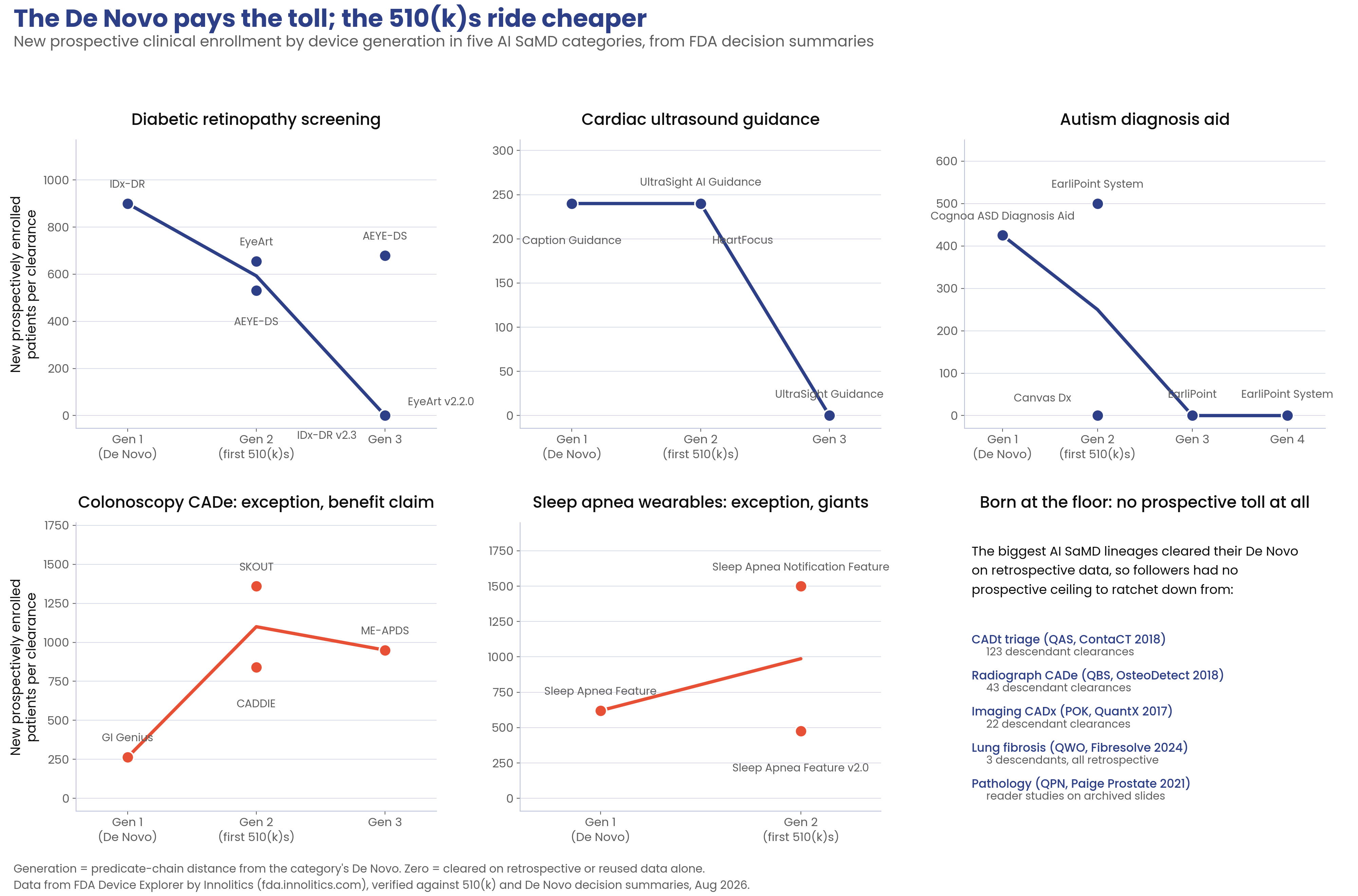
The 870.2380 lineage shows what can follow for competitors. Viz HCM's De Novo took 205 days and produced eleven 510(k)s in three years, several with worse headline sensitivity than the original. As we showed in The De Novo Pays the Toll, prospective enrollment in an AI category falls toward zero by the third predicate generation. Every OMI algorithm now in development has a US predicate to cite, and a set of special controls to meet, as of September 3.
What to take from it 🔗
Read the identification paragraph, not the product code. A product code is a filing label; the identification sets the legal boundary of the device type, and its verbs decide whether your intended use fits. "Refer," "identify for follow-up," and "interpret for confirmation" are in the cleared vocabulary of ECG AI. "Activate," "bypass," and "treat" are not, and as of this month one company owns the first regulation that contains them.
Technology is negotiable; the claim is not. Corvair moved from rules to a deep network under an unchanged intended use and cleared in a 510(k). The Queen of Hearts changed the claim and could not. If your model is better than the guideline criteria it was trained against, decide early whether the product says so on the label, because that sentence is the difference between a $26,067 filing and a $173,782 one.
A cheaper route was available. An OMI algorithm labeled to "identify patients with signs associated with acute coronary occlusion for further cardiology evaluation, in parallel to the standard of care" reads like a 870.2380 device and could plausibly have cleared by 510(k) against Viz HCM in about a year for roughly 15 percent of the fee, with a later filing to expand the claim once the field data existed. Powerful Medical chose to author the category instead. With an RCT in hand, a Breakthrough designation, and a competitor set that includes every academic group with an ECG archive, that is the right trade: the label they have is the label the market wanted, and the special controls will be shaped by their data.
If you are building on signals rather than pixels, Cardiology AI: Signals Over Pixels maps the four pillars and the product codes that go with them. For the choice between shrinking a claim to fit a predicate and filing to create one, How Far Can a 510(k) Predicate Stretch? covers the first choice and De Novo Requests for Diagnostic Devices covers the second.
Method and sources 🔗
Regulatory facts are from the FDA De Novo database entry for DEN250044 (page dated September 7, 2026), the Federal Register classification order for 21 CFR 870.2380 (Docket 2026-18612, September 11, 2026), the De Novo decision summary for DEN230003, and 510(k) summaries retrieved through the Innolitics FDA Device Explorer. The predicate lineage was built by reverse predicate lookup from DEN230003 on September 13, 2026, and is complete to that date. De Novo counts and review times cover all 489 De Novo records in the Device Explorer corpus; FDA's AI flag depends on submission documents, and DEN250044 is not yet flagged, so the 2026 AI count is a floor.
Clinical performance figures are from Herman et al. (Eur Heart J Digit Health, 2023), the JACC: Cardiovascular Interventions registry (October 2025), and Shroyer et al. (Am J Emerg Med, 2025); the DIFOCCULT-3 and deployment figures are company-reported. Fees are FY2026 MDUFA rates. The special controls for SHS are inferred from precedent and will be replaced by FDA's text when the classification order posts.
Further reading 🔗
ArticleAI/ML
Cardiology AI: Signals Over Pixels
A deep dive into the 97 cleared cardiovascular AI/ML SaMD devices, the four archetypes that organize them, and what they reveal about the future of FDA-cleared software.
 Yujan Shrestha

ArticleAI/ML
The De Novo Pays the Toll: How Sample Size Shrinks Across AI Device Generations
We traced every AI SaMD De Novo’s predicate descendants and found prospective enrollment falling toward zero by the third generation. Where you sit on your category’s generation...
Yujan Shrestha

About the Author 🔗

Yujan Shrestha, MD
Partner
I am a physician, software engineer, AI/ML expert, and regulatory consultant. I have been developing medical device software for 10 years. I have helped startups and Fortune 500 companies write medical grade software and secure regulatory clearance. I was born in Nepal, came to the states when I was 4, and learned to code BASIC when I was 8. I graduated with a BME degree from UT Austin and a MD degree from UT Houston. I am passionate about decreasing barriers to translating medical devices from the lab to the clinic for the benefit of patients and physicians alike.