
Engineers describe each model and each deterministic algorithm: its inputs, outputs, architecture, training data and how the pieces chain into the device output. They run the current model on a pilot set to estimate the size and spread of its error, which the biostatistician turns into a powered sample size. With the clinical team they design how the reference standard is produced for training data and for the test set, including the number of readers, how they read and how disagreements are resolved.
On the map: Algorithm and dataset description. Pilot inference for the power study. Ground-truth adjudication design.
Rows are disciplines, columns are stages 1 to 8. Select a square to open that task.
Back to the full map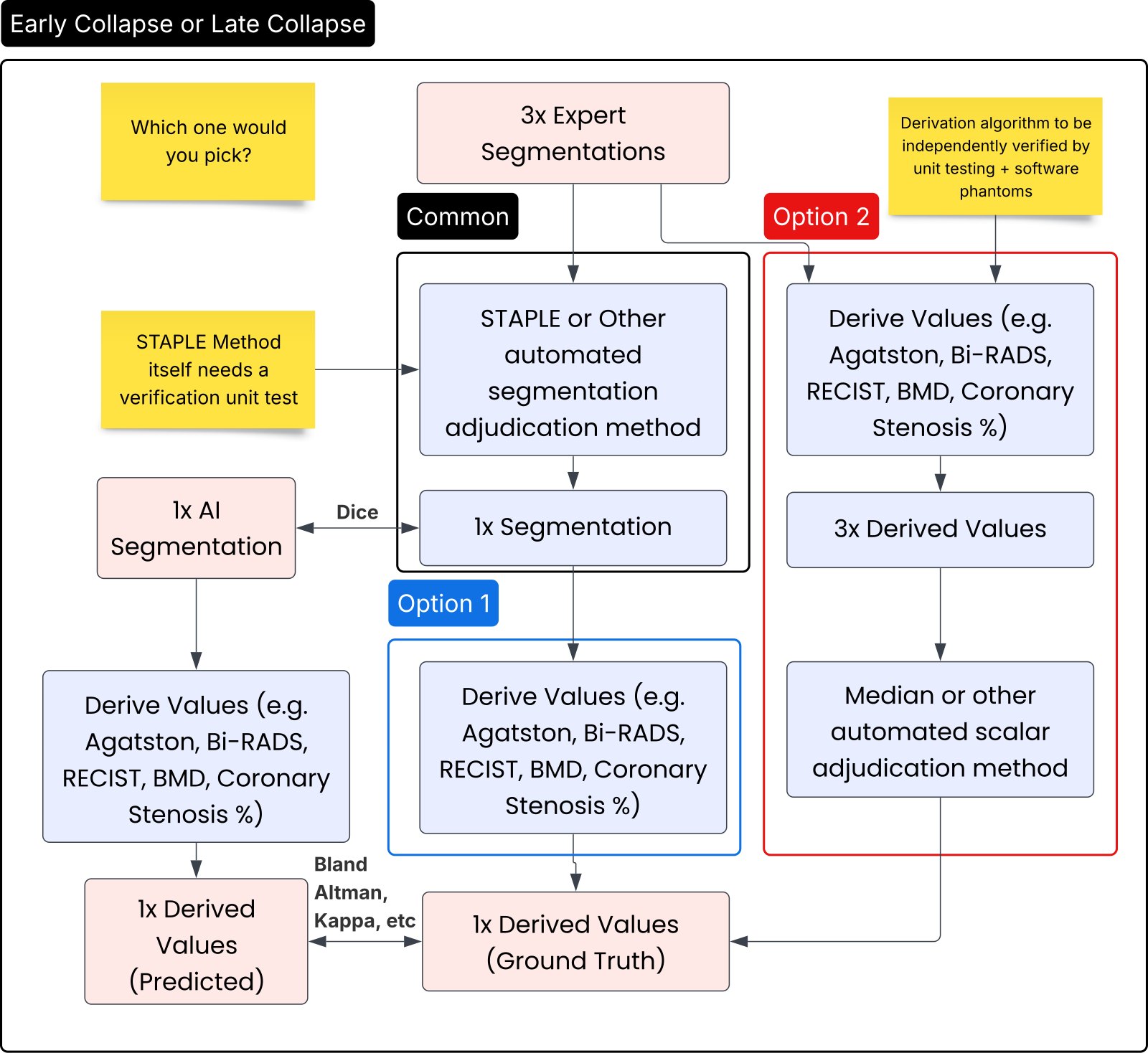
Give clinical the pilot error and failure rate before the sample size is fixed, and describe the algorithm to regulatory in the words the pre-sub will use.
Each model and algorithm gets a stable name, a defined input and output, and a place in one data-flow diagram. Learned models are listed apart from deterministic steps, and the order in the diagram must match the prose. Measurements computed from a segmentation with simple arithmetic are described that way so they can be verified with unit tests.
The pilot run gives a realistic estimate of the device's bias and error spread against a provisional reference. The biostatistician combines these with the planned acceptance limits, checks power under optimistic, nominal and pessimistic error levels, and adds margin for subgroups and unusable cases.
Training labels may come from one expert. Test labels come from at least three independent readers who did not label training data and are blinded to the device output. For measurement endpoints the team prefers deriving the value from each reader's segmentation and combining by mean or median, which makes adjudication automatic and lets inter-reader agreement be reported. Any AI-assisted or automated labeling must be explained and validated, or dropped.
Data are split by site and patient so none appear on both sides. Sampling is stratified on scanner manufacturer, sex, protocol and difficult cases. Inclusion and exclusion criteria are written down before sampling so the excluded share can be justified.
See the open positions and apply.