
Sprints start with the features that carry the most clinical or technical risk, so problems surface while the design or the claim can still change. Each risk and security control is built as a requirement, with tests written alongside the code and checked in code review. Before test-set results are seen, the team freezes the model weights and records the exact artifact that will be tested.
On the map: Riskiest features first. Implement risk and security controls. Freeze model weights.
Rows are disciplines, columns are stages 1 to 8. Select a square to open that task.
Back to the full map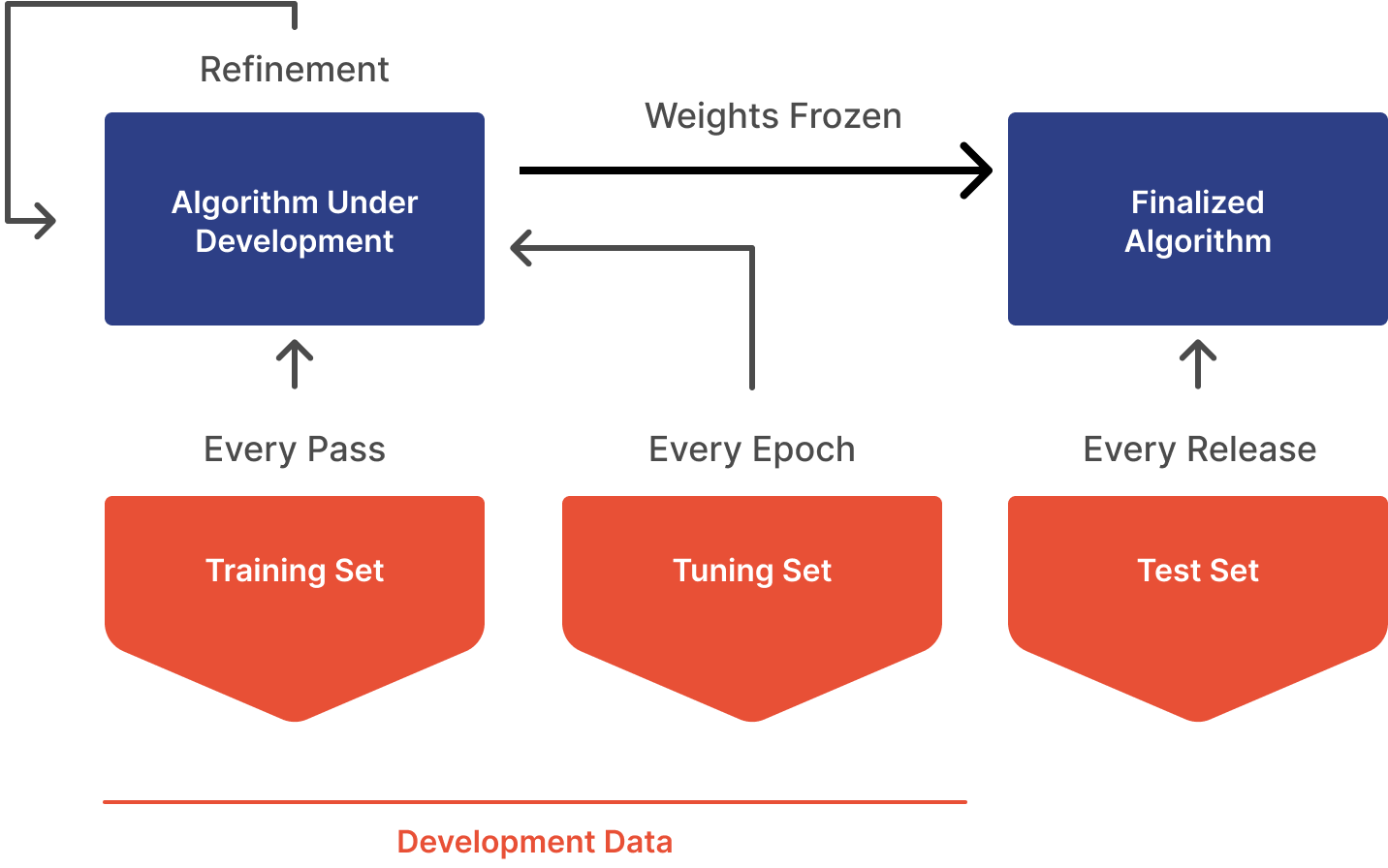
Tell regulatory and cybersecurity about any new interface or output before it ships in a sprint.
The team ranks features by how likely they are to fail and how much a failure would cost the claim or the schedule. Model performance on hard cases, input handling such as orientation and series selection, and the measurement math usually lead. Report layout and convenience features wait.
Each control traces from its risk to a requirement to a verification protocol. Engineers prefer automated unit or end-to-end tests that run on every pull request, and use manual tests only where a person must judge the output. Reviewers check that requirements, architecture and documents were updated before a change is merged.
Weights are frozen once tuning-set performance meets the target and before the development team sees test results. The frozen model is archived with its hash, code revision, dependency lock and data manifest. Changes to AI components after the freeze are avoided, and any change needs a written case that the results still hold.
Test data access is limited to people outside model development. Engineers hand over an evaluation script, someone else runs it, and each run is logged with the date, the reason and the result.
See the open positions and apply.