
The clinical lead reads the intended use and the predicate's 510(k) summary and decides which kind of evidence the claim needs. A measurement or detection claim is usually supported by a standalone study against a reference standard. A claim that readers do better with the device needs a multi-reader multi-case study, and some claims need prospective data. The lead also lists the data the client already holds, the sites that could supply more, and what each source would cost to use.
On the map: Clinical evidence needed. Standalone, reader study or prospective study. Inventory data sources and sites.
Rows are disciplines, columns are stages 1 to 8. Select a square to open that task.
Back to the full map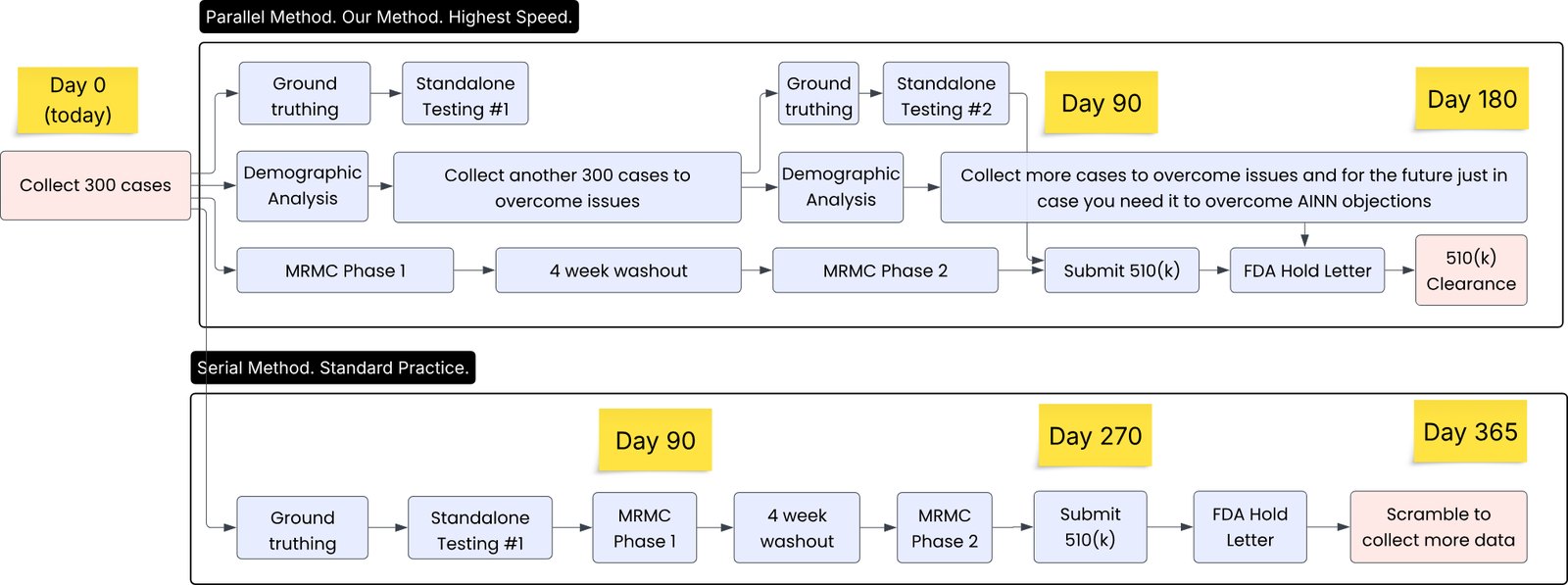
Ask regulatory what evidence the predicate implies and engineering what the model will output, then pick a standalone, reader or prospective study. That choice drives most of the budget.
Start from the claim and the predicate. If the device only measures or flags and the user reviews every output, a standalone comparison is usually enough. If the labeling says the device improves reader performance, or the predicate ran a reader study, plan one. Prospective data is reserved for outcomes that cannot be read from archived images or records.
Check that it is representative of the intended population, that it can be split by site or patient so the test cases never touched training, and that scanners, protocols and demographics cover the subgroups FDA will ask about. Data that fails these checks stays in development.
Plan for test data from sites that did not contribute training data, and for enough spread across manufacturers and patient groups to support subgroup analysis. Keep a second source in reserve so more cases can be added if FDA asks for them during review.
See the open positions and apply.